Team Finds 'Metafilms' Can Shrink Radio, Radar Devices
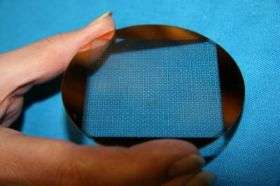
Recent research at the National Institute of Standards and Technology has demonstrated that thin films made of “metamaterials”—manmade composites engineered to offer strange combinations of electromagnetic properties—can reduce the size of resonating circuits that generate microwaves. The work is a step forward in the worldwide quest to further shrink electronic devices such as cell phones, radios, and radar equipment.
Metamaterials may be best known as a possible means of “cloaking” to produce an illusion of invisibility, somewhat like the low-reflectivity coatings that help stealth fighter jets evade radar. As described in a new paper, NIST researchers and collaborators performed calculations and simulations of two-dimensional surface versions, dubbed “metafilms,” composed of metallic patches or dielectric pucks. Vibrating particles in these metafilms cause incoming electromagnetic energy to behave in unique ways.
The researcher team deduced the effects of placing a metafilm across the inside center of a common type of resonator, a cavity in which microwaves continuously ricochet back and forth. Resonant cavities are used to tune microwave systems to radiate or detect specific frequencies.
To resonate, the cavity’s main dimension must be at least half the wavelength of the desired frequency, so for a mobile phone operating at a frequency of 1 gigahertz, the resonator would be about 15 centimeters long. Other research groups have shown that filling part of the cavity with bulk metamaterials allows resonators to be shrunk beyond the usual size limit.
The NIST team showed the same effect can be achieved with a single metafilm, which consumes less space, thus allowing for the possibility of smaller resonators, as well as less energy loss. More sophisticated metafilm designs would enhance the effect further so that, in principle, resonators could be made as small as desired, according to the paper.
The metafilm creates an illusion that the resonator is longer than its small physical size by shifting the phase of the electromagnetic energy as it passes through the metafilm, lead author Chris Holloway explains, as if space were expanded in the middle of the cavity. This occurs because the metafilm’s scattering structures, like atoms or molecules in conventional dielectric or magnetic materials, trap electric and magnetic energy locally. The microwaves respond to this uneven energy landscape by adjusting their phases to achieve stable resonance conditions inside the cavity.
On the downside, the researchers also found that, due to losses in the metafilm, smaller resonators have a lower quality factor, or ability to store energy. Accordingly, trade-offs need to be made in device design with respect to operating frequency, resonator size and quality factor, according to the paper. The authors include two from the University of Pennsylvania and a guest researcher from the University of Colorado.
Citation: C.L. Holloway, D.C. Love, E.F. Kuester, A. Salandrino and N. Engheta. Sub-wavelength resonators: on the use of metafilms to overcome the {lambda}/2 size limit. IET Microwaves, Antennas & Propagation, Volume 2, Issue 2, March, 2008, p. 120-129.
Source: National Institute of Standards and Technology


