Physicists Ponder Atoms Without Nuclei
March 19, 2008 By Lisa Zyga
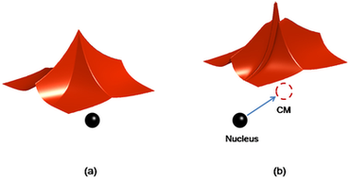
This illustration ashows the absolute value of the real part of the two-electron wave function for the H-initial state (a) before and (b) after an attosecond full-cycle pulse with a half-cycle momentum transfer equal to 10 atomic units and pulse duration equal to 0.6 atomic units. The arrow in (b) points in the direction in which the wavepacket is displaced with respect to the nucleus and the CM denotes the center of mass of the wavepacket. The small cut in the wavepacket in (b) is due to the electron-electron repulsion in the continuum. Image Credit: Darko Dimitrovski.
You might remember learning in sixth grade science class that isotopes are atoms that have lost or gained a few neutrons, and ions are atoms that have lost or gained a few electrons. But what about an atom that has lost its entire nucleus – when essentially all that remains are the electrons whizzing around in their defined orbits?
What to call such a system is not yet an urgent matter, since, for now, an atom without a nucleus is just a hypothetical concept. But physicists John Briggs and Darko Dimitrovski from the University of Freiburg in Germany have recently described how such an atom might be created with the use of an attosecond laser. Capable of generating pulses that last just one billionth of a billionth of a second (10-18 seconds), an attosecond laser could possibly “detach” the electrons from an atom and – keeping their shape largely intact – remove them from being centered around the nucleus.
“I would not call it an ‘atom,’” Briggs told PhysOrg.com. “Maybe an ‘atom without a nucleus’ or a ‘filleted atom.’ However, one should not forget that when several electrons are involved, once the nucleus is away, the electrons will repel themselves, and the ‘atom’ will be destroyed. Nevertheless, coincident detection of the electrons should allow reconstruction of the initial wavepacket.”
Briggs said that he is not aware of the idea of an atom without a nucleus being proposed before. But such a thing could potentially be created because the duration of an attosecond laser pulse is much shorter than the orbital time of an atom’s ground-state electrons. In a hydrogen atom, for example, an electron takes about 24 attoseconds to orbit the nucleus. Besides being short, the attosecond laser pulse must also be very strong, with an electric field equal to or greater than the nuclear field experienced by a bound electron.
The researchers propose that a single short (10-attosecond), strong (1018-watt) laser pulse interacting coherently with the ground electrons could be used to remove all the electrons from an atom, completely ionizing the atom. In the first half-cycle of a pulse, several atomic units of momentum would be transferred, causing the electrons to accelerate away from the nucleus without changing the form of their initial wavefunction.
Normally, an electron wavepacket that leaves an atom spreads out and loses its shape, and the electrons quickly repel each other and fly apart. However, due to the extremely short attosecond pulse, the wavepacket has almost no time to spread.
Although a single half-cycle pulse can produce this wavepacket, electromagnetic theory shows that a half-cycle alone cannot be produced. So the researchers use the second half-cycle pulse to stop the electron wavepacket from moving away from the nucleus, producing a stationary atomic electron cloud spatially distant from its nucleus. Instead of being centered around the original nucleus, the wavepacket has shifted and is centered around the pulse’s mean momentum.
The researchers explain that this scheme could apply not only to single- or multi-electron atoms, but also to molecules. The greatest challenge, of course, is in building an attosecond laser with such a short, strong pulse.
A sufficient attosecond laser – once it exists – could enable researchers to test Briggs and Dimitrovski’s proposal. Using different half-pulses, researchers could create atoms without nuclei, as well as slow down electron wavepackets for extraction by detector fields.
“We conceived this as a ‘sexy’ little experiment,” Briggs explained. “However, the real message of the paper is that one should be able to fully ionize an atom or molecule (or even clusters of atoms or plasmas) and then control and manipulate, by further half-cycle momentum kicks, the state of the continuum electron wavepacket. The possibility of observing rather directly the spatial bound-state atomic wavefunction moving nucleus-free, essentially undistorted, is just one example of this general technique that the development of strong attosecond lasers will make realizable.”
More information: Briggs, John S.; and Dimitrovski, Darko. “Ionization in attosecond pulses: creating atoms without nuclei?” New Journal of Physics 10 (2008) 025013.
Copyright 2008 PhysOrg.com.
All rights reserved. This material may not be published, broadcast, rewritten or redistributed in whole or part without the express written permission of PhysOrg.com.
-
Physicists create first 'frequency comb' to probe ultraviolet wavelengths
Feb 01, 2012 |
5 / 5 (6) |
4
-
New light at the end of the tunnel
Oct 17, 2011 |
5 / 5 (3) |
7
-
Watching electrons in molecules
Oct 14, 2011 |
4.1 / 5 (7) |
1
-
Characterizing behavior of individual electrons during chemical reactions
Aug 15, 2011 |
5 / 5 (5) |
4
-
Lightwave electronics at sharp metal tips
Jul 07, 2011 |
4 / 5 (4) |
3
-
Engineers build first sub-10-nm carbon nanotube transistor
Feb 01, 2012 |
4.9 / 5 (31) |
30
-
Something old, something new: Evolution and the structural divergence of duplicate genes
Jan 31, 2012 |
4.6 / 5 (7) |
1
-
The hidden nanoworld of ice crystals: Revealing the dynamic behavior of quasi-liquid layers
Jan 30, 2012 |
5 / 5 (3) |
1
-
Stock market network reveals investor clustering
Jan 27, 2012 |
3.9 / 5 (23) |
8
-
Of microchemistry and molecules: Electronic microfluidic device synthesizes biocompatible probes
Jan 26, 2012 |
5 / 5 (1) |
0
-
gas leaks in space
4 hours ago
-
Weight required to balance a boom stand?
5 hours ago
-
Questions about Equivalence principle & Einstein Elevator?
7 hours ago
-
Kinetic energy of gas
8 hours ago
-
Understanding induced emfs
10 hours ago
-
What is the precise definition of a year?
11 hours ago
- More from Physics Forums - General Physics
More news stories
Explained: Sigma
It's a question that arises with virtually every major new finding in science or medicine: What makes a result reliable enough to be taken seriously? The answer has to do with statistical significance -- but ...
Feb 09, 2012 |
5 / 5 (19) |
69
Quantum physicist explains $100K offer for proof scaled-up quantum computing is impossible
(PhysOrg.com) -- MIT researcher Scott Aaronson has certainly riled the physics community with his offer this past Friday, of $100,000 to anyone who can prove that scaled-up quantum computing is impossible. ...
Diamond light, brighter than the sun
Its the size of five football pitches and generates light 10 billion times brighter than the sun. As the Diamond Light Source celebrates its tenth anniversary this year, Penny Bailey visits one of the ...
Feb 07, 2012 |
4.3 / 5 (7) |
18
|
Physicists 'record' magnetic breakthrough
An international team of scientists has demonstrated a revolutionary new way of magnetic recording which will allow information to be processed hundreds of times faster than by current hard drive technology.
Feb 07, 2012 |
4.5 / 5 (41) |
14
|
Hints of the Higgs - papers are submitted
Back in December 2011, the ATLAS and CMS experiments at CERN presented some exciting results that provided tantalising hints of the Higgs boson.
Feb 08, 2012 |
4.1 / 5 (7) |
10
Google might launch Drive for cloud storage soon
(PhysOrg.com) -- Google's next big move, according to the Wall Street Journal, is a cloud storage service called Drive. Hardly first to the plate, Google is simply catching up to introducing its cloud reposi ...
Latin America mining boom clashes with conservation
Latin America is experiencing a mining boom as prices rise fuelled by a hike in global demand, but the region is also being hit by a wave of violent protests, strikes and rallies by environmentalists.
Love a click away in Indonesia's Twitter Republic
He was a geeky kid from Yogyakarta, she a glamorous city girl in Jakarta. In a country with one of the world's most vibrant social networking scenes they fell in love on Twitter.
Walney offshore wind farm is world's biggest (for now)
(PhysOrg.com) -- The Walney wind farm on the Irish Sea--characterized by high tides, waves and windy weather--officially opened this week. The farm is treated in the press as a very big deal as the Walney ...
GPS court ruling leaves US phone tracking unclear
A US Supreme Court decision requiring a warrant to place a GPS device on the car of a criminal suspect leaves unresolved the bigger issue of police tracking using mobile phones, legal experts say.
Europeans protest controversial Internet pact
Tens of thousands of people marched in protests in more than a dozen European cities Saturday against a controversial anti-online piracy pact that critics say could curtail Internet freedom.
Mar 20, 2008
Rank: 2.5 / 5 (2)
Mar 22, 2008
Rank: not rated yet