'Designer enzymes' created by chemists
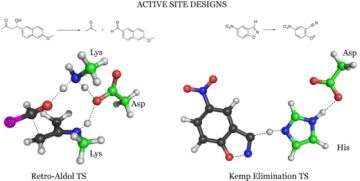
Chemists from UCLA and the University of Washington have succeeded in creating "designer enzymes," a major milestone in computational chemistry and protein engineering.
The research, by a UCLA chemistry group led by professor Kendall Houk and a Washington group headed by biochemist David Baker, is reported March 19 in the advance online publication of the journal Nature. The Defense Advanced Research Projects Agency (DARPA) supported the study.
Designer enzymes will have applications for defense against biological warfare, by deactivating pathogenic biological agents, and for creating more effective medications, according to Houk.
"The design of new enzymes for reactions not normally catalyzed in nature is finally feasible," Houk said. "The goal of our research is to use computational methods to design the arrangement of groups inside a protein to cause any desired reaction to occur."
"Enzymes are such potent catalysts; we want to harness that catalytic ability," said research co-author Jason DeChancie, an advanced UCLA chemistry graduate student working with Houk's group. "We want to design enzymes for reactions that naturally occurring enzymes don't do. There are limits on the reactions that natural enzymes carry out, compared with what we can dream up that enzymes can potentially do."
Combining chemistry, mathematics and physics, the scientists report in the Nature paper that they have successfully created designer enzymes for a chemical reaction known as the Kemp elimination, a non-natural chemical transformation in which hydrogen is pulled off a carbon atom.
In a previous paper, published in the journal Science on March 7, the chemists reported another successful chemical reaction that uses designer enzymes to catalyze a retro-aldol reaction, which involves breaking a carbon-carbon bond. The aldol reaction is a key process in living organisms associated with the processing and synthesis of carbohydrates. This reaction is also widely used in the large-scale production of commodity chemicals and in the pharmaceutical industry, Houk said.
"Previous reports of designed enzymes have not been very successful, and some have been withdrawn," said Houk, UCLA's lead author of both papers. "That is hardly surprising, considering the challenge of designing in days or weeks what nature has perfected over billions of years of evolution. The rate enhancements by our designer enzymes are modest and hardly competitive, so far, with those observed for their natural counterparts."
"We hope with improvements in technology, that we can close the gap between designer enzymes and natural enzymes," DeChancie said.
"Most scientists thought this would be impossible, and we felt the same way after many failures," said Fernando Clemente, a former UCLA postdoctoral scholar and co-author of the Science paper. "But improvements in design and sophistication eventually led to success."
Clemente is now at Gaussian Inc., the company that created the software used in the Houk group's research.
The implementation of the aldol reaction in the active site of an enzyme has been an important challenge. The reaction involves at least six chemical transformations, requiring UCLA scientists to compute all six chemical steps with their corresponding transition states. The structures were then combined in such a way to allow all six steps to occur.
Both studies were funded by DARPA, the U.S. Defense Department's central research and development organization, with additional federal support from the National Science Foundation.
Natural enzymes, which are relatively large protein molecules, are the powerful catalysts that control the reactions that sustain life. They play a central role in the chemical reactions involved in the transformation of food into the essential nutrients that provide energy, among many other critical functions.
Houk's team of 30 computational chemists uses quantum mechanical calculations to explore chemical reactions with supercomputers. Quantum mechanics is the fundamental theory that can predict all chemistry.
Houk and Baker's research groups have worked together for three years. Using algorithms and supercomputers, the UCLA chemists design the active site for the enzymes — the area of the enzymes in which the chemical reactions take place — and give a blueprint for the active site to their University of Washington colleagues. Baker and his group then use their computer programs to design a sequence of amino acids that fold to produce an active site like the one designed by Houk's group; Baker's group produces the enzymes.
Houk's group uses modern computational methods based on the physical laws of quantum mechanics to study in detail the mechanisms of chemical reactions. They have been involved in the DARPA-funded Protein Design Processes program, whose goal is to develop the technology that would make possible the design and creation of man-made working enzymes. The role of UCLA chemists has been the design of the active sites of the enzymes. By exploring multiple combinations of chemical groups, they can determine those that are most suitable to facilitate any given chemical transformation. Then, they determine the precise three-dimensional arrangement of these chemical groups, which is critical for the specificity and activity of the enzyme, with an accuracy of less than a hundredth of a nanometer.
Enzymes are the ultimate "green" catalysts by performing under ambient conditions in water, Houk said.
This technology will find tremendous applications, Houk said.
How far off are designer enzymes with important applications?
"I think we're there," DeChancie said. "These papers are showing the technology is now in place."
Source: UCLA


