Death of massive star creates brightest burst ever seen
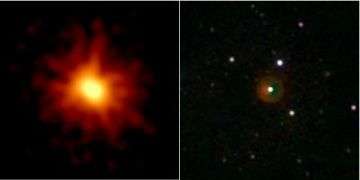
Gamma-Ray Bursts are the most powerful explosive events in the Universe. They occur in far-off galaxies and so are usually faint. But on the morning of March 19th 2008 the Swift satellite found a burst which was so bright it could have been seen without binoculars or a telescope even though it was seven thousand times further away than the Andromeda galaxy.
The burst was discovered by the Swift satellite on a fantastic day for GRB hunters. Swift typically finds only two a week; but for the first time Swift found five bursts within 24 hours. The second burst of the day is the new record holder. The enormous energy released in the explosion – brighter than the light from all of the stars in five million Milky Way Galaxies – was caused by the death of a massive star which collapsed to form a black hole.
Dr. Julian Osborne of the University of Leicester, lead investigator for the Swift UK Science Data Centre, said “It’s great to find so many GRBs in one day, and the discovery of the brightest burst ever seen will allow us to explore this incredible explosion in exquisite detail.”
The location of the burst was rapidly pinpointed using the UK-built X-ray and Optical cameras on Swift. Dr. Paul O’Brien, also of the University of Leicester and a member of the Swift Science Team said, “The explosion happened at a distance of over twenty billion light years from Earth. To detect a naked eye object from such a distance really is extraordinary.”
Astronomers around the world are now observing the decaying glow from this burst as it fades away. These include UK teams from the Universities of Leicester, Warwick and Hertfordshire using the Gemini-North Telescope in Hawaii and the Liverpool John Moores University using the Liverpool Telescope on La Palma in the Canary Islands.
Professor Nial Tanvir, of the University of Leicester, said: “Our Gemini observations allowed us to measure the distance to the GRB, and to investigate the behaviour of gas close to the burst as it was blasted by the energy of the explosion”.
Source: University of Leicester


