Mantis shrimp vision reveals new way that animals can see
March 20, 2008
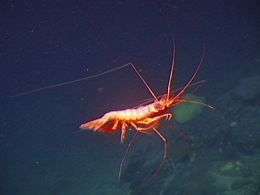
A deep sea shrimp out in open water. Credit: National Oceanic and Atmospheric Administration
Mantis shrimp can see the world in a way that had never been observed in any animal before, researchers report in the March 20th Current Biology. The discovery—which marks the fourth type of visual system—suggests that the ability to perceive circular polarized light may lend mantis shrimp a secret mode of communication.
“Mantis shrimp ventured into a new dimension of vision,” said Justin Marshall of the University of Queensland in Australia. Also known as stomatopods, mantis shrimp are large and particularly violent marine crustaceans that aren’t actually a kind of shrimp but look something like one.
Marshall describes circular polarized light as a spiraling beam that spins either to the left or the right. Scientists had shown before that some animals, such as scarab beetles, reflect that kind of light, but they hadn’t shown that any animal could actually see it—until now, that is.
“It’s complicated physics,” Marshall said, “but that makes it all the more amazing that some animals would use it for something.” Using it required the stomatopods to evolve a kind of filter in their eyes oriented at a precise 45 degree angle to photoreceptors underneath that pick up on linearly polarized light. The filter turns the circularly polarized light into its linear form. Many animals make use of linearly polarized light, Marshall said. To people, however, it is only glare, hence the need for polarized sun glasses.
In the new study, the researchers describe the anatomical basis for stomatopods’ remarkable vision in detail and show that these structures are stimulated when circular polarized light shines into them. They also offer behavioral proof of the stomatopods’ ability by training them to associate either left-handed or right-handed circular polarized light (L-CPL or R-CPL) with a food reward.
During tests, when no food was present, the researchers presented the animals with two feeding tubes, one reflecting L-CPL and the other R-CPL. The stomatopods chose the tube reflecting the CPL handedness to which they had originally been trained at levels significantly above chance, the researchers found.
Although it’s not yet clear exactly what the mantis shrimps’ newfound visual ability is good for in nature, Marshall said it’s likely all about sex.
Stomatopods are known to use highly specialized color and linear polarization signals for complex social interactions, he noted. And by using circular-polarization imaging, his team has identified three species of stomatopods (within the genus Odontodactus) where CPL is reflected from the cuticles of males but not females. Those sex-specific reflective areas are on parts of the body that stomatopods frequently use for behavioral displays.
“The precise role that these signals, visible to a CPL visual system, play in stomatopod sexual signaling is not yet known, but we speculate that these CPL reflections could act as a secret communication channel,” the researchers concluded. “Linear polarization signals, used by marine invertebrates, are visible to animals like cephalopods that prey on stomatopods and are therefore open to exploitation. Also, other genera of stomatopods that we have examined have variable CPL sensitivity, and may be unable to view the sexual displays of Odontodactylus species, making this a private channel of communication, unavailable to both predators and potential stomatopod competitors.
“Whatever the use of CPL signals and CPL vision to stomatopods, comparing design features of their CPL reflectors and sensors to those of man-made systems will be interesting,” they added. “Humans use CPL filters and imaging in everyday photography, medical photography, and object-detection systems in turbid environments. The reefs and waters that many stomatopods inhabit are often turbid, and it is perhaps no surprise that, perhaps as long as 400 million years ago (when stomatopod crustaceans first appeared), nature got there first.”
Source: Cell Press
-
The 'natural' asymmetry of biological molecules may have come from space
Jan 11, 2011 |
4.5 / 5 (4) |
0
-
TUM robots 'Kinect' to sandwiches and popcorn
Dec 12, 2011 |
5 / 5 (1) |
1
-
Police: Dozens of teens involved in Vt. sext ring
Aug 18, 2011 |
not rated yet |
1
-
Pig bladder cells help regenerate an war veteran’s leg muscle
Jun 22, 2011 |
5 / 5 (2) |
0
-
MABEL flies her maiden voyage
Jan 25, 2011 |
not rated yet |
0
-
Engineers build first sub-10-nm carbon nanotube transistor
Feb 01, 2012 |
4.9 / 5 (33) |
30
-
Something old, something new: Evolution and the structural divergence of duplicate genes
Jan 31, 2012 |
4.6 / 5 (7) |
1
-
The hidden nanoworld of ice crystals: Revealing the dynamic behavior of quasi-liquid layers
Jan 30, 2012 |
5 / 5 (5) |
1
-
Stock market network reveals investor clustering
Jan 27, 2012 |
3.9 / 5 (23) |
8
-
Of microchemistry and molecules: Electronic microfluidic device synthesizes biocompatible probes
Jan 26, 2012 |
5 / 5 (2) |
0
More news stories
New molecule has potential to help treat genetic diseases and HIV
(PhysOrg.com) -- Chemists at The University of Texas at Austin have created a molecule that's so good at tangling itself inside the double helix of a DNA sequence that it can stay there for up to 16 days before ...
16 minutes ago |
5 / 5 (1) |
0
|
Integrated pest management recommendations for the southern pine beetle
The southern pine beetle, Dendroctonus frontalis Zimmermann, is a chronic insect pest within pine forests in the southeastern United States. Under favorable environmental and host conditions, it is an agg ...
3 hours ago |
not rated yet |
0
A mitosis mystery solved: How chromosomes align perfectly in a dividing cell
Although the process of mitotic cell division has been studied intensely for more than 50 years, Whitehead Institute researchers have only now solved the mystery of how cells correctly align their chromosomes during symmetric ...
17 hours ago |
4.5 / 5 (22) |
0
|
Researchers find extensive RNA editing in human transcriptome
In a new study published online in Nature Biotechnology, researchers from BGI, the world's largest genomics organization, reported the evidence of extensive RNA editing in a human cell line by analysis of RNA-seq data, demons ...
17 hours ago |
5 / 5 (4) |
0
|
The proteins ensuring genome protection
Researchers from the University of Geneva (UNIGE), Switzerland, have discovered the crucial role of two proteins in developing a cell 'anti-enzyme shield'. This protection system, which operates at the level of molecular ...
17 hours ago |
5 / 5 (3) |
0
|
Social psychologist: Lust makes you smarter and evidence that seven deadly sins are good for you
(Medical Xpress) -- Good news for lovers on Valentine’s Day - the seven deadly sins, including Lust, are good for you. University of Melbourne social psychologist Dr Simon Laham uses modern research to make a compelling ...
The joy of cheques
An electronic cheque which eliminates the need for costly processing by banks but preserves the simplicity and ease of a traditional cheque book has been designed by a team of academics in the UK.
Research shows promise in converting camelina oil into jet fuel
(PhysOrg.com) -- Researchers at Montana State University-Northern have developed a process to convert camelina oil to jet fuel and other high-value chemicals. MSU has applied for a U.S. patent and research is ongoing.
Researchers make breakthrough in stem cell research
(Medical Xpress) -- University of Queensland scientists have developed a world-first method for producing adult stem cells that will substantially impact patients who have a range of serious diseases.
Research finds injuries to professional athletes from routine play or practice often reported as 'freak accidents' in me
(Medical Xpress) -- A new report from the Johns Hopkins Center for Injury Research and Policy finds injuries to professional athletes from routine play or practice are often characterized as freak accidents in ...
Researchers' paper wins Best Paper Award for 2011
A paper written by Dr. Paul Gratz and his graduate student, Reena Panda, from the Department of Electrical and Computer Engineering at Texas A&M University was selected as one of the best papers from IEEE Computer Architecture ...