Chemists find important contributor to smog
Chemists at the University of California, San Diego have discovered that a chemical reaction in the atmosphere above major cities long assumed to be unimportant in urban air pollution is in fact a significant contributor to urban ozone—the main component of smog.
Their finding, detailed in the March 21 issue of the journal Science, should help air quality experts devise better strategies to reduce ozone for the more than 300 counties across the United States with ozone levels that exceed new standards announced last week by the Environmental Protection Agency.
It should also benefit cities in the rest of the world such as Mexico City and Beijing that are now grappling with major air quality and urban smog problems. More than 100 million people worldwide currently live in cities that fail to meet international standards for air quality.
“This study provides us with additional insight into the chemistry of urban ozone production,” said Amitabha Sinha, a professor of chemistry and biochemistry at UC San Diego who headed the research team. “It shows us that the chemistry of urban ozone is even more complicated than we initially assumed. With improved knowledge of how ozone is produced, we should be in a better position to control the air quality of large urban areas across the United States as well as around the world.”
Urban ozone levels peak in the afternoon hours of large cities after being generated through a complex series of chemical reactions involving the interaction of sunlight with hydrocarbons and nitrogen oxides from automobile exhaust. Ozone production is initiated when hydroxyl radicals, OH, are produced from water vapor. Atmospheric chemists had long assumed that the lion’s share of the OH involved in urban ozone production is generated when ultraviolet radiation with wavelengths less than 320 nanometers dissociates ambient ozone to form excited oxygen atoms, which, in turn, react with water vapor to produce hydroxyl radicals. These OH radicals subsequently attack hydrocarbons and the resulting products combine through a series of chemical reactions with nitric oxide, NO, to produce nitrogen dioxide, NO2, and eventually ozone, O3.
Sinha’s team found in laboratory experiments that another chemical reaction also plays a significant role in urban OH radical production—perhaps comparable to that from the reaction of excited oxygen atoms with water vapor under certain conditions. This new mechanism involves reactions between water vapor and NO2 in electronically “excited states,” produced when NO2 absorbs visible light between the wavelengths of 450 to 650 nanometers.
German scientists first proposed this method of producing OH radicals in 1997. Their measurements, however, did not detect any OH radicals being formed and, as a result, they suggested that the reaction would play a fairly insignificant role in the atmosphere.
The more recent measurements by the UC San Diego team suggest that this method of OH radical production occurs at a rate that is ten times faster than previously estimated. And because radiation in the 450 to 650 nanometers wavelength range is not filtered out as effectively in the lowest portion of the atmosphere as the ultraviolet radiation in the vicinity of 320 nanometers that generate OH radicals from water vapor and ozone, Sinha and other atmospheric scientists believe it’s likely to have a major role in the formation of smog.
“Identifying the sources of atmospheric OH radical production is important to understanding how to control the ozone problem, since it is the reaction of OH radicals with hydrocarbons that ultimately leads to urban ozone,” Sinha said. “The chemistry of urban ozone production is complicated and it just got bit more complicated with the addition of this new source of OH radicals.”
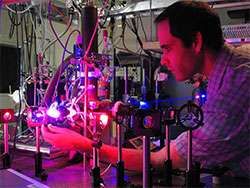
Sinha’s team—which included postdoctoral fellow Shuping Li and graduate student Jamie Matthews—was able to make the most precise measurement to date of the rate of this reaction with an innovative laser technique that allowed the team to directly monitor the OH radicals with significantly higher sensitivity then previously used to study this reaction.
“It’s a relatively slow reaction with a rate that is at least a thousand times slower than that for producing OH from the reaction of excited oxygen atoms with water molecules,” said Sinha. “However, there is a lot of solar radiation coming down over the visible wavelength region, so even a slow reaction can become important. The upshot is that atmospheric models have ignored this reaction altogether, assuming that because nothing can be seen using conventional techniques, nothing must be happening.”
Source: University of California - San Diego


