Research shows Earth's earliest animal ecosystem was complex and included sexual reproduction
March 20, 2008
Research shows Earth's earliest animal ecosystem was complex and included sexual reproduction

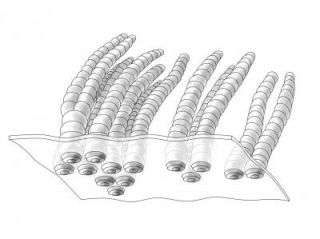
Artist's reconstruction of Funisia dorothea, showing how it may have looked. Credit: Daniel Garson, Droser lab, UC Riverside

Two paleontologists studying ancient fossils they excavated in the South Australian outback argue that Earth’s ecosystem has been complex for hundreds of millions of years – at least since around 565 million years ago, which is included in a period in Earth’s history called the Neoproterozoic era.

Until now, the dominant paradigm in the field of paleobiology has been that the earliest multicellular animals were simple, and that strategies organisms use today to survive, reproduce and grow in numbers have arisen over time due to several factors. These factors include evolutionary and ecological pressures that both predators and competition for food and other resources have imposed on the ecosystem.

But in describing the ecology and reproductive strategies of Funisia dorothea, a tubular organism preserved as a fossil, the researchers found that the organism had multiple means of growing and propagating – similar to strategies used by most invertebrate organisms for propagation today.
Research shows Earth's earliest animal ecosystem was complex and included sexual reproduction

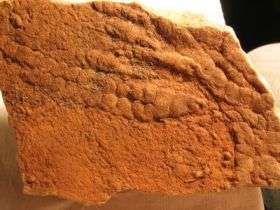
Funisia dorothea seen branching in a fossil excavated in South Australia. Credit: Droser lab, UC Riverside

Funisia dorothea grew in abundance, covering the seafloor, during the Neoproterozoic, a 100 million-year period ending around 540 million years ago in Earth’s history, during which no predators were around. Mary Droser, one of the paleontologists involved in the study and a professor of Earth sciences at UC Riverside, first discovered the rope-resembling organism in 2005 near Ediacara, South Australia (the site of the excavations), and gave it its name (Funisia after “rope” in Latin; dorothea after Dorothy, Droser’s mother).

“How Funisia appears in the fossils clearly shows that ecosystems were complex very early in the history of animals on Earth – that is, before organisms developed skeletons and before the advent of widespread predation,” said Droser, who was joined in the research by James G. Gehling of the South Australia Museum.

Study results appear in the March 21 issue of Science.

Droser and Gehling observed that Funisia appears as 30 cm-long tubes in the fossils. They also observed that the tubes commonly occur in closely-packed groups of five to fifteen individuals, displaying a pattern of propagation that often accompanies animal sexual reproduction.

“In general, individuals of an organism grow close to each other, in part, to ensure reproductive success,” said Droser, the first author of the research paper and the chair of the Department of Earth Sciences. “In Funisia, we are very likely seeing sexual reproduction in Earth’s early ecosystem – possibly the very first instance of sexual reproduction in animals on our planet.”

According to Droser and Gehling, the clusters of similarly sized individuals of Funisia are strongly suggestive of “spats,” huge numbers of offspring an organism gives birth to at once. Besides producing spats, the individual tubular organisms reproduced by budding, and grew by adding bits to their tips.

“Among living organisms, spat production results almost always from sexual reproduction and only very rarely from asexual reproduction,” Droser said.

Rachel Wood, a paleontologist at the University of Edinburgh, United Kingdom, who was not involved in the research, said the finding shows that fundamental ecological strategies were already established in the earliest known animal communities, some 570 million years ago.

“The fact that Funisia shows close-packed growth on the sea floor allows us to infer that this organism also reproduced sexually, producing a limited number of larval spatfalls,” she said. “This is how many primitive animals, such as sponges and corals, reproduce and grow today. So although we do not know the affinities of many of these oldest animals, we do know that their communities were structured in very similar ways to those that exist today.”

Scientists believe that a clear picture of the early ecosystem on our planet can inform us how early life evolved, what it looked like, and how organisms respond to environmental and other changes.

“The nature of the early ecosystem also clues us on what to look for on other planets in our search for extraterrestrial life,” Droser said.

Source: University of California - Riverside

4.6 /5 (18 votes)  

Filter


Move the slider to adjust rank threshold, so that you can hide some of the comments.


Display comments: newest first

Ragtime
Mar 20, 2008

Rank: 2 / 5 (1)
By my opinion, the start of so called precambrian explosion (some 542 Myrs ago) in biodiversity was caused just by introducing of sexual reproduction into evolution. This event has occured slighly before the precambrian evolution in fact, in the so called Avalon period (some 575 Myrs ago), so that the Funisia disputed were sexually active organisms, already.

So now we can know exactly about the very first moment, when two organisms have had sex on our planet.
Rank 4.6 /5 (18 votes)
Tags

Relevant PhysicsForums posts

More news stories

A mitosis mystery solved: How chromosomes align perfectly in a dividing cell

Although the process of mitotic cell division has been studied intensely for more than 50 years, Whitehead Institute researchers have only now solved the mystery of how cells correctly align their chromosomes during symmetric ...

Biology / Cell & Microbiology

created 14 hours ago | popularity 4.5 / 5 (22) | comments 0 | with audio podcast

Researchers find extensive RNA editing in human transcriptome

In a new study published online in Nature Biotechnology, researchers from BGI, the world's largest genomics organization, reported the evidence of extensive RNA editing in a human cell line by analysis of RNA-seq data, demons ...

Biology / Biotechnology

created 14 hours ago | popularity 5 / 5 (4) | comments 0 | with audio podcast

The proteins ensuring genome protection

Researchers from the University of Geneva (UNIGE), Switzerland, have discovered the crucial role of two proteins in developing a cell 'anti-enzyme shield'. This protection system, which operates at the level of molecular ...

Biology / Cell & Microbiology

created 14 hours ago | popularity 5 / 5 (3) | comments 0 | with audio podcast

Entire genome of extinct human decoded from fossil

(PhysOrg.com) -- In 2010, Svante Pääbo and his colleagues presented a draft version of the genome from a small fragment of a human finger bone discovered in Denisova Cave in southern Siberia. The ...

Biology / Biotechnology

created Feb 07, 2012 | popularity 4.7 / 5 (60) | comments 51 | with audio podcast

Why are there so few fish in the Earth's oceans?

(PhysOrg.com) -- A Stony Brook University researcher has found that, contrary to popular belief, there are not plenty of fish in the sea.

Biology / Plants & Animals

created Feb 08, 2012 | popularity 4.3 / 5 (19) | comments 27 | with audio podcast


Japan's Fukushima reactor may be reheating: operator

Temperature readings at one of the crippled Fukushima nuclear reactors have risen above Japan's stringent new safety standard but there was no immediate danger, its operator said Sunday.

Scientists discover molecular secrets of 2,000-year-old Chinese herbal remedy

For roughly two thousand years, Chinese herbalists have treated Malaria using a root extract, commonly known as Chang Shan, from a type of hydrangea that grows in Tibet and Nepal. More recent studies suggest that halofuginone, ...

New method to examine batteries -- MRI from the inside

There is an ever-increasing need for advanced batteries for portable electronics, such as phones, cameras, and music players, but also to power electric vehicles and to facilitate the distribution and storage of energy derived ...

Google might launch Drive for cloud storage soon

(PhysOrg.com) -- Google's next big move, according to the Wall Street Journal, is a cloud storage service called Drive. Hardly first to the plate, Google is simply catching up to introducing its cloud reposi ...

Lab study raises questions over nano-particle impact

Tests involving chickens have raised questions about the impact on health from engineered nano-particles, the ultra-fine grains commonly used in drugs and processed foods, scientists said on Sunday.

Starve a virus, feed a cure? Findings show how some cells protect themselves against HIV

A protein that protects some of our immune cells from the most common and virulent form of HIV works by starving the virus of the molecular building blocks that it needs to replicate, according to research published online ...