Scientists show that a microRNA can reduce lung cancer growth
March 20th, 2008 Scientists show that a microRNA can reduce lung cancer growth

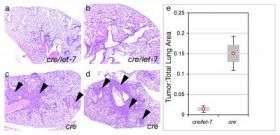
Sections from lungs of mice with tumors that were untreated (c, d) or treated (a, b) with intranasal dosing of let-7 miRNA. Points indicate tumor mass. Statistic show mice treated with let-7 had substantially reduced tumor load. Credit: Kerscher-Slack/Yale

A small RNA molecule, known as let-7 microRNA (miRNA), substantially reduced cancer growth in multiple mouse models of lung cancer, according to work by researchers at Yale University and Asuragen, Inc., published in the journal Cell Cycle.

Cancer afflicts 1.5 million people a year in the United States alone, and lung cancer is the most common and deadly form of cancer worldwide. This study indicates a direct role for a miRNA in cancer progression and introduces a new paradigm of using miRNAs as effective therapeutic agents to treat human cancer.

“We believe this is the first report of a miRNA being used to a beneficial effect on any cancer, let alone lung cancers, the deadliest of all cancers worldwide,” said senior author Frank Slack, associate professor of molecular, cellular and developmental biology at Yale.

Slack’s research group initially discovered the let-7 miRNA in C. elegans, a tiny worm used as a model system for studying how organisms develop, grow and age. They went on to show that in humans, let-7 negatively regulates a well-known determinant of human lung cancers, the RAS oncogene.

In collaboration with scientists at Asuragen, the Slack lab has studied the tumor suppressor activity of this small RNA. Their work revealed that let-7 is commonly present at substantially reduced levels in lung tumors — and that reduced levels of let-7 likely contribute to the development of the tumors. These discoveries focused public attention and research efforts to understand the potential use of naturally occurring microRNAs like let-7 to combat cancer.

This new work demonstrates that let-7 inhibits the growth of lung cancer cells in culture and in lung tumors in mice. They also showed that let-7 can be applied as an intranasal drug to reduce tumor formation in a RAS mouse model lung cancer.

“We believe that our studies provide the first direct evidence in mammals, that let-7 functions as a tumor suppressor gene,” said Slack. “Because multiple cell lines and mouse models of lung cancer were used, it appears that therapeutic application of let-7 may provide benefits to a broad group of lung cancer patients.”

“This has been a very productive industry-academic collaboration between Yale and Asuragen scientists” commented Matt Winkler CEO of Asuragen. “This work provides further evidence of the importance of miRNAs in the development of cancer and provides additional support for miRNA replacement therapy as an important component of effective cancer treatment regimens of the future.”

Source: Yale University


print this article email this article download pdf blog this article bookmark this article     Digg this Stumble it share on Facebook share on Reddit add to delicious save to Yahoo! bookmarks
4.7/5 after 3 votes


March 20th, 2008 all stories
Medicine & Health / Cancer

Comments: 0
Rank: 4.7/5 after 3 votes

  • Stumble this up

  • Digg this

  • Share it:
  • share on Facebook
  • share on MySpace
  • share on Slashdot
  • rss-newsfeed
  • share on Google
  • share on Reddit
  • add to delicious
  • save to Yahoo! bookmarks
  • share on Windows Live
  • Add to Mixx!
Rating: 4.7/5 after 3 votes


Tags


  • Physicists Demonstrate Quantum Memory with Matter Qubits
    Physicists Demonstrate Quantum Memory with Matter Qubits
    Physics / General Physics
    created Jul 03, 2009 | popularity 4.4 / 5 (17) | comments 1
  • 'Holey' Nanosheets for Wastewater Dye Removal
    Nanotechnology / Nanomaterials
    created Jul 01, 2009 | popularity 5 / 5 (5) | comments 1
  • Jellyfish Robot Swims Like its Biological Counterpart
    Jellyfish Robot Swims Like its Biological Counterpart
    Electronics / Robotics
    created Jun 26, 2009 | popularity 4.4 / 5 (8) | comments 1
  • Could Maxwell's Demon Exist in Nanoscale Systems?
    Could Maxwell's Demon Exist in Nanoscale Systems?
    Physics / General Physics
    created Jun 24, 2009 | popularity 4.4 / 5 (18) | comments 29
  • Living Safely with Robots, Beyond Asimov's Laws
    Living Safely with Robots, Beyond Asimov's Laws
    Electronics / Robotics
    created Jun 22, 2009 | popularity 4.6 / 5 (54) | comments 40
  • Other News

    One step closer to an artificial nerve cell

    Medicine & Health / Research

    created 57 minutes ago | popularity not rated yet | comments 0

    (PhysOrg.com) -- Scientists at Karolinska Institutet and Linköping University (Sweden) are well on the way to creating the first artificial nerve cell that can communicate specifically with nerve cells in the body using neurotransmitters. ...


    Chemicals in common consumer products may play a role in pre-term births

    Medicine & Health / Health

    created 53 minutes ago | popularity not rated yet | comments 0

    (PhysOrg.com) -- A new study of expectant mothers suggests that a group of common environmental contaminants called phthalates, which are present in many industrial and consumer products including everyday personal care items, ...


    Students with depression twice as likely to drop out of college (w/ Podcast)

    Medicine & Health / Psychology & Psychiatry

    created 34 minutes ago | popularity not rated yet | comments 0

    (PhysOrg.com) -- College students with depression are twice as likely as their classmates to drop out of school, new research shows.


    New study pinpoints difference in the way children with autism learn new behaviors

    Medicine & Health / Neuroscience

    created 4 hours ago | popularity not rated yet | comments 0

    Researchers from the Kennedy Krieger Institute and Johns Hopkins University School of Medicine have collaborated to uncover important new insights into the neurological basis of autism.


    Dogs, humans, put heads together to find cure for brain cancer

    Medicine & Health / Genetics

    created 2 hours ago | popularity not rated yet | comments 0

    Pinpointing the genes involved in human brain cancer can be like looking for a needle in a haystack, and sometimes the needle you find may not be the right one. By comparing human and canine genomes, researchers at North ...