Researchers achieve dramatic increase in thermoelectric efficiency
March 20, 2008
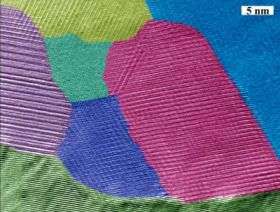
A Cross-Section of Nano-Crystalline Bismuth Antimony Telluride Grains

A cross-section of nano-crystalline bismuth antimony telluride grains, as viewed through transmission electron microscope. Colors highlight the features of each grain of the semiconductor alloy in bulk form. A team of researchers from Boston College and MIT produced a major increase in thermoelectric efficiency after using nanotechnology to structure the material, which is commonly used in industry and research. Credit: Boston College, MIT and GMZ Inc.

Researchers at Boston College and MIT have used nanotechnology to achieve a major increase in thermoelectric efficiency, a milestone that paves the way for a new generation of products — from semiconductors and air conditioners to car exhaust systems and solar power technology — that run cleaner.

The team’s low-cost approach, details of which are published today in the online version of the journal Science, involves building tiny alloy nanostructures that can serve as micro-coolers and power generators. The researchers said that in addition to being inexpensive, their method will likely result in practical, near-term enhancements to make products consume less energy or capture energy that would otherwise be wasted.

The findings represent a key milestone in the quest to harness the thermoelectric effect, which has both enticed and frustrated scientists since its discovery in the early 19th century. The effect refers to certain materials that can convert heat into electricity and vice versa. But there has been a hitch in trying to exploit the effect: most materials that conduct electricity also conduct heat, so their temperature equalizes quickly. In order to improve efficiency, scientists have sought materials that will conduct electricity but not similarly conduct heat.

Using nanotechnology, the researchers at BC and MIT produced a big increase in the thermoelectric efficiency of bismuth antimony telluride — a semiconductor alloy that has been commonly used in commercial devices since the 1950s — in bulk form. Specifically, the team realized a 40 percent increase in the alloy’s figure of merit, a term scientists use to measure a material’s relative performance. The achievement marks the first such gain in a half-century using the cost-effective material that functions at room temperatures and up to 250 degrees Celsius. The success using the relatively inexpensive and environmentally friendly alloy means the discovery can quickly be applied to a range of uses, leading to higher cooling and power generation efficiency.

“By using nanotechnology, we have found a way to improve an old material by breaking it up and then rebuilding it in a composite of nanostructures in bulk form,” said Boston College physicist Zhifeng Ren, one of the leaders of the project. “This method is low cost and can be scaled for mass production. This represents an exciting opportunity to improve the performance of thermoelectric materials in a cost-effective manner.”

“These thermoelectric materials are already used in many applications, but this better material can have a bigger impact,” said Gang Chen, the Warren and Towneley Rohsenow Professor of Mechanical Engineering at MIT and another leader of the project.

At its core, thermoelectricity is the “hot and cool” issue of physics. Heating one end of a wire, for example, causes electrons to move to the cooler end, producing an electric current. In reverse, applying a current to the same wire will carry heat away from a hot section to a cool section. Phonons, a quantum mode of vibration, play a key role because they are the primary means by which heat conduction takes place in insulating solids.

Bismuth antimony telluride is a material commonly used in thermoelectric products, and the researchers crushed it into a nanoscopic dust and then reconstituted it in bulk form, albeit with nanoscale constituents. The grains and irregularities of the reconstituted alloy dramatically slowed the passage of phonons through the material, radically transforming the thermoelectric performance by blocking heat flow while allowing the electrical flow.

In addition to Ren and six researchers at his BC lab, the international team involved MIT researchers, including Chen and Institute Professor Mildred S. Dresselhaus; research scientist Bed Poudel at GMZ Energy, Inc, a Newton, Mass.-based company formed by Ren, Chen, and CEO Mike Clary; as well as BC visiting Professor Junming Liu, a physicist from Nanjing University in China.

Thermoelectric materials have been used by NASA to generate power for far-away spacecraft. These materials have been used by specialty automobile seat makers to keep drivers cool during the summer. The auto industry has been experimenting with ways to use thermoelectric materials to convert waste heat from a car exhaust systems into electric current to help power vehicles.

Source: Boston College

4.7 /5 (48 votes)  

Filter


Move the slider to adjust rank threshold, so that you can hide some of the comments.


Display comments: newest first

ShadowRam
Mar 20, 2008

Rank: 1 / 5 (1)
IF the material isn't too heavy, then this could definitely help in a Hybrid Vehicle. Where the ICE could not only produce raw power, but the wasted heat can also be re-accumulated
zevkirsh
Mar 20, 2008

Rank: 1 / 5 (2)
this may also have ramifications for HVAC..... Air conditioners are probably the most antiquated, un-improved industrial technologies still out there.
Z
UncleMatt
Mar 20, 2008

Rank: 5 / 5 (1)
Does anyone know what the final efficiency that was achieved? Some thermoelectric materials are under 5% efficient, so doubling is making progress, but hardly and hopefully not the final efficiency that can be reached.
Rank 4.7 /5 (48 votes)
Tags

Relevant PhysicsForums posts
  • polymer nanocomposites
    created10 hours ago
  • Corrosion Tests on Magnesium
    created23 hours ago
  • polyethylene copper nanocomposite
    createdFeb 09, 2012
  • Output of xrd analysis
    createdFeb 08, 2012
  • Transport phenomena problem based on problems 18.B11 and 19B.6 from Bird, stewart, lw
    createdFeb 06, 2012
  • Help with material selection - Car Piston
    createdFeb 05, 2012
  • More from Physics Forums - Materials & Chemical Engineering

More news stories

What lies beneath: Mapping hidden nanostructures

The ability to diagnose and predict the properties of materials is vital, particularly in the expanding field of nanotechnology. Electron and atom-probe microscopy can categorize atoms in thin sheets of material, ...

Nanotechnology / Nanophysics

created 2 hours ago | popularity 5 / 5 (1) | comments 1

'Dark plasmons' transmit energy

Microscopic channels of gold nanoparticles have the ability to transmit electromagnetic energy that starts as light and propagates via "dark plasmons," according to researchers at Rice University.

Nanotechnology / Nanophysics

created 19 hours ago | popularity 5 / 5 (6) | comments 1 | with audio podcast

Nanotube therapy takes aim at breast cancer stem cells

Wake Forest Baptist Medical Center researchers have again proven that injecting multiwalled carbon nanotubes (MWCNTs) into tumors and heating them with a quick, 30-second laser treatment can kill them.

Nanotechnology / Bio & Medicine

created Feb 09, 2012 | popularity 5 / 5 (1) | comments 0 | with audio podcast

New kind of solar cell could capture significantly more energy than current cells

New solar cells could increase the maximum efficiency of solar panels by over 25%, according to scientists from the University of Cambridge.

Nanotechnology / Nanophysics

created Feb 08, 2012 | popularity 4.5 / 5 (11) | comments 14 | with audio podcast

Nanoshell whispering galleries improve thin solar panels

Visitors to Statuary Hall in the U.S. Capitol Building may have experienced a curious acoustic feature that allows a person to whisper softly at one side of the cavernous, half-domed room and for another on ...

Nanotechnology / Nanomaterials

created Feb 07, 2012 | popularity 4.3 / 5 (6) | comments 6 | with audio podcast


New understanding of DNA repair could eventually lead to cancer therapy

A research group in the Faculty of Medicine & Dentistry at the University of Alberta is hoping its latest discovery could one day be used to develop new therapies that target certain types of cancers.

Zuckerberg's focus drives Facebook's ascent

When Mark Zuckerberg showed up to rent Judy Fusco's Los Altos, Calif., house in the fall of 2004, soon after he'd arrived in Silicon Valley, the landlord was immediately struck by his confidence.

Both maternal and paternal age linked to autism

Older maternal and paternal age are jointly associated with having a child with autism, according to a recently published study led by researchers at The University of Texas Health Science Center at Houston (UTHealth).

Night, weekend delivery OK for babies with birth defects

Weekday delivery is no better than night or weekend delivery for infants with birth defects, according to a new study presented today at The Pregnancy Meeting, the Society for Maternal-Fetal Medicine's annual conference. ...

Sonic Cradle lands spot in TED exhibition

A Simon Fraser University graduate student project that melds music, meditation and modern technology has landed a rare spot as an exhibit at TEDActive 2012 in Palm Springs, California this month.

Drug halts organ damage in inflammatory genetic disorder

A new study shows that Kineret (anakinra), a medication approved for the treatment of rheumatoid arthritis, is effective in stopping the progression of organ damage in people with neonatal-onset multisystem inflammatory disease ...