Researchers developing system to efficiently convert biomass to ethanol
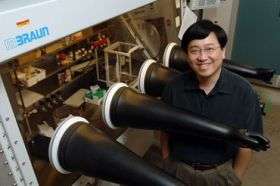
Iowa State University researchers are developing an integrated system of thermochemical and catalytic technologies to efficiently produce ethanol from plant biomass.
The U.S. Department of Agriculture and the U.S. Department of Energy recently announced they'll support the research with a two-year grant of up to $944,899. The departments are awarding $18.4 million over three years to 21 universities and companies for biomass research, development and demonstration projects.
"These grants help fund the innovative research needed to develop technologies and systems that lead to the production of bio-based products and biofuels," said Ed Schafer, the U.S. secretary of agriculture.
"Increasing supplies of renewable energy and using more energy efficient technologies must continue to play an indispensable role in reducing greenhouse gas emissions and meeting the rapidly growing demand for energy," said Samuel Bodman, the U.S. secretary of energy.
Victor Lin, a professor of chemistry and director of the Center for Catalysis, will lead the Iowa State project. The project also includes Robert C. Brown, the Iowa Farm Bureau Director of the Bioeconomy Institute; George Kraus, the director of the Institute for Physical Research and Technology; Marek Pruski, a scientist for the Department of Energy's Ames Laboratory located at Iowa State; and Justinus Satrio, a project manager at the Center for Sustainable Environmental Technologies.
They're working to develop a biomass-to-ethanol system that would work like this: Plant biomass such as corn stalks and switchgrass would be broken down by fast pyrolysis, a process that uses heat at 900 degrees Fahrenheit in the absence of oxygen to convert biomass into a bio-oil. The bio-oil would be gasified with steam and/or oxygen at 1,100 to 1,500 degrees Fahrenheit to produce a synthesis gas, a mixture of carbon monoxide, hydrogen, carbon dioxide and short-chain hydrocarbon gases. The hydrogen and carbon monoxide in the synthesis gas would be reacted with a nanotechnology-based catalyst to produce ethanol fuel.
Lin said researchers have looked at catalysts to produce ethanol from synthesis gas for years. But there were some problems with the old chemistry and research progress has slowed since the early 1990s. The chemistry didn't produce the selective reactions necessary for efficient production. There were also issues with controlling those reactions.
But now, "With the emphasis on biomass and biorenewables, I think there will be a renaissance of this research and technology," Lin said.
His idea for a new kind of catalyst is based on solid nanospheres just 250 billionths of a meter in diameter that have honeycomb channels running through them. Lin said those channels can be loaded with a metallic catalyst and other species that can promote higher reactivity and product selectivity. The new technology, because of the nanoporous structure and the unique spatial arrangement of the catalytic components, solves some of the selectivity and control problems of the old chemistry.
Lin has already worked on the synthesis gas-to-ethanol catalyst for a year and has filed a patent application.
Satrio, of Iowa State's Center for Sustainable Environmental Technologies, called the research collaboration "a very exciting project. This is on the cutting edge of this technology."
The center's focus will be to develop a system that efficiently and economically produces clean synthesis gas that's ready to be reacted with Lin's catalyst. Center researchers will use the two thermochemical technologies (fast pyrolysis and gasification) with the goal of developing a complete conversion system that makes economic sense for the future.
Transporting biomass to fuel production plants isn't easy or cheap because of the bulk and quantities involved. The Department of Energy has estimated a biorefinery would need at least 2,000 tons of biomass per day. A year's supply would cover 100 acres with 25 feet of biomass.
The Iowa State idea calls for biomass to be transported to small, local fast pyrolysis plants that would convert the plant fiber into liquid bio-oil, Satrio said. The bio-oil would be much easier to transport to bigger, regional facilities where it could be efficiently gasified at high pressure and catalytically converted into ethanol.
The departments of agriculture and energy said the 21 research projects won grants because they can advance President George Bush's Advanced Energy Initiative. The initiative's goals are to change the way the country powers its cars, homes and businesses by increasing energy efficiency and diversifying energy sources. Funding for the projects will be provided through the departments' Biomass Research and Development Initiative.
Source: Iowa State University


