MIT aims to search for Earth-like planets with Google's help
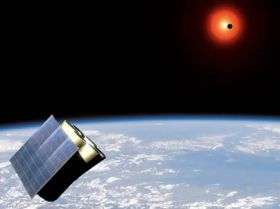
MIT scientists are designing a satellite-based observatory that they say could for the first time provide a sensitive survey of the entire sky to search for planets outside the solar system that appear to cross in front of bright stars. The system could rapidly discover hundreds of planets similar to the Earth.
Google, the Internet search powerhouse that in recent years has expanded to include mapping of the stars as well as the surfaces of the moon and Mars and which has an ongoing collaboration with NASA's Ames Research Center, provided a small seed grant to fund development of the wide-field digital cameras needed for the satellite. Because of the huge amount of data that will be generated by the satellite, Google has an interest in working on the development of ways of sifting through that data to find useful information.
Dubbed the Transiting Exoplanet Survey Satellite (TESS), the satellite could potentially be launched in 2012. "Decades, or even centuries after the TESS survey is completed, the new planetary systems it discovers will continue to be studied because they are both nearby and bright," says George R. Ricker, senior research scientist at the Kavli Institute for Astrophysics and Space Research at MIT and leader of the project. "In fact, when starships transporting colonists first depart the solar system, they may well be headed toward a TESS-discovered planet as their new home."
Most of the more than 200 extrasolar planets discovered so far have been much larger than Earth, similar in size to the solar system's giant planets (ranging from Jupiter to Neptune), or even larger. But to search for planets where there's a possibility of finding signs of living organisms, astronomers are much more interested in those that are similar to our own world.
Most searches so far depend on the gravitational attraction that planets exert on their stars in order to detect them, and therefore are best at finding large planets that orbit close to their stars. TESS, however, would search for stars whose orbits as seen from Earth carry them directly in front of the star, obscuring a tiny amount of starlight. Some ground-based searches have used this method and found about 20 planets so far, but a space-based search could detect much smaller, Earth-sized planets, as well as those with larger orbits.
This transit-detection method, by measuring the exact amount of light obscured by the planet, can pinpoint the planet's size. When combined with spectroscopic follow-up observations, it can determine the planet's temperature, probe the chemistry of its atmosphere, and perhaps even find signs of life, such as the presence of oxygen in the air.
The satellite will be equipped with six high-resolution, wide-field digital cameras, which are now under development. Two years after launch, the cameras--which have a total resolution of 192 megapixels--will cover the whole sky, getting precise brightness measurements of about two million stars in total.
Statistically, since the orientation of orbits is random, about one star out of a thousand will have its planets' orbits oriented perpendicular to Earth so that the planets will regularly cross in front of it, which is called a planetary transit. So, out of the two million stars observed, the new observatory should be able to find more than a thousand planetary systems within two years.
In fact, if a new estimate based on recent observations of dusty disks is confirmed, there might even be up to 10 times as many such planets.
Because the satellite will be repeatedly taking detailed pictures of the entire sky, the amount of data collected will be enormous. As a result, only selected portions will actually be transmitted back to Earth. But the remaining data will be stored on the satellite for about three months, so if astronomers want to check images in response to an unexpected event, such as a gamma-ray burst or supernova explosion, "they can send us the coordinates [of that event] and we could send them the information," Ricker says.
The team is still trying to secure the full funding to build, launch and operate the satellite, once the design work is completed this year. The Harvard-Smithsonian Center for Astrophysics and the Origins of Life Initiative, NASA Goddard and NASA Ames as well as the privately funded Las Cumbres Observatory Global Telescope Network are already scientific participants with MIT on the TESS program.
The NASA Ames Research Center is a full partner in the TESS program. Their Small Spacecraft Division, formed in 2006, specializes in low-cost, rapid development of spacecraft and missions. Further, NASA Ames is partnering with universities and industry to support privately financed space missions and related activities.
Regardless of the funding for the satellite, the same wide-field cameras being developed for TESS could also be used for a planned ground-based search for dark matter in the universe--the invisible, unknown material that astronomers believe is more prevalent in space than the ordinary matter that we can see. Some of the unknown dark-matter particles must constantly be striking the Earth, and the plan is to train a bank of cameras inside tanks of fluid deep underground, to detect flashes of light produced by the impacts of these dark particles. Ricker's Kavli group is participating with MIT physics professor Peter Fisher's team in this new physics research initiative.
The electronic detectors for the new cameras are being developed in collaboration with MIT's Lincoln Laboratory. The lab's expertise in building large, highly sensitive detectors is a significant factor in making possible these unique cameras, which have no moving parts at all. If all goes well and funding is secured, the satellite could be launched in 2012 with NASA support, or even earlier with a private sponsor.
Ricker's MIT colleagues on the TESS project include Kavli Institute research scientist Roland Vanderspek, professors Sara Seager, Josh Winn, Adam Burgasser, Jim Elliot, Jacqueline Hewitt and several others.
Source: MIT


