New Method Offers Insight into Radiation Damage to DNA
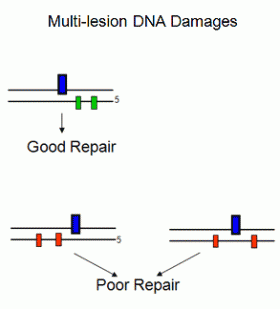
A new technique for assessing the damage radiation causes to DNA indicates that the spatial arrangement of damaged sites, or lesions, is more important than the number of lesions in determining the severity of the damage. The technique, developed by scientists at the U.S. Department of Energy (DOE)'s Brookhaven National Laboratory, helps reveal why high-energy charged particles such as the heavy ions in outer space are more potentially harmful than lower-energy forms of radiation such as x-rays and gamma rays.
The research could help clarify the risks faced by future astronauts flying long-term missions to the moon or Mars. It will be published in the March 19, 2008 issue of the journal Nucleic Acids Research.
The technique uses different colored fluorescent "tags" instead of radioactive ones to monitor repair of damage to DNA, life's genetic instruction molecule. Because these fluorescent tags reduce the amount of hazardous waste associated with the research (and its cost) the Brookhaven scientists, Betsy Sutherland and Brigitte Paap, now at Arizona State University, have been recognized by DOE's Office of Science for their "Best in Class" pollution prevention innovation.
"Understanding the effects on humans of radiation exposure - whether in the natural environment, in outer space, in the workplace, or due to radiation therapy - requires insight into the induction and repair of damage to DNA," said Sutherland, an expert in the study of space radiation. "It's very rewarding to come up with a new technique that helps us understand this process while at the same time reducing the waste associated with traditional techniques."
Radiation can damage the DNA "double helix" - a two-stranded, twisting molecule - in a variety of ways: 1) by knocking off one or more of the DNA "bases" known by the letters A, T, G, and C, which form the bonds between the two strands of the double helix; 2) by oxidizing these bases; or 3) by breaking through one or both strands. All can result in a failure of the molecule to perform its main task - telling cells which proteins to make. That can lead to out-of-control cell growth (cancer) or death. Cells can often repair radiation-damaged DNA, using specialized enzymes to excise and patch up the damaged segments.
But damage from ionizing particle radiation appears to be harder to repair than that caused by lower-energy forms of radiation such as x-rays and gamma rays. Scientists have long hypothesized that the reason for this difference was that the high-energy ionizing particles caused more complex damage containing many lesions close together on the DNA, leading to slower and less-accurate repair. The technique developed by Sutherland and Paap allowed them to test this hypothesis.
Using standard techniques of molecular biology, the scientists created synthetic DNA with known lesions in a variety of spatial arrangements with a red fluorescent tag attached to one end of the strand and a green fluorescent tag at the other end. They then applied a DNA repair enzyme, which clips the DNA at damaged sites. The scientists then used gel electrophoresis to separate the fragments according to their length. By looking at the red- and green-tagged bands, and determining their length, the scientists were able to measure how well the repair enzyme recognized and repaired the DNA damage.
The results were surprising: Instead of being dependent on the number of lesions, the ability of the repair enzyme to recognize the damaged sites appeared to be most affected by the spatial arrangement of lesions on the DNA strands. The scientists found that the enzyme readily recognized and repaired lesions on one of the DNA's two strands that occurred all to one side of a reference lesion on the opposite strand (think of it as "upstream"). These upstream lesions were successfully repaired regardless of whether there were only two or many lesions in the damage. If the lesions occurred "downstream" from the reference lesion, however, the repair enzyme was unable to work properly, no matter whether the clustered damage was a simple, two-lesion cluster, similar to those caused by x-rays, or a complex multi-lesion cluster like those induced by space radiation. When the lesions occurred in a two-sided cluster both up and downstream from the reference lesion, again the repair enzyme worked poorly.
"Since x-rays produce about half upstream, easily repaired clusters and about half downstream, repair-resistant clusters, about half of them would be readily repaired," Sutherland said. "The heavy, charged particles in space radiation, on the other hand, produce much more complex, two-sided clusters, containing so many lesions that most of them are repair-resistant. This directional dependence of the ability to repair lesions explains why damage from charged-particle radiation, such as that encountered in outer space, is more harmful," she said.
Pollution prevention award
The technique using fluorescently labeled synthetic DNA fragments replaces a technique in which radioactive isotopes are used as tags. While efficient, radioactive isotopes are more expensive than the fluorescent tags. Also, using radioactive tracers requires frequent preparation of freshly labeled DNA, and disposal of the experimental samples as hazardous waste - which further increases the cost of the research.
Fluorescently labeled molecules can be stored frozen for long periods. So the new method minimizes waste generation and improves worker safety by avoiding the handling of radioactive material.
The technique may now be used throughout the DOE labs and in universities and industry, and may be considered for other awards, including the White House "Closing the Circle" award competition.
Source: Brookhaven National Laboratory


