Black carbon pollution emerges as major player in global warming
March 23rd, 2008 Black carbon pollution emerges as major player in global warming

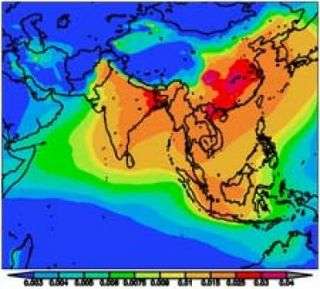
The polluting effects of cooking using biomass like wood or cow dung in south Asia are illustrated through a measurement of aerosol optical depth, a way of measuring the quantity of pollutants in the air by the relative ability of light to penetrate through them. This representation shows reconstructed levels of pollution from 2004 and 2005. Credit: Scripps Institution of Oceanography, UC San Diego

Black carbon, a form of particulate air pollution most often produced from biomass burning, cooking with solid fuels and diesel exhaust, has a warming effect in the atmosphere three to four times greater than prevailing estimates, according to scientists in an upcoming review article in the journal Nature Geoscience.

Scripps Institution of Oceanography at UC San Diego atmospheric scientist V. Ramanathan and University of Iowa chemical engineer Greg Carmichael, said that soot and other forms of black carbon could have as much as 60 percent of the current global warming effect of carbon dioxide, more than that of any greenhouse gas besides CO2. The researchers also noted, however, that mitigation would have immediate societal benefits in addition to the long term effect of reducing greenhouse gas emissions.

The article, “Global and regional climate changes due to black carbon,” will be posted in the online version of Nature Geoscience on Sunday, March 23.

“Observationally based studies such as ours are converging on the same large magnitude of black carbon heating as modeling studies from Stanford, Caltech and NASA,” said Ramanathan. “We now have to examine if black carbon is also having a large role in the retreat of arctic sea ice and Himalayan glaciers as suggested by recent studies.”

In the paper, Ramanathan and Carmichael integrated observed data from satellites, aircraft and surface instruments about the warming effect of black carbon and found that its forcing, or warming effect in the atmosphere, is about 0.9 watts per meter squared. That compares to estimates of between 0.2 watts per meter squared and 0.4 watts per meter squared that were agreed upon as a consensus estimate in a report released last year by the Intergovernmental Panel on Climate Change (IPCC), a U.N.-sponsored agency that periodically synthesizes the body of climate change research.

Ramanathan and Carmichael said the conservative estimates are based on widely used computer model simulations that do not take into account the amplification of black carbon’s warming effect when mixed with other aerosols such as sulfates. The models also do not adequately represent the full range of altitudes at which the warming effect occurs. The most recent observations, in contrast, have found significant black carbon warming effects at altitudes in the range of 2 kilometers (6,500 feet), levels at which black carbon particles absorb not only sunlight but also solar energy reflected by clouds at lower altitudes.

Between 25 and 35 percent of black carbon in the global atmosphere comes from China and India, emitted from the burning of wood and cow dung in household cooking and through the use of coal to heat homes. Countries in Europe and elsewhere that rely heavily on diesel fuel for transportation also contribute large amounts.

“Per capita emissions of black carbon from the United States and some European countries are still comparable to those from south Asia and east Asia,” Ramanathan said.

In south Asia, pollution often forms a prevalent brownish haze that has been termed the “atmospheric brown cloud.” Ramanathan’s previous research has indicated that the warming effects of this smog appear to be accelerating the melt of Himalayan glaciers that provide billions of people throughout Asia with drinking water. In addition, the inhalation of smoke during indoor cooking has been linked to the deaths of an estimated 400,000 women and children in south and east Asia.

Elimination of black carbon, a contributor to global warming and a public health hazard, offers a nearly instant return on investment, the researchers said. Black carbon particles only remain airborne for weeks at most compared to carbon dioxide, which remains in the atmosphere for more than a century. In addition, technology that could substantially reduce black carbon emissions already exists in the form of commercially available products.

Ramanathan said that an observation program for which he is currently seeking corporate sponsorship could dramatically illustrate the benefits. Known as Project Surya, the proposed venture would provide some 20,000 rural Indian households with smoke-free cookers and equipped to transmit data. At the same time, a team of researchers led by Ramanathan would observe air pollution levels in the region to measure the effect of the cookers.

Carmichael said he hopes that the paper’s presentation of the immediacy of the benefits will make it easier to generate political and regulatory momentum toward reduction of black carbon emissions.

“It offers a chance to get better traction for implementing strategies for reducing black carbon,” he said.

The National Science Foundation, the National Oceanic and Atmospheric Administration and the National Aeronautics and Space Administration funded the review.

Source: University of California - San Diego


print this article email this article download pdf blog this article bookmark this article     Digg this Stumble it share on Facebook share on Reddit add to delicious save to Yahoo! bookmarks
4.1/5 after 32 votes

Rank Filter

Move the slider to adjust rank threshold, so that you can hide some of the comments.


Display comments: newest first

  • NotParker - Mar 23, 2008
    • Rank: 2.5 / 5 (11)
    Europe decided to comply with Kyoto by emphasizing diesel cars.

    It made things worse.

    Biofuel also makes things worse.

    Al Gore - Killer of the Environment
  • Doug_Huffman - Mar 23, 2008
    • Rank: 1.8 / 5 (8)
    Search and research until the desired conclusion is rationalized. Food and fodder as fuel is foolish. Bio-renewables renew more slowly than they are consumed.
  • aufever - Mar 23, 2008
    • Rank: 2.5 / 5 (10)
    In case you Global Warmers missed it Scientist Explains Global Warming Ended a Decade Ago.
    http://www.theaus...,00.html
    Also we have had Historic Snow Cover in the Northern Hemisphere and NOAA NOAA: Coolest Winter Since 2001 for U.S., Globe

    http://www.noaane...est.html

  • CWFlink - Mar 23, 2008
    • Rank: 2.3 / 5 (9)
    So what do we do when we find that it is not CO2 but in fact smoke from the 3rd world that is the true cause of what WAS global warming?
    It may well be that the industrialized nations need NOT burn less, but that the non-industrialized nations need to industrialize to obtain electricity for heating and cooking... WITHOUT the particulate matter we already keep out of our smokestacks here in the US. We need a strong economy so that we have the capital needed to invest in environmentally safe power systems for the 3rd world.
  • nilbud - Mar 23, 2008
    • Rank: 2.3 / 5 (8)
    The decadent west has enough money to provide university education to all who want it. We spend all our time trying to get that villa with the cool view instead of sorting out the world. I hate hippies but there has to be more selflessness and less greed. Check out www.ted.com and do more than golf and jetski.
  • RAL - Mar 24, 2008
    • Rank: 2 / 5 (4)
    So does black carbon pollution offer hope that we can warm the planet up after the world's unusually cold winter and cooling deep ocean water? Should we be encouraging it to save us from the next Chicken Little Theory elevated into "consensus" by the politicians?
  • cybrbeast - Mar 24, 2008
    • Rank: 2 / 5 (1)
    I thought catalytic converters in diesel engines removed the black carbon by burning unburnt hydrocarbons. How can diesel engines then contribute so much to this problem?
  • NotParker - Mar 24, 2008
    • Rank: 2.3 / 5 (3)
    http://www.agu.or...233.html

    Laws that favor the use of diesel, rather than gasoline, engines in cars may actually encourage global warming, according to a new study. Although diesel cars obtain 25 to 35 percent better mileage and emit less carbon dioxide than similar gasoline cars, they can emit 25 to 400 times more mass of particulate black carbon and associated organic matter ("soot") per kilometer [mile]. The warming due to soot may more than offset the cooling due to reduced carbon dioxide emissions over several decades, according to Mark Z. Jacobson, Associate Professor of Civil and Environmental Engineering at Stanford University.
  • deepsand - Mar 24, 2008
    • Rank: 3 / 5 (2)
    So what do we do when we find that it is not CO2 but in fact smoke from the 3rd world that is the true cause of what WAS global warming?
    It may well be that the industrialized nations need NOT burn less, but that the non-industrialized nations need to industrialize to obtain electricity for heating and cooking... WITHOUT the particulate matter we already keep out of our smokestacks here in the US. We need a strong economy so that we have the capital needed to invest in environmentally safe power systems for the 3rd world.


    The West exported its smokestack industries to the developing countries, and now imports the products those industries produce, at a cost well below that of what it would cost to produce such domestically.

    Were, for example, the U.S. to re-patriate such industries, its CO2 emmisions would be roughly 30% higher than at present.

    As it is our demand for cheap product that drives the market for the output of the industries in question, to hold foreign countries alone responsible for their contributions to global waste, of any type, is hypocritical.

    Given that we bear more than a little responsibility for such waste production, and if we are to discharge such obligation in an equitable manner, we must reduce our use of such products, pay higher prices for such, so that those industries have the necessary capital for modifying their plants, or provide direct aid toward the costs of such modifications.
  • deepsand - Apr 13, 2008
    • Rank: 3 / 5 (2)
    I thought catalytic converters in diesel engines removed the black carbon by burning unburnt hydrocarbons. How can diesel engines then contribute so much to this problem?


    Catalytic converters do not remove particulate matter from the exhaust stream but use catalysts to promote chemical reactions so as to change certain gaseous components into less harmful ones.

    And, absent the particulates, diesel engines are actually cleaner burning than are gasoline engines.

March 23rd, 2008 all stories
Space & Earth / Earth Sciences

Comments: 10
Rank: 4.1/5 after 32 votes

  • Stumble this up

  • Digg this

  • Share it:
  • share on Facebook
  • share on MySpace
  • share on Slashdot
  • rss-newsfeed
  • share on Google
  • share on Reddit
  • add to delicious
  • save to Yahoo! bookmarks
  • share on Windows Live
  • Add to Mixx!
Rating: 4.1/5 after 32 votes

  • Related Stories

  • Sulfate lens enhances climate warming properties of atmospheric soot
    created Jun 29, 2009 | popularity not rated yet | comments 0
  • Vt. farmers cut cows' emissions by altering diets
    created Jun 21, 2009 | popularity not rated yet | comments 0
  • The mystery of particles
    created Jun 19, 2009 | popularity not rated yet | comments 0
  • Spring agricultural fires have large impact on melting Arctic
    created May 26, 2009 | popularity not rated yet | comments 0
  • Former coal mine aids Arctic climate research
    created May 08, 2009 | popularity not rated yet | comments 0

Tags


  • Physicists Demonstrate Quantum Memory with Matter Qubits
    Physicists Demonstrate Quantum Memory with Matter Qubits
    Physics / General Physics
    created 23 hours ago | popularity 4.5 / 5 (11) | comments 1
  • 'Holey' Nanosheets for Wastewater Dye Removal
    Nanotechnology / Nanomaterials
    created Jul 01, 2009 | popularity 5 / 5 (5) | comments 1
  • Jellyfish Robot Swims Like its Biological Counterpart
    Jellyfish Robot Swims Like its Biological Counterpart
    Electronics / Robotics
    created Jun 26, 2009 | popularity 4.4 / 5 (7) | comments 1
  • Could Maxwell's Demon Exist in Nanoscale Systems?
    Could Maxwell's Demon Exist in Nanoscale Systems?
    Physics / General Physics
    created Jun 24, 2009 | popularity 4.4 / 5 (18) | comments 29
  • Living Safely with Robots, Beyond Asimov's Laws
    Living Safely with Robots, Beyond Asimov's Laws
    Electronics / Robotics
    created Jun 22, 2009 | popularity 4.6 / 5 (51) | comments 39
  • Other News

    Global warming tactic cools climate but won’t help corals, say researchers

    Space & Earth / Earth Sciences

    created 20 hours ago | popularity 2.3 / 5 (3) | comments 6

    (PhysOrg.com) -- “Geoengineering” experiments proposed to reduce global warming by blocking sunlight with atmosphere-injected particles may cool the world but still leave carbon dioxide levels dangerously high, Stanford scientists ...


    Coolest spacecraft ever in orbit around L2

    Coolest spacecraft ever in orbit around L2

    Space & Earth / Space Exploration

    created 22 hours ago | popularity 4.8 / 5 (5) | comments 3

    (PhysOrg.com) -- Last night, the detectors of Planck's High Frequency Instrument reached their amazingly low operational temperature of -273°C, making them the coldest known objects in space. The spacecraft ...


    Senator may have won fight over private rocket manufacturing

    Space & Earth / Space Exploration

    created 22 hours ago | popularity 4.5 / 5 (2) | comments 2

    For months, a powerful Republican senator from Alabama has fought the Obama administration to block $150 million that the White House wanted to spend to help private companies build rockets capable of reaching the international ...


    The least sea ice in 800 years

    The least sea ice in 800 years

    Space & Earth / Earth Sciences

    created Jul 01, 2009 | popularity 4.3 / 5 (57) | comments 44

    New research, which reconstructs the extent of ice in the sea between Greenland and Svalbard from the 13th century to the present indicates that there has never been so little sea ice as there is now. The ...


    Gas around young galaxy

    Intense heat killed the Universe's would-be galaxies, researchers say

    Space & Earth / Astronomy

    created Jul 01, 2009 | popularity 3.1 / 5 (18) | comments 23

    (PhysOrg.com) -- Our Milky Way galaxy only survived because it was already immersed in a large clump of dark matter which trapped gases inside it, scientists led by Durham University's Institute for Computational ...