New triple-threat weapon needed in war between man and microbe
March 24, 2008 New triple-threat weapon needed in war between man and microbe

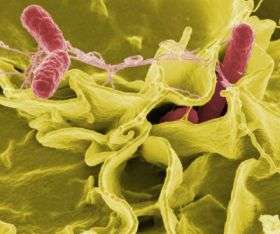
Without a breakthrough, microbial resistance might be inevitable in humanity's struggle against infectious disease, a medicinal chemist reports. Above is a color-enhanced scanning electron micrograph showing Salmonella typhimurium (red) invading cultured human cells. Courtesy of National Institute of Allergy and Infectious Diseases of the NIH

Mankind’s age-old battle against infectious diseases stands to rage on and on, unless scientists develop a new generation of triple-action antibiotics, according to an article scheduled for the March 28 issue of ACS’ monthly Journal of Natural Products.

In the article, Lester A. Mitscher presents a “rather personalized” account of the turbulent tug-of-war between microbes and mankind, describing past tactics, lessons learned, and a cautious prediction about the road ahead.

Mitscher notes, for instance, that “miracle drugs” in the 1940s and ’50s failed to live up to expectations. Though penicillin promised an end to infections worldwide in 1941, reports of resistant bacteria appeared only a year later. “Significant clinical resistance is now known for virtually all antibiotics in medical use,” the article states. “Unfortunately, the problem is getting worse since big pharma has largely withdrawn from research directed toward new antibiotic discovery.”

The review concludes that microbial resistance is inevitable pending unforeseen breakthroughs. One involves development of new antibiotics that go beyond killing or slowing the growth of disease-causing microbes. Those new medications would contain antimutagenic ingredients that discourage bacteria from mutating into resistant forms. In addition, they would pack immunostimulants that enlist the body’s own immune defense system to fight off an infection.

“Continued close observation and exploitation of natural phenomena appear at present to be the wisest course for scientists to follow in trying to deal with this problem,” says Mitscher.

Source: ACS


print this article email this article download pdf blog this article bookmark this article     Stumble it Digg this share on Facebook retweet share on Reddit add to delicious
Rate this story - 4.5 /5 (13 votes)

Rank Filter

Move the slider to adjust rank threshold, so that you can hide some of the comments.


Display comments: newest first

  • zbarlici - Mar 24, 2008
    • Rank: not rated yet
    triple-action antibiotics? First we`d better see a quadruple-action antibiotic policy in place worldwide, aimed at ensuring proper use of antibiotics, as from what i understand there is too much abuse of antibiotic use as it is, in a sense that it is relied on too much and it is improperly used...
  • Soylent - Mar 25, 2008
    • Rank: not rated yet
    Currently drug companies develop drugs that can be patented and sold at a large markup to cover R&D costs and generate a profit.

    Perhaps it would be better if society could put out a large bounty on drug treatments for all diseases in proportion to what curing or controling them is worth to society and only allow this bounty to be collected upon meeting specific demands for efficacy, safety and at the expense of not patenting the drug. That would allow society a good measure of control over which diseases are targeted by drug companies.

March 24, 2008 all stories

Comments: 2

4.5 /5 (13 votes)
  • Stumble this up

  • Digg this

  • share this

  • hide
  • Related Stories


Other News

Researchers solve structure of NMDA receptor unit that could be drug target for neurological diseases

Chemistry / Biochemistry

created 8 hours ago | popularity not rated yet | comments 0

A team of scientists at Cold Spring Harbor Laboratory reports on Thursday their success in solving the molecular structure of a key portion of a cellular receptor implicated in Alzheimer's, Parkinson's, and other serious ...


New chemical reaction offers opportunities for drug development

Chemistry / Biochemistry

created 2 hours ago | popularity 5 / 5 (1) | comments 0

(PhysOrg.com) -- Scientists at University College Dublin have solved a chemistry problem which has stumped researchers worldwide for more than a decade. The results have earned the group the cover story of the leading scientific ...


Sweet as can be: How E. coli gets ahead

Chemistry / Biochemistry

created 10 hours ago | popularity not rated yet | comments 0

Scientists at the University of York have discovered how certain bacteria such as Escherichia coli have evolved to capture rare sugars from their environment giving them an evolutionary advantage in naturally competitive enviro ...


H1N1 Virus Can Be Killed by Acidic Ozone Water

H1N1 Virus Can Be Killed by Acidic Ozone Water

Chemistry / Biochemistry

created Nov 09, 2009 | popularity 4.8 / 5 (26) | comments 10

(PhysOrg.com) -- Scientists have found that acidic ozone water can deactivate H1N1 viruses very effectively, offering a promising disinfectant for the millions of people trying to avoid the disease. Acidic ...


Toward home-brewed electricity with 'personalized solar energy'

Toward home-brewed electricity with 'personalized solar energy'

Chemistry / Materials Science

created Nov 04, 2009 | popularity 3.4 / 5 (9) | comments 5

New scientific discoveries are moving society toward the era of "personalized solar energy," in which the focus of electricity production shifts from huge central generating stations to individuals in their ...