A fly's tiny brain may hold huge human benefits
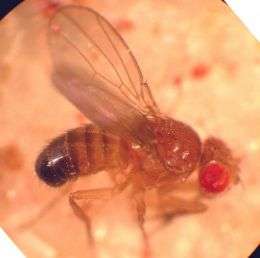
Before swatting at one of those pesky flies that come out as the days lengthen and the temperature rises, one should probably think twice. A University of Missouri researcher has found, through the study of Drosophila (a type of fruit fly), that by manipulating levels of certain compounds associated with the “circuitry” of the brain, key genes related to memory can be isolated and tested. The results of the study may benefit human patients suffering from Parkinson’s disease and could eventually lead to discoveries in the treatment of depression.
“The implication for human health is that it could influence our understanding of the cognitive decline associated with Parkinson’s disease and depression in humans,” said Troy Zars, MU assistant professor of biological science in the College of Arts and Science.
The idea that animals have a system that can match the quality of a memory with the significance of the memory is well established. If the event is significant, the memory and detail surrounding it is much stronger, lasts longer and is more easily recalled compared to more insignificant or common events. The problem the study addresses is the understanding of the mechanism by which that occurs.
“We have developed a strategy to address how this matching occurs, so we can ‘turn that crank’ over and over again. It allows us to answer the questions, ‘What gene is it" How does it function" How does it interact with other proteins"’ We can find brand-new, completely unexpected things,” Zars said.
A major goal of neuroscience is to discover and study memory-forming structures within a brain. Zars said he works with Drosophila because they are a well-established genetic model, have a relatively less complex brain than the mouse or human (250,000 neurons versus 100 billion neurons), and have a broad repertoire of behaviors.
Memory in the flies was tested using a specialized chamber in which single flies were allowed to wander freely. The chamber was outfitted with heating elements. When the fly moved to a particular side, the whole chamber rapidly heated to an uncomfortable temperature. The flies eventually learned, or remembered, to avoid that half if brain “circuitry” is functioning properly. A mutation in certain flies, however, altered the levels of serotonin and dopamine, which resulted in lower memory scores.
“This research is important because by studying a simple brain it will help us ultimately understand complex neural systems," Zars said. Zars’ study was published this week in Proceedings of the National Academy of Sciences.
Source: University of Missouri-Columbia


