Scientists reveal ants as fungus farmers
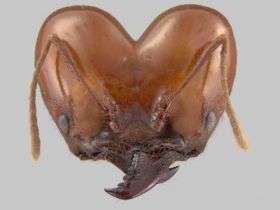
It turns out ants, like humans, are true farmers. The difference is that ants are farming fungus. Entomologists Ted Schultz and Seán Brady at the Smithsonian’s National Museum of Natural History have published a paper in the March 24 issue of the journal Proceedings of the National Academy of Sciences, providing new insight into the agricultural abilities of ants and how these abilities have evolved throughout time.
Using DNA sequencing, the scientists were able to construct an “evolutionary tree” of fungus-growing ants, which revealed a single pioneering ancestor that discovered agriculture approximately 50 million years ago.
In the past 25 million years, four different specialized agricultural systems have evolved, leading to the most recently evolved and best-known fungus-growing ant species—“leaf-cutter ants.” The ants do not eat the leaves; they grow their fungus gardens on them and then eat the fungus. By studying the agricultural evolution of leaf-cutter ants, as well as various other species, scientists may be able to develop improved human agricultural and medical methods.
“Agriculture is very rare in the animal world,” said Schultz. “We only know of four animal groups that have discovered agriculture: ants, termites, bark beetles and humans. By studying certain fungus-growing ants, which our study indicates are almost like ‘living fossils,’ we might be able to better understand steps involved in the evolution of ant agriculture.”
To complete their research, scientists spent more than 15 years assembling a comprehensive array of specimens, which included 91 ant species, 65 of which were fungus-growing ant species representing all different groups of fungus-growing ants. Researchers then used DNA sequencing, combined with a variety of state-of-the-art computer algorithms, to construct an evolutionary tree of fungus-growing ants. Dominican amber fungus-growing ant fossils were used to calibrate time intervals on the evolutionary tree.
From this evolutionary tree, scientists were able to determine that fungus-growing ants are all descended from a common ancestor that pioneered agriculture 50 million years ago during a period of global warming. The researchers also determined that in the past 25 million years, four different specialized agricultural systems emerged.
Each of these systems has its own unique set of cultivated fungi. For example, approximately 20 million years ago one group of fungus-growing ants discovered “higher agriculture,” meaning they cultivated their fungi to produce specialized “fruits” that the ants would harvest and eat for food. Leaf-cutter ants, which belong to this group, originated recently—less than 10 million years ago. Finally, it also was discovered that there are certain fungus-growing ant species living in South America today that are “missing links” in evolution.
More information on fungus-growing ants can be found in the museum’s newest permanent exhibition, “Butterflies + Plants: Partners in Evolution.”
Source: Smithsonian


