Common aquatic animals show extreme resistance to radiation
March 25, 2008 Common aquatic animals show extreme resistance to radiation

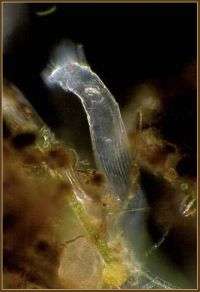
A bdelloid rotifer browses in a mass of decaying vegetation. Its two red eyes can be clearly seen. Its corona and sensory antenna lie just beyond the plane of focus. Image and caption courtesy of, and © www.micrographia.com

Scientists at Harvard University have found that a common class of freshwater invertebrate animals called bdelloid rotifers are extraordinarily resistant to ionizing radiation, surviving and continuing to reproduce after doses of gamma radiation much greater than that tolerated by any other animal species studied to date.

Because free radicals such as those generated by radiation have been implicated in inflammation, cancer, and aging in higher organisms, the findings -- published this week in the Proceedings of the National Academy of Sciences by Harvard's Matthew Meselson and graduate student Eugene Gladyshev -- could stimulate new lines of research into these medically important problems.

"Bdelloid rotifers are far more resistant to ionizing radiation than any of the hundreds of other animal species for which radiation resistance has been examined," says Meselson, Thomas Dudley Cabot Professor of the Natural Sciences in Harvard's Faculty of Arts and Sciences. "They are able to recover and resume normal reproduction after receiving a dose of radiation that shatters their genomes, causing hundreds of DNA double-strand breaks which they are nevertheless able to repair."

Meselson and Gladyshev found that the bdelloid rotifers Adineta vaga and Philodina roseola remained reproductively viable after doses of radiation roughly five times greater than other classes of rotifers and other animals could endure.

Such radiation resistance appears not to be the result of any special protection of DNA itself against breakage, the researchers say, but instead reflects bdelloid rotifers' extraordinary ability to protect their DNA-repairing machinery from radiation damage.

Roughly a half-millimeter in size and commonly observed under microscopes in high-school biology classes, bdelloid rotifers are highly unusual in several regards: They appear to be exclusively asexual, have relatively few transposable genes, and can survive and reproduce after complete desiccation at any stage of their life cycle. Meselson and Gladyshev hypothesize that it's this last property that explains bdelloids' apparently unique resistance to radiation.

Bdelloid rotifers have been widely studied since at least 1702, when the renowned Dutch scientist and microscopy pioneer van Leeuwenhoek added water to dust retrieved from a rain gutter on his house and observed the organisms in the resulting fluid. He subsequently described the creatures in a letter to Britain's Royal Society, which still counts an envelope of van Leeuwenhoek's rain-gutter dust among its holdings.

Source: Harvard University


Rate this story - 4.6 /5 (9 votes)


March 25, 2008 all stories

Comments: 0

4.6 /5 (9 votes)

  • hide
  • Related Stories

  • No sex, but plenty of gene transfer
    created May 29, 2008 | popularity not rated yet | comments 0
  • A common aquatic animal's genome can capture foreign DNA
    created May 29, 2008 | popularity not rated yet | comments 0
  • Is DNA repair a substitute for sex?
    created Apr 02, 2008 | popularity not rated yet | comments 0
  • Acupuncture reduces hot flashes, improves sex drive for breast cancer patients
    created 45 minutes ago | popularity not rated yet | comments 0
  • As the World Churns
    created Dec 28, 2009 | popularity not rated yet | comments 0


Other News

Tarantula venom-based MD therapy to be advanced by UB scientists' biotech company

Biology / Biotechnology

created 15 minutes ago | popularity not rated yet | comments 0

University at Buffalo biophysicists have found a protein in tarantula venom that shows promise as a potential therapy for muscular dystrophy (MD). They have formed a start-up biotech company in Buffalo -- Rose Pharmaceuticals ...


Researchers Use New Acoustic Tools to Study Marine Mammals and Fish

Researchers Use New Acoustic Tools to Study Marine Mammals and Fish

Biology / Ecology

created 59 minutes ago | popularity not rated yet | comments 0

(PhysOrg.com) -- Over the past decade, researchers have developed a variety of reliable real-time and archival instruments to study sounds made or heard by marine mammals and fish. These new sensors are now ...


Tracking Virus Resistance Genes in Watermelon Made Easier

Tracking Virus Resistance Genes in Watermelon Made Easier

Biology / Biotechnology

created 1hour ago | popularity not rated yet | comments 0

(PhysOrg.com) -- Finding watermelon genes that confer resistance to the devastating zucchini yellow mosaic virus (ZYMV) has just been made easier, thanks to molecular markers developed by Agricultural Research ...


First molars provide insight into evolution of great apes, humans

First molars provide insight into evolution of apes, humans

Biology / Evolution

created 20 hours ago | popularity 3 / 5 (2) | comments 0

(PhysOrg.com) -- The timing of molar emergence and its relation to growth and reproduction in apes is being reported by two scientists at Arizona State University's Institute of Human Origins in the Dec. 28 ...


Student sleuths using DNA reveal zoo of 95 species in NYC homes -- and new evidence of food fraud

Student sleuths using DNA reveal zoo of 95 species in NYC homes -- and new evidence of food fraud

Biology / Cell & Microbiology

created Dec 28, 2009 | popularity 5 / 5 (12) | comments 4

Two New York City high school students exploring their homes using the latest high-tech DNA analysis techniques were astonished to discover a veritable zoo of 95 animal species surrounding them, in everything ...