Antarctic ice shelf disintegrating as result of climate change, say scientists
March 25, 2008 Wilkins Ice Shelf

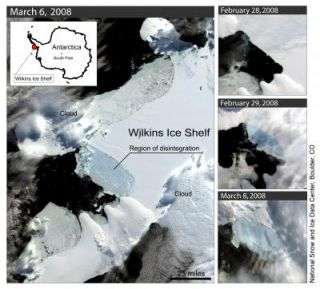
This series of satellite images shows the Wilkins Ice Shelf as it begins to break up. The large image is from March 6. The images at right, from top to bottom, are from Feb. 28, Feb. 29 and March 8. The images were processed from the MODIS satellite sensor flying on NASA's Earth Observing System Aqua and Terra satellites. Images courtesy NSIDC, NASA, University of Colorado

Satellite imagery from the University of Colorado at Boulder's National Snow and Ice Data Center shows a portion of Antarctica's massive Wilkins Ice Shelf has begun to collapse because of rapid climate change in a fast-warming region of the continent.

While the area of collapse involves 160 square miles at present, a large part of the 5,000-square-mile Wilkins Ice Shelf is now supported only by a narrow strip of ice between two islands, said CU-Boulder's Ted Scambos, lead scientist at NSIDC. "If there is a little bit more retreat, this last 'ice buttress' could collapse and we'd likely lose about half the total ice shelf area in the next few years."

In the past 50 years, the western Antarctic Peninsula has experienced the biggest temperature increase on Earth, rising by 0.9 degree F per decade. "We believe the Wilkins has been in place for at least a few hundred years, but warm air and exposure to ocean waves are causing a breakup," said Scambos, who first spotted the disintegration activity in March.

Satellite images indicate the Wilkins began its collapse on Feb. 28. Data revealed that a large iceberg, measuring 25.5 by 1.5 miles, fell away from the ice shelf's southwestern front, triggering a runaway disintegration of 220 square miles of the shelf interior. The Wilkins Ice Shelf is a broad sheet of permanent floating ice on the southwest Antarctic Peninsula roughly 1,000 miles south of South America.

The edge of the shelf crumbled into the sky-blue pattern of exposed deep glacial ice that has become characteristic of climate-induced ice shelf breakups such as the Larsen B ice shelf breakup in 2002, said Scambos. A narrow beam of intact ice about 3.7 miles wide was protecting the remaining shelf from further breakup as of March 23.

Scientists track ice shelves and study collapses carefully because some of them hold back glaciers, which if unleashed, can accelerate and raise sea level, Scambos said. "The Wilkins disintegration won't raise sea level because it already floats in the ocean, and few glaciers flow into it. However, the collapse underscores that the Wilkins region has experienced an intense melt season. Regional sea ice has all but vanished, leaving the ice shelf exposed to the action of waves."

With Antarctica's summer melt season drawing to a close, scientists do not expect the Wilkins to further disintegrate in the next several months. "This unusual show is over for this season," Scambos said. "But come January, we'll be watching to see if the Wilkins continues to fall apart."

After images from NASA's Moderate Resolution Imaging Spectroradiometer, or MODIS, and data from the ICESat satellite showed that a portion of the ice shelf was in a state of collapse in March, Scambos alerted colleagues around the world.

The British Antarctic Survey flew over the shelf, collecting video footage and other observations. BAS glaciologist David Vaughan, who said the ice shelf is supported by a single strip of ice strung between two islands, said the Wilkins is the largest ice shelf on West Antarctica yet to be threatened. "This shelf is hanging by a thread."

Associate Professor Cheng-Chien Liu at Taiwan's National Cheng-Kung University used high-resolution color satellite images of the area from Taiwan's Formosat-2 satellite operated by the National Space Organization to analyze the activity. "It looks as if something is slicing the ice shelf piece by piece on an incredible scale, kilometers long but only a few hundred meters in width," Cheng-Chien said.

In addition, Andrés Rivera and Gino Cassasa at the Laboratory for Glaciology and Climate Change at the Center of Scientific Study in Chile acquired images of the Wilkins from the ASTER instrument aboard NASA's Terra satellite.

The combined efforts have begun to provide observational data that will improve scientific understanding of the mechanisms behind ice shelf collapse, Scambos said. "The Wilkins is an example of an event we don't see very often, but it's a key process in being able to predict how sea level will change in the future."

The Wilkins is one of a string of ice shelves that have collapsed in the West Antarctic Peninsula in the past 30 years. The Larsen B became the most well-known of these, disappearing in just over 30 days in 2002. The Prince Gustav Channel, Larsen Inlet, Larsen A, Wordie, Muller and Jones ice shelf collapses also underscore the unprecedented warming in this region of Antarctica, said Scambos.

Source: University of Colorado at Boulder


print this article email this article download pdf blog this article bookmark this article     Stumble it Digg this share on Facebook retweet share on Reddit add to delicious
Rate this story - 3.6 /5 (55 votes)

Rank Filter

Move the slider to adjust rank threshold, so that you can hide some of the comments.


Display comments: newest first

  • zevkirsh - Mar 25, 2008
    • Rank: 2 / 5 (4)
    how about instead of global warming....it is breaking up because of local warming?
  • Whys - Mar 26, 2008
    • Rank: 2.7 / 5 (3)
    how about instead of the toaster burned my toast... it was burned by hot air?
  • photojack - Mar 26, 2008
    • Rank: 2 / 5 (1)
    I suppose adoucette, in the forums will still be in denial! Whether global warming is influenced heavily or not by the activities of man, something has to be done and plans have to be made, and quickly. IT IS PROCEEDING AS WE SPEAK! We need to study how the Netherlands has fought back the sea if our coastal cities expect to survive in any form approximating their current state. Dykes will need to be designed, funded and built to a level that exceeds those of New Orleans. I suspect the Army Corps of Engineers and their counterparts in the rest of the world will be busy for the foreseeable future!
  • Sophos - Mar 26, 2008
    • Rank: 2.5 / 5 (2)
    So we'll be able to farm down there sooner because of global warming
    Yea
  • zevkirsh - Mar 26, 2008
    • Rank: 2 / 5 (3)
    good riddance, i was tired of that ice shelf anyways!
  • WolfAtTheDoor - Mar 26, 2008
    • Rank: 3.5 / 5 (2)
    What I wouldn't give for an honest discussion on the issue. Instead, everytime I read something, or hear someone I have to ask myself, "What's their agenda? What angle are they coming from? Is this person saying anything useful?"
  • 1bigschwantz - Mar 26, 2008
    • Rank: 1 / 5 (2)
    Th eproblem is,,when we DO do something,,the enviroes wont like it! The 'something' will turn out not to be as 'green' as we were told. We were told that we had to go to electric cars from the mid 60's thru 1995, due to all the studies assuring us that it was the best way to go. So in 1995 GM thought they had a real viable elec car, and there was some buzz over it. Sure enough the enviros started claiming thae the elec car may not be so green after all because no on thought to look at the power plant part of this very simple equation. But something as complex as global warming and climate change ( a nice vauge term that can label every dead bird as a victim if it) has been decided. Ive read on this web site how bio-fules may not be so hot either. After all the buzz over bio-fuels? So what are we to believe? If someone comes up with the very solution that we are told to do...lo and behold, something will turn out to be wrong with it. Most of this junk is nothing more than a political movement.
  • NigelW - Mar 28, 2008
    • Rank: not rated yet
    Well I guess its a bit of a worry really eh. Wilkins is so close to the West Antarctic Ice Sheet so if its warming seas that have taken out the Wilkins, then that same water is sloshing quietly in and out of the under-sea cracks beneath the WAIS as well. With WAIS grounded on surfaces that are virtually entirely below sea level

    http://en.wikiped...face.jpg

    we must assume that whats impacting the Wilkins is chewing away at the base of WAIS as well. That is not a comforting thought.
  • lengould100 - Jun 09, 2008
    • Rank: not rated yet
    "So in 1995 GM thought they had a real viable elec car, and there was some buzz over it. " -- That is SO lame. Stupid GM stole the battery technology they used, got sued for it, and had to crush all the cars to avoid a costly settlement. Electric cars are what YOU WILL be driving, sooner or later, your choice. I'll be going PHEV the minute any manufacturer makes it affordable, mainly because I don't like enriching the petroleum bunch.

    Lame.

March 25, 2008 all stories

Comments: 9

3.6 /5 (55 votes)
  • Stumble this up

  • Digg this

  • share this

  • hide
  • Related Stories

  • Icebergs break away from Antarctic iceshelf
    created Apr 28, 2009 | popularity not rated yet | comments 0
  • Catastrophic sea levels 'distinct possibility' this century: study
    created Apr 15, 2009 | popularity not rated yet | comments 0
  • Ice Bridge Supporting Wilkins Ice Shelf Collapses
    created Apr 08, 2009 | popularity not rated yet | comments 0
  • Blubbery 'researchers' lend fin to climate science
    created Apr 06, 2009 | popularity not rated yet | comments 0
  • Collapse of the ice bridge supporting Wilkins Ice Shelf appears imminent
    created Apr 03, 2009 | popularity not rated yet | comments 0


  • hide
  • Relevant PhysicsForums posts

  • cycles
    created Nov 08, 2009
  • The Origin of the term 'fossil' fuels
    created Nov 05, 2009
  • co2
    created Nov 03, 2009
  • Early Earths Sulfidic Ocean Conditions
    created Oct 30, 2009
  • vegetation
    created Oct 29, 2009
  • climate change
    created Oct 29, 2009
  • More from Physics Forums - Earth

Other News

Planetary Society plans new 'solar sail'

Space & Earth / Space Exploration

created 3 hours ago | popularity 5 / 5 (1) | comments 0

(AP) -- Four years after its first solar sail ended up in the ocean instead of orbit, The Planetary Society announced Monday that by the end of 2010 it will try again to launch a spacecraft that will be propelled by the ...


L-R: Chiwetel Ejiofor, Amanda Peet and John Cusack at the premiere of "2012"

NASA on crusade to debunk 2012 apocalypse myths

Space & Earth / Space Exploration

created 9 hours ago | popularity 4 / 5 (1) | comments 1

The world is not coming to an end on December 21, 2012, the US space agency insisted Monday in a rare campaign to dispel widespread rumors fueled by the Internet and a new Hollywood movie.


Antarctica glacier retreat creates new carbon dioxide store

Antarctica glacier retreat creates new carbon dioxide store

Space & Earth / Earth Sciences

created 13 hours ago | popularity 3.5 / 5 (4) | comments 0

Large blooms of tiny marine plants called phytoplankton are flourishing in areas of open water left exposed by the recent and rapid melting of ice shelves and glaciers around the Antarctic Peninsula. This ...


Australian scientists call for urgent 'global cooling' to save coral reefs

Space & Earth / Environment

created 4 hours ago | popularity 3 / 5 (2) | comments 0

(PhysOrg.com) -- Australian marine scientists have issued an urgent call for massive and rapid worldwide cuts in carbon emissions, deep enough to prevent atmospheric CO2 levels rising to 450 parts per million (ppm).


NASA satellites see Ida spreading out before landfall

NASA satellites see Ida spreading out before landfall

Space & Earth / Earth Sciences

created 4 hours ago | popularity not rated yet | comments 0

NASA's Aqua and Terra satellites are keeping a close eye on Tropical Storm Ida, and both have instruments aboard that show her clouds and rains are already widespread inland over the U.S. Gulf coast states. ...