Climate change threatens Amazonian small farmers
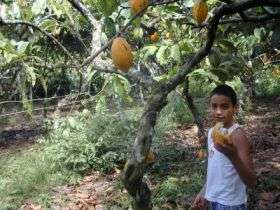
A six-year study of Amazonian small farmers and their responses to climate change shows the farmers are vulnerable to natural catastrophes and risky land use practices, say Indiana University Bloomington anthropologists Eduardo Brondizio and Emilio Moran.
The researchers report in Philosophical Transactions of the Royal Society B (now accessible online) that an increase in climate anomalies like El Nino could ultimately drive many small farmers to ruin, forcing them into Brazilian cities that may be ill-equipped to employ, house and feed them.
The researchers found a rapid decay in farmers' memories even of major climate events. For example, more than 50 percent of the farmers surveyed in 2002 did not recall the El Nino-caused drought of 1997 and 1998 -- the worst drought in recent recorded history.
"Because there's so much variability -- even within a three-year period -- most farmers do not seem to maintain a memory of major weather events unless they had some unusual and specific relevance to their lives," said Brondizio, the paper's corresponding author. "Small farmers' collective memory about past climate events is also impacted by the high rate of turnover as new farmers arrive and others leave for cities or new frontiers. It takes time for farmers to learn about a new environment. High rates of family turnover in rural areas further limit the sharing of knowledge and experiences and forms of collective action, such as preventing the spread of accidental fires, to cope with challenging times."
Increasing vulnerability to fire during extended droughts not only impacts the economy, but the forest environment, too.
"Once dry vegetation is affected by fire, the vegetation that comes back is also more fire susceptible, a process well documented in the Amazonian literature," Brondizio said. "Yet the use of fire for land management continues to be widespread in the absence of agricultural support for small farmers."
Minor climate variation would seem to favor the small farmer, as unlike large-scale farmers, most small farmers plant a wide variety of crops. Variation in rainfall one year might cause low yields of some crops, but may leave the others unaffected. Large-scale farmers are also vulnerable but in different ways. As they tend to plant capital intensive large-scale monocultures, climate change for a given growing season could be innocuous -- or it could be catastrophic.
But small farmers are also limited in what they can do. Not only are Amazonian small farmers less likely than corporate farmers to have access to current weather data and information about a coming drought, they also have less access to equipment that might protect crops from fire during times of unusual dryness or from flood during times of above-normal rainfall.
"Farmers are aware of the climate change discussion," Brondizio said. "But because climate data and forecasts are presented at a regional scale not applicable at the farm level, farmers prefer not to take the risk of changing land use practices."
Emilio Moran added, "They tend to do what they have always done -- but that is a recipe for trouble under conditions of climate change, wherein extreme events will become more common. While some individuals adjust their practices relatively fast, it usually takes a generation to observe changes at the population level."
To avoid the negative human and economic consequences of an even larger exodus of small farmers to the cities, Brondizio says regional and national governments must make an effort to help small farmers cope by producing and disseminating knowledge that is useful to them. He also says small farmers require better provision and access to services commonly available to large-scale farmers. Moran says the number of data-gathering weather stations must be increased.
"What is needed is to maintain roads and to provide appropriate technical assistance, health care, and other services to encourage these farmers to stay in the region," Brondizio said. "As far as climate change is concerned, the lack of extension services is a problem. Small farmers will need people to translate climate information into information they can use to make decisions. We also know there is a need to generate more data about what's going on locally which may help local farmers predict something like drought or their risk of fire."
Source: Indiana University


