Smart brake light system would provide more information to drivers
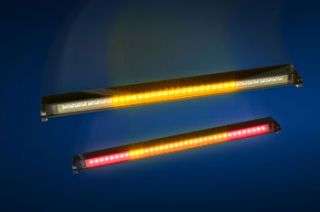
You are driving in heavy traffic. The brake lights on the car in front of you come on. Is the car slowing or is it going to stop? It slows to 25 mph and the lights go off. You drop back. The car in front of you stops suddenly! You stop just in time. The car behind you collects your rear bumper.
“The problem is that brake lights are yes and no – on and off,” according to John Hennage of Montross, Va., a Ph.D. mechanical engineering student in Virginia Tech’s College of Engineering. “The driver behind does not know the speed at which the car in front is slowing or stopping. The only other signal would be the smoke off the tires.”
The solution is an intelligent brake light system that communicates slowing and urgent stopping – rather than simply that the brake pedal is being touched. “A driver could be tapping his foot in time to music and the brake lights would blink. Or, a driver can rest her foot on the pedal and the lights would glow. It’s not enough information for the following driver,” said Hennage.
With the support of Manassas, Va., businessman Meade Gwinn, Hennage and Virginia Tech Mechanical Engineering Professor Mehdi Ahmadian have invented an intelligent brake light system, which they will show off at the Mid-America Trucking Show at the Kentucky Fair and Exposition Center in Louisville on March 27-29, 2008.
Gwinn came up with the idea for communicating braking speed after being rear ended on Rt. 66 in Northern Virginia. “It was part of a chain reaction accident,” he said. Afterward, he walked down the line of cars to make sure others were okay. “Two cars back was a young woman with a child in the car. They were okay but she kept saying, ‘I couldn’t tell how fast he was stopping.’ I thought, wouldn’t it be a good idea if rear tail lights communicated better and the following driver knew how fast you were stopping so they could take appropriate action?”
Years later, his youngest daughter, a student at Virginia Tech, suggested Gwinn try and get in touch with one of the engineering departments at the university. In 2000, Gwinn wrote to the university president, which led to a meeting with Walter O’Brien, professor and then head of the mechanical engineering department. “He was very helpful and encouraging, saying that this concept had the potential of great application at a very low cost,” Gwinn said. “He subsequently introduced me to Dr. Mehdi Ahmadian, who was able to develop this project into a teaching/research curriculum over the next several years.”
Ahmadian contacted Hennage to help the group of students who were assigned the problem. “I know electricity and had experience programming microcontrollers,” said Hennage, who had previously developed LED lights for commercial trucks, which Ahmadian knew.
The students developed a horizontal light bar. Lights in the middle glow amber for slowing. When stopping speed crosses a threshold to urgent, red lights flash on either side of the amber lights. If deceleration is rapid, all of the lights flash red.
“The draw backs are that the light bar would be an additional brake light because the law forbids altering original equipment,” said John Talerico, a licensing associate with Virginia Tech Intellectual Properties Inc. (VTIP). But the biggest obstacle is that the light bars cost $50 each to produce.”
So in fall of 2007, Ahmadian and Talerico approached Hennage about developing a cheaper unit that does the same thing by tapping into existing lights. “It would be for commercial trucks rather than private cars because commercial vehicles typically have redundant lights,” Hennage said. “Private cars are 10 to 15 years behind commercial vehicles in terms of LED lighting.”
Hennage developed a gravity or deceleration sensor control. Under normal braking – to slow or to stop slowly – the tail lights work in the normal fashion. But under heavy braking, extra lights flash.
“We also have the ability to connect other sensors to the microcontroller, such as from the automatic braking system, the automatic traction control, and the collision avoidance system,” said Hennage. “If any of these systems are activated, lights could flash to alert drivers of nearby vehicles.”
“There are various ways for this invention to work and we have a working prototype,” said Talerico. “A manufacturer can take the specifications and produce this circuit in mass quantities.”
Gwinn said, “Not only is this concept approaching potential commercialization, which will be most gratifying; but the educational benefit derived by numerous mechanical engineering students over the years is very heartwarming to me as well. I have met so many talented and enthusiastic students to have made significant contributions to the concept.
“The real reward to all of us, however, is to know that if this venture works out, millions of drivers will find the roads a much safer place to drive,” Gwinn said. “In the end, we are all winners!”
Source: Virginia Tech, By Susan Trulove


