Additional evidence of wolverine found in the Tahoe National Forest
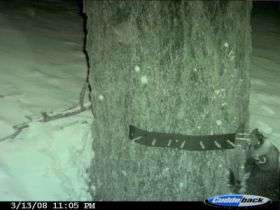
During ongoing investigations by an Oregon State University graduate student, the Forest Service, and California Department of Fish and Game (DFG), two additional wolverine photographs were captured this past week. A variety of hair, track and scat samples were also sent for analysis to determine if these were from a wolverine. After the initial photograph of a wolverine was taken by a remote camera on Feb. 28, 2008, in the Tahoe National Forest, researchers, biologists and volunteers intensified the search for more detections in the same general area, north of Truckee, Calif.
Dogs trained to identify wolverine scat were used to search the area. A large grid (approximately 150 square miles) with remote cameras and hair snares was established and monitored. Ground searches were made looking for wolverine tracks. Flights were conducted to detect possible radio telemetry signals from wolverines previously fitted with radio transmitters in studies in Montana.
These combined efforts yielded a search of 155 miles. Approximately 50 scat and hair samples were found and sent to the Forest Service Rocky Mountain Research Station’s Genetic Laboratory for analysis. Genetic information from the analysis will determine if the sample was from a wolverine and if positive, possibly the animal’s place of origin as well as its sex.
“It has been a wonderful experience working with such an enthusiastic and dedicated crew from many different agencies,” stated Katie Moriarty, Oregon State University graduate student who coordinated the investigations and took the first photo of the wolverine. “Work has been extremely demanding and without the assistance of these volunteers, it would have been nearly impossible to obtain new evidence. Finding the tracks, photographs, and scat has been tremendously gratifying.”
An interagency wolverine team was initiated to include Forest Service and DFG in consultation with wolverine experts from Idaho, Montana, and Washington. Through regular conference calls and meetings, this group is working to develop a coordinated strategy in search of additional wolverine evidence in the short term. Funding will be provided for this monitoring and data gathering by the Forest Service and DFG. Long term, DFG plans to launch a wolverine survey effort in conjunction with a Sierra Nevada red fox survey.
“These confirmations of wolverine in the Tahoe region have prompted us to dust off previous survey plans for the entire Sierra Nevada that were not implemented because of the uncertainty in detecting the species,” said Eric Loft, chief of DFG's Wildlife Branch. “The news has already generated numerous, previously unreported, sightings of wolverine from the public that should be followed up and may help guide planning for additional surveys.”
Wolverine experts are urging restraint regarding speculation as to where this individual originated and what it may mean to the local area. There are a number of possibilities as to where the animal came from. It may be a native California wolverine; an arrival from a population further north or there is a possibility that it may have been an escaped or released captive animal.
“Forest Service scientists at the Pacific Southwest Research Station are very excited about these confirmed detections of a wolverine in the Sierra Nevada Mountains,” said Beth Pendleton, acting director of the station and its eight labs in California and Hawaii. “Station scientists will continue to work with the Tahoe National Forest and California Department of Fish and Game to gather and share information on this rare carnivore.”
Pacific Southwest Research Station scientists helped to develop many of the detection methods biologists are now using to collect more wolverine evidence on the national forest. They also managed the marten study that inadvertently led to a Feb. 28 photograph of a wolverine, which provided the first scientific confirmation of the animal in California since the 1920s.
A link to a Pacific Southwest Research publication showing types of detection methods biologists use to detect carnivores can be found at: http://www.fs.fed.us/psw/publications/documents/gtr-157/
“It is too early to say how this will affect the National Forest,” said Tom Quinn, Tahoe National Forest Supervisor. “We are working with the researchers and wolverine experts to learn as much as we can. We all have received many e-mails and calls in the last two weeks from the public with photos or possible wolverine sightings. Unfortunately, the photos have been other species and not wolverines, but we appreciate public assistance in trying to learn more about this species.”
Wolverine background information: The North American wolverine is a large member of the weasel family. Adult males weigh 26 to 40 pounds, while females are 17 to 26 pounds. It resembles a small bear, with a bushy tail and broad head. Its diet includes carrion, small animals, birds, insects and berries.
U.S. populations are found largely in the Northern Cascades in Washington, the Northern Rockies in Montana and Idaho, and in Alaska. Wolverines have large home ranges that vary greatly depending upon gender, age and food availability. In order to avoid interference with ongoing studies, Forest Service officials are not releasing the exact location where the wolverine was photographed.
The Forest Service regional forester for California has listed the wolverine as a sensitive species, and the 2004 Sierra Nevada Forest Plan Amendment directs the Forest Service to conduct an analysis to determine if activities within five miles of where a wolverine was detected will affect the species.
Source: US Forest Service


