Faster koa tree growth without adverse ecosystem effects
March 27, 2008 Faster koa tree growth without adverse ecosystem effects

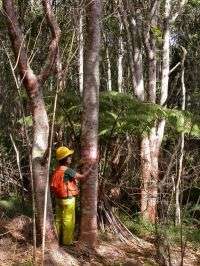
Janis Haraguchi, an Institute of Pacific Islands Forestry biologist, measures the diameter of an Acacia koa tree. Haraguchi and other US Forest Service scientists found the stem diameter of koa trees with timber potential doubled through a combination of treatments that included thinning, herbicides and fertilizers. Credit: U.S. Forest Service

U.S. Forest Service scientists with the Institute of Pacific Islands Forestry have completed a study on ways to make high-value koa trees grow faster, while increasing biodiversity, carbon sequestration, scenic beauty and recreation opportunities in native Hawaiían forests.

Acacia koa is a native Hawaiían hardwood tree that traditionally has been prized as a craft and furniture-making wood. Its range has been greatly reduced because of logging and land clearing for agricultural production.

Scientists involved in the study have published their findings in the April edition of Forest Ecology and Management, a scientific journal covering forest ecosystems worldwide. The article is entitled, “Understory Structure in a 23-Year-Old Acacia Koa Forest and Two-Year Growth Responses to Silvicultural Treatments.”

Previous studies have shown that a lack of knowledge about koa tree production has hampered commercial forestry investment efforts in Hawaií.

Scientists in this study began to fill this knowledge gap in 2002 when they started measuring how koa trees respond to the thinning of competing trees and the application of fertilizers. They were also concerned about how the trees and understory plants responded to chemical control of non-native grasses because about 20 percent of endangered plants in Hawaií are understory species found in koa forests.

They found the potential koa crop trees in the test area on the eastern slope of Mauna Loa annually increased their stem diameter at chest height by nearly 120 percent.

In addition, they found the treatments did not adversely affect the growth of native understory plants and non-native grasses did not grow more where tree thinning had occurred. Scientists even found fertilizers reduced the growth of these alien grasses when compared to unfertilized test plots.

The study’s findings also showed the treatments were either neutral or beneficial to forest bird habitat, an important consideration because many trees in koa forests bear fleshy fruits or provide habitat for insects eaten by many Hawaiían birds.

“Our findings indicate the use of low-impact silvicultural treatments in young koa stands not only increases wood production, but also is compatible with maintenance of healthy, intact native understory vegetation,” said Paul.

Source: US Forest Service


print this article email this article download pdf blog this article bookmark this article     Stumble it Digg this share on Facebook retweet share on Reddit add to delicious
Rate this story - 5 /5 (2 votes)


March 27, 2008 all stories

Comments: 0

5 /5 (2 votes)
  • Stumble this up

  • Digg this

  • share this

  • hide
  • Related Stories

  • Report: Nearly all native birds in Hawaii in peril
    created Mar 20, 2009 | popularity not rated yet | comments 0
  • Campers see hassle, expense in digital TV switch
    created Jun 13, 2009 | popularity not rated yet | comments 0


Other News

Asian carp may have breached barrier protecting Lake Michigan

Biology / Ecology

created 2 hours ago | popularity 5 / 5 (2) | comments 0

Two feared species of Asian carp have zoomed beyond the $9 million electric barriers built to keep them out of Lake Michigan. Now, the only thing left between the carp and the Great Lakes is a lock and dam in southern Chicago.


Got a pain? -- Have a cup of Brazilian mint

Biology / Plants & Animals

created 4 hours ago | popularity 4.6 / 5 (5) | comments 0

For thousands of years it has been prescribed by traditional healers in Brazil to treat a range of ailments from headaches and stomach pain to fever and flu.


Opposites attract: Monkeys choose mating partners with different genes

Biology / Evolution

created 4 hours ago | popularity 5 / 5 (1) | comments 0

The world's largest species of monkey 'chooses' mates with genes that are different from their own to guarantee healthy and strong offspring, according to a new research study.


When is a stem cell really a stem cell?

When is a stem cell really a stem cell?

Biology / Biotechnology

created 5 hours ago | popularity 4.7 / 5 (3) | comments 0

(PhysOrg.com) -- Induced pluripotent stem (iPS) cells -- adult cells reprogrammed to look and function like versatile embryonic stem cells -- are of growing interest in medicine. They may provide a way to ...


Ice Cold: Cooler Than Being Cool

Ice Cold: Cooler Than Being Cool

Biology / Cell & Microbiology

created 6 hours ago | popularity 4.1 / 5 (7) | comments 0

(PhysOrg.com) -- Water expands when it freezes. Anyone who has ever left a can of soda or bottle of water in the freezer too long has witnessed this first hand. So how do plants and animals survive severe ...