Armed beetles find a mate, whatever their size
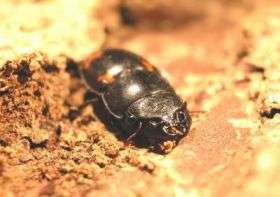
March 27, 2008 L. japonicus

Librodor japonicus. Credit: Kensuke Okada

One species of armed beetle is proving that size doesn’t necessarily matter when it comes to finding a mate. The creature’s ‘pulling techniques’ will be revealed in the April edition of the Royal Entomological Society’s Ecological Entomology journal.

In the world of armed beetles, biggest is usually best, as males often fight for mating rights and those with the largest jaws beat off the competition. However, this is not always the case with one particular species.

Researchers at Okayama University in Japan have been monitoring the mating habits of large, medium and small Librodor japonicus males, and found that this particular species adopts a different tactic to finding a mate depending on the size of certain body parts.

The largest male beetles wait for females at the feeding areas and fight for the right to mate – the males with the biggest jaws stand the best chance of winning. The medium sized beetles which are too small to beat the bigger males have developed relatively bigger wings than their larger counterparts, and they use these to search for the feeding sites which are unoccupied by large males.

The smallest male beetles have adopted a completely different tactic – they stay at the feeding sites with the big males, and attempt ‘sneaky matings’ with females behind the bigger male’s backs. What’s more, these males have relatively larger testes and produce sperm that is more competitive than the bigger males.

The L. japonicus beetles have ensured that, through their size-determined mating tactics, they all have a chance of finding a mate, and sometimes with no fighting involved.

Researcher Takahisa Miyatake said, "Although other studies of armed beetles have observed 2 different sizes of males, we have shown that males can adopt up to three different behavioural tactics to improve their mating success."

Source: Wiley


print this article email this article download pdf blog this article bookmark this article     Stumble it Digg this share on Facebook retweet share on Reddit add to delicious
Rate this story - 5 /5 (2 votes)

Rank Filter

Move the slider to adjust rank threshold, so that you can hide some of the comments.


Display comments: newest first

  • HeRoze - Mar 27, 2008
    • Rank: not rated yet
    omg-lmao. whew.
    I know this is serious, but man... i'm cryin here.

March 27, 2008 all stories

Comments: 1

5 /5 (2 votes)
  • Stumble this up

  • Digg this

  • share this

  • hide
  • Related Stories

  • Good males are bad fathers
    created Jun 25, 2009 | popularity not rated yet | comments 0
  • Lustful beetles desire water, not sex
    created Mar 05, 2009 | popularity not rated yet | comments 0
  • Mating that causes injuries
    created Feb 20, 2009 | popularity not rated yet | comments 0
  • Spider love: Little guys get lots more
    created Dec 08, 2008 | popularity not rated yet | comments 0
  • How 'secondary' sex characters can drive the origin of species
    created Aug 25, 2008 | popularity not rated yet | comments 0


Other News

Variable Temperatures Leave Insects wtih a Frosty Reception

Biology / Plants & Animals

created 9 hours ago | popularity not rated yet | comments 0

(PhysOrg.com) -- For the first time, scientists at The University of Western Ontario have shown that insects exposed to repeated periods of cold will trade reproduction for immediate survival.


When camouflage is a plant's best protection

Rare woodland plant uses 'cryptic coloration' to hide from predators

Biology / Plants & Animals

created 11 hours ago | popularity 4.3 / 5 (3) | comments 0

It is well known that some animal species use camouflage to hide from predators. Individuals that are able to blend in to their surroundings and avoid being eaten are able to survive longer, reproduce, and ...


Cells defend themselves from viruses, bacteria with armor of protein errors

Biology / Cell & Microbiology

created 13 hours ago | popularity 5 / 5 (7) | comments 0

When cells are confronted with an invading virus or bacteria or exposed to an irritating chemical, they protect themselves by going off their DNA recipe and inserting the wrong amino acid into new proteins to defend them ...


'Safety valve' protects photosynthesis from too much light

Biology / Cell & Microbiology

created 13 hours ago | popularity 4.7 / 5 (3) | comments 0

Photosynthetic organisms need to cope with a wide range of light intensities, which can change over timescales of seconds to minutes. Too much light can damage the photosynthetic machinery and cause cell death. Scientists ...


Researchers discover biological basis of 'bacterial immune system'

Biology / Cell & Microbiology

created 13 hours ago | popularity 4.7 / 5 (3) | comments 0

Bacteria don't have easy lives. In addition to mammalian immune systems that besiege the bugs, they have natural enemies called bacteriophages, viruses that kill half the bacteria on Earth every two days.