Probing Question: How were the Egyptian pyramids built?
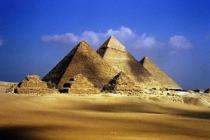
March 27, 2008 Pyramids at Giza

Pyramids at Giza. Photo: Diana Chaytor

The Aztecs, Mayans and ancient Egyptians were three very different civilizations with one very large similarity: pyramids. However, of these three ancient cultures, the Egyptians set the standard for what most people recognize as classic pyramid design: massive monuments with a square base and four smooth-sided triangular sides, rising to a point. The Aztecs and Mayans built their pyramids with tiered steps and a flat top.

The ancient Egyptians probably chose that distinctive form for their pharaohs' tombs because of their solar religion, explained Donald Redford, professor of Classics and ancient Mediterranean studies at Penn State. The Egyptian sun god Ra, considered the father of all pharaohs, was said to have created himself from a pyramid-shaped mound of earth before creating all other gods. The pyramid's shape is thought to have symbolized the sun's rays.

According to Redford, "The Egyptians began using the pyramid form shortly after 2700 B.C., and the great heyday of constructing them for royalty extended for about a thousand years, until about 1700 B.C." The first pyramid was built by King Djoser during Egypt's Third Dynasty. His architect, Imohtep, created a step pyramid by stacking six mastabas, rectangular buildings of the sort in which earlier kings had been buried. The largest and most well-known pyramids in Egypt are the Pyramids at Giza, including the Great Pyramid of Giza designed for Pharaoh Khufu.

For centuries, people have theorized how the great pyramids were built. Some have suggested that they must have been constructed by extraterrestrials, while others believe the Egyptians possessed a technology that has been lost through the ages.

But the process of building pyramids, while complicated, was not as colossal an undertaking as many of us believe, Redford says. Estimates suggest that between 20,000 and 30,000 laborers were needed to build the Great Pyramid at Giza in less than 23 years. By comparison, Notre Dame Cathedral in Paris took almost 200 years to complete.

According to Redford, pharaohs traditionally began building their pyramids as soon as they took the throne. The pharaoh would first establish a committee composed of an overseer of construction, a chief engineer and an architect. The pyramids were usually placed on the western side of the Nile because the pharaoh's soul was meant to join with the sun disc during its descent before continuing with the sun in its eternal round. Added Redford, the two deciding factors when choosing a building site were its orientation to the western horizon where the sun set and the proximity to Memphis, the central city of ancient Egypt.

The cores of the pyramids were often composed of local limestone, said Redford. Finer quality limestone composed the outer layer of the pyramids, giving them a white sheen that could be seen from miles away. The capstone was usually made of granite, basalt, or another very hard stone and could be plated with gold, silver or electrum, an alloy of gold and silver, and would also be highly reflective in the bright sun.

Said Redford, the image most people have of slaves being forced to build the pyramids against their will is incorrect. "The concept of slavery is a very complicated problem in ancient Egypt," he noted, "because the legal aspects of indentured servitude and slavery were very complicated." The peasants who worked on the pyramids were given tax breaks and were taken to 'pyramid cities' where they were given shelter, food and clothing, he noted.

According to Redford, ancient Egyptian quarrying methods -- the processes for cutting and removing stone -- are still being studied. Scholars have found evidence that copper chisels were using for quarrying sandstone and limestone, for example, but harder stones such as granite and diorite would have required stronger materials, said Redford. Dolerite, a hard, black igneous rock, was used in the quarries of Aswan to remove granite.

During excavation, massive dolerite "pounders" were used to pulverize the stone around the edge of the granite block that needed to be extracted. According to Redford, 60 to 70 men would pound out the stone. At the bottom, they rammed wooden pegs into slots they had cut, and filled the slots with water. The pegs would expand, splitting the stone, and the block was then slid down onto a waiting boat.

Teams of oxen or manpower were used to drag the stones on a prepared slipway that was lubricated with oil. Said Redford, a scene from a 19th century B.C. tomb in Middle Egypt depicts "an alabaster statue 20 feet high pulled by 173 men on four ropes with a man lubricating the slipway as the pulling went on."

Once the stones were at the construction site, ramps were built to get them into place on the pyramid, said Redford. These ramps were made of mud brick and coated with chips of plaster to harden the surface. "If they consistently raised the ramp course by course as the teams dragged their blocks up, they could have gotten them into place fairly easily," he noted. At least one such ramp still exists, he said.

When answering to skepticism about how such heavy stones could have been moved without machinery, Redford says, "I usually show the skeptic a picture of 20 of my workers at an archaeological dig site pulling up a two-and-a-half ton granite block." He added, "I know it's possible because I was on the ropes too."

Source: By Marissa McCauley, Research/Penn State


print this article email this article download pdf blog this article bookmark this article     Stumble it Digg this share on Facebook retweet share on Reddit add to delicious
Rate this story - 3.8 /5 (75 votes)

Rank Filter

Move the slider to adjust rank threshold, so that you can hide some of the comments.


Display comments: newest first

  • visual - Mar 28, 2008
    • Rank: not rated yet
    Said Yoda, the order of words in this sentence is really weird!
  • neilwilkes - Mar 31, 2008
    • Rank: not rated yet
    What on earth is this man thinking of?
    30,000 people in 23 years?
    Unlikely in the extreme.
    We are talking about 2,500,000 blocks of stone in this building weighing an average of 6 tons.
    Just do the maths.
    Also, with the famous "ramps" theory, the ramps themselves would have been even more massive than the pyramid itself. A n incline of no more than 1 in 8 would be needed, more likely 1 in 10 because of the massive stones in the vaulted ceiling of the so-called "Queens Chamber", plus the stones in the so-called "Kings Chamber" are much heavier than the average. So where are the remains of these ramps? What was used (and who) to make them?

    The fact is that we know they built it, we just do not know how. They obviously had a method for moving large blocks of stone that made it easy, not hard. But heave-ho up (non-existent) massive ramps?
    Has this author ever actually visited the site?
  • SMMAssociates - Apr 04, 2008
    • Rank: not rated yet
    Given the assumption that the pyramids were built up first, and then covered with casing stones while moving downward, why not an essentially circular ramp using parts of the yet-unfinished portion of the pyramid? As you go back down, you fill in the steps with the remains of the ramp, and then place the casing stones.

    Lots of work involved in building the ramps this way, and making a turn (if it's not circular) could be interesting, but it might solve the "mile long ramp" problem.

    Just ruminating....
  • pyramidguy - May 27, 2008
    • Rank: not rated yet
    The Egyptians did not use mud ramps to move the stones to placement level. They used movable wooden ramps. I provide complete details in my web page. Look it up in the first page of a Google search on "Egyptian pyramid construction." fsteiger@fsteiger.com
  • Giza - Aug 02, 2008
    • Rank: 5 / 5 (1)
    In 2006 I was doing research for a university study in Australia concerning the construction of the Pyramids at Giza. Working with real excavated artefacts and ancient documents I was able to discover an ancient type of pulley that is unknown in the modern world until now. I am a mechanical fitter and people consider that my knowledge of mechanics at a practical level assisted me with this discovery.

    This ancient pulley walks up (or down) steps in a similar way to a three wheel step-trolley and I firmly believe that this is how the ancient Egyptians built their Pyramids. The Giza Pyramids have steps of course, which I have termed "racks" and of course there are four "racks" in a square based Pyramid. The wooden ancient Egyptian Pinion-Pulleys made positive engagements with the Pyramid's stone "racks" carrying a stone block each, rotating as they were being hoisted with ropes. No ramps were required as the Pyramid itself was used.

    This ancient pulley has a mechanical advantage of 2.8, thus is a simple machine and proves the Greek historian, Herodotus to be absolutely correct as he recorded wooden machines made of short wooden planks were used to raise the blocks of stone.

    These planks only needed to be the side length of a Pyramid block which is about one metre and were easily carried also, as Herodotus also records. Well, Herodotus was only writing what Egyptian Priests told him and Egyptian Priests recorded history as part of their duties.

    A working model has been made and a book about all of this has been published and I wish the World's people to know of this. This book is dedicated to the Egyptian people to promote "new awareness of their intelligent and innovative glorious historical past".

    RAISING STONE 1 - Paul Hai's racks & pinions theory. (121 pages)
    ISBN 9780646476797
    Please visit my website at www.haitheory.com

    Best Regards to you all,
    Paul Hai

March 27, 2008 all stories

Comments: 5

3.8 /5 (75 votes)
  • Stumble this up

  • Digg this

  • share this

  • hide
  • Related Stories

  • Large-scale cousin of elusive 'magnetic monopoles' found
    created Oct 06, 2009 | popularity not rated yet | comments 0
  • People with type 2 diabetes not meeting important nutritional recommendations
    created Sep 03, 2009 | popularity not rated yet | comments 0
  • Egypt to open inner chambers of 'bent' pyramid
    created Mar 16, 2009 | popularity not rated yet | comments 0
  • Scientists: Earthquakes, El Ninos fatal to earliest civilization in Americas
    created Jan 19, 2009 | popularity not rated yet | comments 0
  • This week's Web Winners: Investment help
    created Jan 13, 2009 | popularity not rated yet | comments 0


  • hide
  • Relevant PhysicsForums posts

Other News

Growth in secular attitudes leaves Americans room for belief in God

Other Sciences / Social Sciences

created Oct 31, 2009 | popularity 4 / 5 (5) | comments 115

(PhysOrg.com) -- The nature of the American religious experience is changing as a rising number of people report having no formal religious affiliation, even though the number of Americans who say they pray is increasing, ...


Forest clearances sealed ancient civilisation's downfall

Forest clearances sealed ancient civilisation's downfall

Other Sciences / Archaeology & Fossils

created Nov 02, 2009 | popularity 4.9 / 5 (8) | comments 5

(PhysOrg.com) -- An ancient South American civilisation which disappeared around 1,500 years ago helped to cause its own demise by damaging the fragile ecosystem that held it in place, a study has found. ...


Oscar Pistorius

New study further disputes notion that amputee runners gain advantage from protheses

Other Sciences / Other

created Nov 04, 2009 | popularity 5 / 5 (4) | comments 5

A study by six researchers, including a University of Colorado at Boulder associate professor and his former doctoral student, shows that amputees who use running-specific prosthetic legs have no performance ...


New theory on fairness in economics targets CEO pay

Other Sciences / Economics

created Nov 03, 2009 | popularity 4.3 / 5 (11) | comments 2

(PhysOrg.com) -- Chief executives in 35 of the top Fortune 500 companies were overpaid by about 129 times their "ideal salaries" in 2008, according to a new type of theoretical analysis proposed by a Purdue University researcher ...


Racial segregation key factor in subprime lending

Other Sciences / Economics

created Nov 06, 2009 | popularity 3 / 5 (2) | comments 2

(PhysOrg.com) -- New study examines impact of segregation on the prevalence of high-cost loans in U.S. metro areas. Subprime loans disproportionately located in segregated areas.