MIT tests unique approach to fusion power
March 28th, 2008 MIT tests unique approach to fusion power

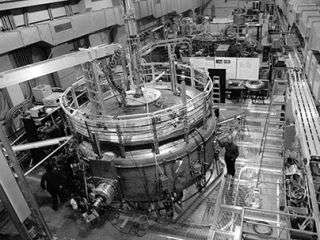
Senior research scientist Jay Kesner stands by the now-operational LDX fusion reactor, in which a series of experiments are being run. Photo by Donna Coveney.

An MIT and Columbia University team has successfully tested a novel reactor that could chart a new path toward nuclear fusion, which could become a safe, reliable and nearly limitless source of energy.

Begun in 1998, the Levitated Dipole Experiment, or LDX, uses a unique configuration where its main magnet is suspended, or levitated, by another magnet above. The system began testing in 2004 in a "supported mode" of operation, where the magnet was held in place by a support structure, which causes significant losses to the plasma--a hot, electrically charged gas where the fusion takes place.

LDX achieved fully levitated operation for the first time last November. A second test run was performed on March 21-22 of this year, in which it had an improved measurement capability and included experiments that clarified and illuminated the earlier results. These experiments demonstrate a substantial improvement in plasma confinement--significant progress toward the goal of producing a fusion reaction-- and a journal article on the results is planned.

Fusion--the process that provides the sun's energy--occurs when two types of atoms fuse, creating a different element (typically helium) and releasing energy. The reactions can only occur at extremely high temperatures and pressures. Because the material is too hot to be contained by any material, fusion reactors work by holding the electrically charged gas, called plasma, in place with strong magnetic fields that keep it from ever touching the walls of the device.

The LDX reactor reproduces the conditions necessary for fusion by imitating the kind of magnetic field that surrounds Earth and Jupiter. A joint project by MIT and Columbia University, it consists of a supercooled, superconducting magnet about the size and shape of a large truck tire. When the reactor is in operation, this half-ton magnet is levitated inside a huge vacuum chamber, using another powerful magnet above the chamber to hold it aloft.

The advantage of the levitating system is that it requires no internal supporting structure, which would interfere with the magnetic field lines surrounding the donut-shaped magnet, explains Jay Kesner of MIT's Plasma Science and Fusion Center, joint director of LDX with Michael Mauel of Columbia. That allows the plasma inside the reactor to flow along those magnetic field lines without bumping into any obstacles that would disrupt it (and the fusion process).

To produce a sustained fusion reaction the right kinds of materials must be confined under enormous, pressure, temperature and density. The "fuel" is typically a mix of deuterium and tritium (known as a D-T cycle), which are two isotopes of hydrogen, the simplest atom. A normal hydrogen atom contains just one proton and one electron, but deuterium adds one neutron, and tritium has two neutrons. So far, numerous experimental reactors using different methods have managed to produce some fusion reactions, but none has yet achieved the elusive goal of "breakeven," in which a reactor produces as much energy as it consumes. To be a practical power source, of course, will require it to put out more than it consumes.

If that can be achieved, many people think it could provide an abundant source of energy with no carbon emissions. The deuterium fuel can be obtained from seawater and there is a virtually limitless supply.

Most fusion experiments have been conducted inside donut-shaped (toroidal) chambers surrounded by magnets, a design that originated in the Soviet Union and is called by the Russian name Tokamak. MIT also operates the most powerful Tokamak reactor in the United States, the Alcator C-mod, which is located in the same building as the new LDX reactor. Tokamaks require a large number of magnets around the wall of the torus, and all of them must be working properly to keep the plasma confined and make fusion possible.

The new approach to fusion being tested in the LDX is the first to use the simplest kind of magnet, a dipole--one that has just two magnetic poles, known as north and south, just like the magnetic fields of Earth and Jupiter. Tokamaks and other fusion reactor designs use much more complex, multi-poled magnetic fields to confine the hot plasma.

Unlike the Tokamak design, in which the magnetic field must be narrowed to squeeze the hot plasma to greater density, in a dipole field the plasma naturally gets condensed, Kesner explains. Vibrations actually increase the density, whereas in a Tokamak any turbulence tends to spread out the hot plasma.

The renowned physicist Richard Feynman once compared confining a plasma inside the magnetic field in a Tokamak to "trying to hold Jell-O with rubber bands," says LDX chief experimentalist Darren Garnier of Columbia. "It's the difference between pulling and pushing." Whereas the Tokamak's magnetic field tries to push the plasma in from the outside, "we have the field lines on the inside, pulling on the plasma," which is inherently more stable, he says.

Another potential advantage of the LDX approach is that it could use a more advanced fuel cycle, known as D-D, with only deuterium. Although it's easier to get a self-sustaining reaction with D-T, tritium doesn't exist naturally and must be manufactured, and the reaction produces energetic neutrons that damage the structure. The D-D approach would avoid these problems.

The LDX magnet has coils made of superconducting niobium-tin alloy, which loses all electrical resistance when cooled below about 15 degrees Kelvin; in the device, it is cooled to 4 degrees Kelvin--4 degrees above absolute zero, or minus 269 degrees Celsius, a temperature that can only be achieved by surrounding the coils with liquid helium. This is the only superconducting magnet currently used in any U.S. fusion reactor.

When in full operation, the frigid magnet, contained in a double-walled vessel that is essentially a large thermos bottle, is surrounded by plasma heated to millions of degrees Celsius. Garnier says that in full operation, the system is quite literally a snowball in hell.

Besides providing data that might someday lead to a practical fusion reactor, the experimental device could provide important lessons about how planetary magnetic fields work, which is still poorly understood. So the experiment is of great interest to planetary physicists as well as to energy researchers.

Keeping the huge magnet levitated to just the right height requires a feedback system that constantly monitors its position, using eight laser beams, and then adjusts the power of the lifting magnet accordingly. "That was tricky to develop," Garnier says, and in early experiments "we did drop it a couple of times." Fortunately, they had designed the structure with a spring-mounted lifter under the magnet, used to lift it into its starting position, which could absorb the falling weight without damage.

Source: MIT


print this article email this article download pdf blog this article bookmark this article     Digg this Stumble it share on Facebook share on Reddit add to delicious save to Yahoo! bookmarks
4.6/5 after 140 votes

Rank Filter

Move the slider to adjust rank threshold, so that you can hide some of the comments.


Display comments: newest first

  • Enthalpy - Mar 28, 2008
    • Rank: 3 / 5 (4)
    Of course, the D-D reaction creates a neutron! Worse, it creates a neutron for 3MeV produced heat, instead of one neutron for 17MeV heat produced by the D-T, and three neutrons for 200MeV heat in fission reactions.

    That's why fusion reactors would be very dirty. They create much more radioactivity by activating surrounding materials than fission reactors do.

    And I'd have liked the paper to explain why this particular reactor should be more able (or less unable) than its competitors to use the D-D reaction.
  • Alexa - Mar 28, 2008
    • Rank: 1 / 5 (3)
    Instead of this, the cold fusion produces just the heat and alpha particles, which are absorbed readily.
  • zevkirsh - Mar 28, 2008
    • Rank: 3 / 5 (3)
    i saw the ldx presentation and met both the MIT and Columbia guys working on it. it's pretty wild stuff. but even the guys working on it agree that the tokamak is where the action is currently at.
  • Enthalpy - Mar 28, 2008
    • Rank: 3.5 / 5 (2)
    Where can I find information about this reactor attempt?
    www.technologyrev...le/14320
    doesn't tell much. I'd to see how the coil looks like, where the plasma is...
  • 1bigschwantz - Mar 28, 2008
    • Rank: 2.2 / 5 (5)
    Sounds like a pretty cool idea, but since there has been fusion research for 30-40 years, and as the old joke goes- fusion is ALWAYS 40 years in the future, Maybe we need to shift some of the giga bucks into hydrogen cell research since there seems to be allot of progress lately. If each house and car had its own fuel cell, there may not be a need for a fusion plant.
  • Enthalpy - Mar 28, 2008
    • Rank: 1 / 5 (3)
    OK, found information about the aspect of the toy.
    Instead of googling LDX, the method was to search
    "Levitated Dipole Experiment"

    However, no single indication why it should be less bad than a tokamak or stellarator, nor why it could better burn D-D than they would - or wouldn't.

    Its plasma is said to be more stable.

    Great deal, instead of all these flawed projects that monopolize the scientists, we would already have renewables.
  • earls - Mar 28, 2008
    • Rank: 3.7 / 5 (3)
    "However, no single indication why it should be less bad than a tokamak or stellarator, nor why it could better burn D-D than they would - or wouldn't."

    "Unlike the Tokamak design, in which the magnetic field must be narrowed to squeeze the hot plasma to greater density, in a dipole field the plasma naturally gets condensed, Kesner explains. Vibrations actually increase the density, whereas in a Tokamak any turbulence tends to spread out the hot plasma."

    Sorry, was the entire article in English except for this part Enthalpy?
  • zevkirsh - Mar 28, 2008
    • Rank: 3 / 5 (2)
    ok the article here is basically not explaining two basic deifference between ldx vs tokomac:
    1) geometery--the article hints at studying the earth's field...but basically a different geometry of magnetic field lines is created as a sphere in the dipole ring rather than the donut tokomac shape.
    2) plasma density...the dipole has much more plasma confined in a smaller volume due to its shape, which could be useful for studying heat transfer, ionization, induction and turbulence
    of burning plasmas.
  • vlam67 - Mar 28, 2008
    • Rank: 1 / 5 (1)
    When in full operation, the frigid magnet, contained in a double-walled vessel that is essentially a large thermos bottle, is surrounded by plasma heated to millions of degrees Celsius. Garnier says that in full operation, the system is quite literally a snowball in hell.


    Interesting concept, but as the magnet and the cooling system is isolated and levitated by another magnet, I do not see anyway that the liquid helium can be replenished as it warms up..which means the reactor must be stopped from time to time to top up the helium?
  • Soylent - Mar 29, 2008
    • Rank: 3.7 / 5 (3)
    "That's why fusion reactors would be very dirty. They create much more radioactivity by activating surrounding materials than fission reactors do. "

    Induced activity is an insignificant source of radioactive waste, especially when suitable materials are chosen in the reactor vessel.(e.g. a mantel of molten FLiBe in the vessel wall as neutron absorber/heat transfer medium and for tritium breeding).

    Even high level fission waste, a much more significant source of activity, isn't a significant problem at all given that you allow reprocessing and burn the actinides in a fast reactor. The rest of the isotopes all have short half-lifes and can easily be stored in dry casks until they pose no credible risk.
  • Soylent - Mar 29, 2008
    • Rank: 3.7 / 5 (3)
    "Great deal, instead of all these flawed projects that monopolize the scientists, we would already have renewables."

    Or we could have just built more clean, safe, cheap fission reactors already instead of wasting all that money on renewables with far higher land use and impact on the environment.
  • earls - Mar 29, 2008
    • Rank: 3 / 5 (2)
    "Its probably not obvious how one goes about collecting the energy, although in some of our technical papers we discuss the issue. We don't "know" that the device is capable of breaking even, but we have a design for a reactor that would based on our best estimates for how the machine operates with our current knowledge.

    Most fusion devices get energy out by taking the energy that is deposited in the walls by neutrons (heat) and using it in a standard steam driven plant. Our reactor concept is to use a low neutron reaction, and so we would not rely on this method (at least not primarily). Instead the machine would probably put out energy in two forms... one as energized charged particles which we could convert to energy using MHD. (If you remember the "Hunt for the Red October" they have a MHD engine... this is opposite.) A second method is to use the large amount of microwave power the system will generate due to the energetic electrons in bore of the high field dipole. These microwaves could then be converted to electrical power using rectennas. Which is the best method would really depend on further development of each and the concept itself."
  • borgheses - Mar 30, 2008
    • Rank: not rated yet
    how about a smaller reactor... inside a buckyball...
  • Ulf - Mar 30, 2008
    • Rank: not rated yet
    Recommended links:

    The Fast Track To Fusion Power by Chris Llewellyn Smith of the UK Atomic Energy Authority

    http://vmsstreame...f001.htm

    Strengthening and Accelerating the Development of Fusion Energy - Chris Llewellyn Smith, UKAEA, Culham, UK

    http://fire.pppl....mith.pdf

  • lengould100 - Dec 03, 2008
    • Rank: not rated yet
    Sounds like a pretty cool idea, but since there has been fusion research for 30-40 years, and as the old joke goes- fusion is ALWAYS 40 years in the future, Maybe we need to shift some of the giga bucks into hydrogen cell research since there seems to be allot of progress lately. If each house and car had its own fuel cell, there may not be a need for a fusion plant.


    Really. And where do you suppose the energy to generate the required hydrogen might come from? You can't get more energy out of hydrogen fuel than you put in to generate it. You can't just dig it up.

March 28th, 2008 all stories
Physics / General Physics

Comments: 15
Rank: 4.6/5 after 140 votes

  • Stumble this up

  • Digg this

  • Share it:
  • share on Facebook
  • share on MySpace
  • share on Slashdot
  • rss-newsfeed
  • share on Google
  • share on Reddit
  • add to delicious
  • save to Yahoo! bookmarks
  • share on Windows Live
  • Add to Mixx!
Rating: 4.6/5 after 140 votes

  • Related Stories

  • A supercharged metal-ion generator: Higher-quality coatings through 'runaway' self-sputtering
    created Jan 29, 2009 | popularity not rated yet | comments 0
  • The world's largest fusion experiment of the stellarator type taking shape
    created Mar 13, 2008 | popularity not rated yet | comments 0
  • Proton treatment could replace x-ray use in radiation therapy
    created Aug 28, 2006 | popularity not rated yet | comments 0
  • US ITER project completes management team
    created Aug 17, 2006 | popularity not rated yet | comments 0
  • Cluster hits the magnetic bull's-eye
    created Jul 18, 2006 | popularity not rated yet | comments 0

Tags


  • Physicists Demonstrate Quantum Memory with Matter Qubits
    Physicists Demonstrate Quantum Memory with Matter Qubits
    Physics / General Physics
    created 18 hours ago | popularity 4.5 / 5 (11) | comments 1
  • 'Holey' Nanosheets for Wastewater Dye Removal
    Nanotechnology / Nanomaterials
    created Jul 01, 2009 | popularity 5 / 5 (5) | comments 1
  • Jellyfish Robot Swims Like its Biological Counterpart
    Jellyfish Robot Swims Like its Biological Counterpart
    Electronics / Robotics
    created Jun 26, 2009 | popularity 4.4 / 5 (7) | comments 1
  • Could Maxwell's Demon Exist in Nanoscale Systems?
    Could Maxwell's Demon Exist in Nanoscale Systems?
    Physics / General Physics
    created Jun 24, 2009 | popularity 4.4 / 5 (18) | comments 29
  • Living Safely with Robots, Beyond Asimov's Laws
    Living Safely with Robots, Beyond Asimov's Laws
    Electronics / Robotics
    created Jun 22, 2009 | popularity 4.6 / 5 (50) | comments 39
  • Other News

    Physicists Demonstrate Quantum Memory with Matter Qubits

    Physicists Demonstrate Quantum Memory with Matter Qubits

    Physics / General Physics

    created 18 hours ago | popularity 4.5 / 5 (11) | comments 1

    (PhysOrg.com) -- For the first time, scientists have successfully operated a quantum gate between two remote particles of matter, marking an important step toward the development of a quantum computer. In ...


    Scientists create first electronic quantum processor

    Scientists create first electronic quantum processor

    Physics / General Physics

    created Jun 28, 2009 | popularity 4.8 / 5 (49) | comments 38

    A team led by Yale University researchers has created the first rudimentary solid-state quantum processor, taking another step toward the ultimate dream of building a quantum computer.


    Fermilab's CDF observes Omega-sub-b baryon

    Fermilab's CDF observes Omega-sub-b baryon

    Physics / General Physics

    created Jun 29, 2009 | popularity 4.6 / 5 (13) | comments 7

    (PhysOrg.com) -- At a recent physics seminar at the Department of Energy’s Fermi National Accelerator Laboratory, Fermilab physicist Pat Lukens of the CDF experiment announced the observation of a new particle, ...


    New insights, and a new angle, on high-temperature superconductivity

    New insights, and a new angle, on high-temperature superconductivity

    Physics / Superconductivity

    created Jun 29, 2009 | popularity 4.8 / 5 (12) | comments 6

    (PhysOrg.com) -- A Princeton-led research team has revealed surprising information about how electron behavior influences the conduction of electricity in a class of high-temperature superconductors. An increased ...


    The art of invisibility and the perfect cat's eye

    The art of invisibility and the perfect cat's eye

    Physics / Optics & Photonics

    created Jun 30, 2009 | popularity 3.9 / 5 (7) | comments 6

    (PhysOrg.com) -- In recent years scientists have explored the impossible by developing invisibility or 'cloaking' devices, but can the same technology also help make things more visible?