Old Solar Cycle Returns
March 28, 2008 Old Solar Cycle Returns

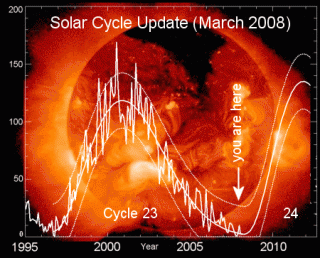
Sunspot counts vs. year: 2008 is a low point in the solar cycle. Smoothed curves are predictions of future activity.

Solar Cycle 23, how can we miss you if you won't go away? Barely three months after forecasters announced the beginning of new Solar Cycle 24, old Solar Cycle 23 has returned. Actually, it never left. Read on.

"This week, three big sunspots appeared and they are all old cycle spots," says NASA solar physicist David Hathaway. "We know this because of their magnetic polarity."

Earlier today, the Solar and Heliospheric Observatory (SOHO) made a magnetic map of the sun.

It shows the north and south magnetic poles of the three sunspots. All are oriented according to the patterns of Solar Cycle 23. Cycle 24 spots would be reversed.

What's going on? Hathaway explains: "We have two solar cycles in progress at the same time. Solar Cycle 24 has begun (the first new-cycle spot appeared in January 2008), but Solar Cycle 23 has not ended."

Strange as it sounds, this is perfectly normal. Around the time of solar minimum--i.e., now--old-cycle spots and new-cycle spots frequently intermingle. Eventually Cycle 23 will fade to zero, giving way in full to Solar Cycle 24, but not yet.

Meanwhile, on March 25th, sunspot 989, the smallest of the three sunspots, unleashed an M2-class solar flare. Flares are measured on a "Richter scale" ranging from A-class (puny) to X-class (powerful). M-class flares are of medium intensity. This one hurled a coronal mass ejection or "CME" into space, but the billion-ton cloud missed Earth.

While the CME was still plowing through the sun's atmosphere, amateur radio astronomer Thomas Ashcraft heard "a heaving sound" coming from the loudspeaker of his 21 MHz shortwave receiver in New Mexico: listen. It was a Type II solar radio burst generated by shock waves at the leading edge of the CME. A thousand miles away in Virginia, David Thomas recorded the same emissions on a chart recorder he connected to his 20 MHz ham rig. "What a pleasant surprise," says Thomas.

We could get more of this kind of activity in the next 7 to 10 days. It will take about that long for the sunspots to cross the face of the sun. The sun's rotation is turning the spots toward Earth, which means the next CME, if there is one, might not miss. CME strikes do no physical harm to Earth but they can cause Northern Lights, satellite glitches and, in extreme cases, power outages.

The real significance of these spots is what they say about the solar cycle, says Hathaway. "Solar Cycle 24 has begun, but we won't be through solar minimum until the number of Cycle 24 spots rises above the declining number of Cycle 23 spots." Based on this latest spate of "old" activity, he thinks the next Solar Max probably won't arrive until 2012.

Source: by Dr. Tony Phillips, Science@NASA


Rate this story - 4.5 /5 (43 votes)


March 28, 2008 all stories

Comments: 0

4.5 /5 (43 votes)

  • hide
  • Related Stories

  • As shuttle's career nears an end, NASA turns focus to satellites
    created Dec 26, 2009 | popularity not rated yet | comments 0
  • A bubbling ball of gas (w/ Video)
    created Nov 11, 2009 | popularity not rated yet | comments 0
  • Solar Mystery Solved
    created Aug 26, 2009 | popularity not rated yet | comments 0
  • Sunspots revealed in striking detail by supercomputers
    created Jun 18, 2009 | popularity not rated yet | comments 0
  • Our Sun: A Little Slow On the Uptake for Cycle 24
    created Apr 27, 2009 | popularity not rated yet | comments 0


  • hide
  • Relevant PhysicsForums posts

  • Spreading Life in the Universe
    created 17 hours ago
  • Force of Gravity in terms of Density
    created Feb 08, 2010
  • what is the relation between gravity and light?
    created Feb 08, 2010
  • Does the Thermoelectric effect apply in sun?
    created Feb 07, 2010
  • More from Physics Forums - General Astronomy

Other News

Orion in a New Ligh

Orion in a New Ligh (w/ Video)

Space & Earth / Astronomy

created 25 minutes ago | popularity not rated yet | comments 0 | with audio podcast

(PhysOrg.com) -- The Orion Nebula reveals many of its hidden secrets in a dramatic image taken by ESO’s new VISTA survey telescope. The telescope’s huge field of view can show the full splendour of the whole ...


India announces long-range nuclear-capable missile test

Space & Earth / Space Exploration

created 1hour ago | popularity 5 / 5 (1) | comments 0

India will test a nuclear-capable missile with a range of over 5,000 kilometres (3,000 miles) within a year, its top military scientist said Wednesday, risking a rise in regional tensions.


Space shuttle Endeavour pulls in at space station (AP)

Space shuttle Endeavour pulls in at space station

Space & Earth / Space Exploration

created 6 hours ago | popularity 5 / 5 (1) | comments 0

(AP) -- Shuttle Endeavour arrived to a warm welcome at the International Space Station early Wednesday, delivering a new room and observation deck that will come close to completing construction 200 miles ...


Climate 'Tipping Points' May Arrive Without Warning, Says Top Forecaster

Space & Earth / Environment

created 16 hours ago | popularity 3.5 / 5 (11) | comments 11 | with audio podcast

(PhysOrg.com) -- A new University of California, Davis, study by a top ecological forecaster says it is harder than experts thought to predict when sudden shifts in Earth's natural systems will occur -- a worrisome finding ...


38 percent of world's surface in danger of desertification

38 percent of world's surface in danger of desertification

Space & Earth / Environment

created 13 hours ago | popularity 2 / 5 (4) | comments 6

A team of Spanish researchers has measured the degradation of the planet's soil using the Life Cycle Assessment (LCA), a scientific methodology that analyses the environmental impact of human activities, and ...