3-D Imaging -- First Insights Into Magnetic Fields
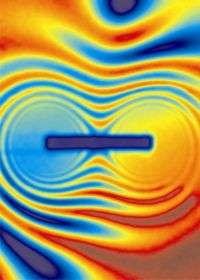
March 30, 2008 Magnetic Fields Around a Dipol

The magnetic field of a dipol magnet visualized by spinpolarized neutrons. Credit: Hahn-Meitner-Institut Berlin

3-D images are not only useful in medicine; the observation of internal structures is also invaluable in many other fields of scientific investigation. Recently, researchers from the Hahn-Meitner-Institute (HMI) in Berlin in cooperation with University of Applied Sciences have succeeded, for the first time, in a direct, three-dimensional visualisation of magnetic fields inside solid, non-transparent materials. This is announced by Nikolay Kardjilov and colleagues in the current issue of the journal Nature Physics.

The researchers in the imaging group used neutrons, subatomic particles that have zero net charge, but do have a magnetic moment, making them ideal for investigating magnetic phenomena in magnetic materials. When in an external magnetic field, the neutrons behave like compass needles, all aligning to point on the direction of the field.

Neutrons also have an internal angular momentum, often referred to by physicists as spin, a property that causes the needle to rotate around the magnetic field, similar to the way in which the Earth rotates on its axis. When all of the magnetic moments point in the same direction then the neutrons are said to be spin-polarised. If a magnetic sample is irradiated with such neutrons, the magnetic moments of the neutrons will begin to rotate around the magnetic fields they encounter in the sample and the direction of their spin changes.

Kardjilov's group used this phenomenon as a measurement parameter for tomography experiments using two spin polarisers (which only allow the passage of neutrons whose spin points in a specific direction) to polarise and then analyse the neutrons. By detecting changes in the spins, it is possible to “see” the magnetic fields within the sample.

Kardjilov explains this by comparison with a medical CT scan; when a specimen is irradiated with x rays the density of the materials present alters the intensity of the light. "It's the same with our magnetic specimen, which changes the spin rotation of the neutrons", says Nikolay Kardjilov. "The equipment only allows passage of neutrons with a specific spin rotation, and this generates the contrast according to how the magnetic properties are distributed within the specimen. By rotating the specimen we can reconstruct a three-dimensional image."

Since 2005, Nikolay Kardjilov has built up the neutron tomography section at HMI and now his group is the first to use spin rotation as a measurement signal for three-dimensional imaging. Normally, neutron imaging relies on the different levels of absorption of radiation by different materials to produce contrast. The measurement of magnetic signals is a novel concept and its success lies partly in the polarisers and analysers, and the detector system, which have been developed and built by the HMI researchers.

Magnetism is one of the central research fields at HMI. To understand high temperature superconductivity, for example, it is vital to understand how magnetic flux lines are distributed and how these flux lines can be established in the material. With Kardjilov's experimental setup, it is now possible, among other things, to visualise magnetic domains in magnetic crystals three-dimensionally.

Source: Helmholtz Association of German Research Centres


print this article email this article download pdf blog this article bookmark this article     Stumble it Digg this share on Facebook retweet share on Reddit add to delicious
Rate this story - 4.6 /5 (47 votes)

Rank Filter

Move the slider to adjust rank threshold, so that you can hide some of the comments.


Display comments: newest first

  • E_L_Earnhardt - Mar 30, 2008
    • Rank: 5 / 5 (2)
    A wonderful addition to the study of living cells! Interaction of electron spins with neutron spins will help explain inteligence transfer, and energy routing!
  • earls - Mar 30, 2008
    • Rank: 3 / 5 (2)
    That doesn't sound like very "neutral" behavior to me.
  • Ralph - Mar 31, 2008
    • Rank: 4 / 5 (1)
    This little article is outstandingly well written. It is clear, concise and amazingly informative. Few general-audience science pieces meet this level of clarity and readability. I learned a lot about neutrons and about the new imaging technique by reading it. Kudos to the author!
  • HeRoze - Mar 31, 2008
    • Rank: 4 / 5 (2)
    Cool- spin rotation technology is the fundamental response used in MRI imaging. MRI uses hydrogen spin alignments, but all else is similar. Good stuff.

March 30, 2008 all stories

Comments: 4

4.6 /5 (47 votes)
  • Stumble this up

  • Digg this

  • share this

  • hide
  • Related Stories


  • hide
  • Relevant PhysicsForums posts

  • How do you separate things from centrifugal force?
    created 1hour ago
  • Physical Science...need help
    created 1hour ago
  • Calculating a Damping Constant
    created 3 hours ago
  • Bodies in motionÂ…..
    created 5 hours ago
  • More from Physics Forums - General Physics

Other News

First Bose-Einstein condensation of strontium

First Bose-Einstein condensation of strontium

Physics / Quantum Physics

created 9 hours ago | popularity 5 / 5 (4) | comments 1

In an international first, scientists from the Institute of Quantum Optics and Quantum Information (IQOQI, Austria) produced a Bose-Einstein condensate of the alkaline-earth element strontium, thus narrowly ...


The LHC tunnel

Peckish bird briefly downs big atom smasher

Physics / General Physics

created 16 hours ago | popularity 3.8 / 5 (9) | comments 11

A peckish bird briefly knocked out part of the world's biggest atom smasher by causing a chain reaction with a piece of bread, the European Organisation for Nuclear Research (CERN) said Monday.


Solving big problems

Solving big problems with new quantum algorithm

Physics / Quantum Physics

created 4 hours ago | popularity 4.3 / 5 (10) | comments 0

(PhysOrg.com) -- In a recently published paper, Aram Harrow at the University of Bristol and colleagues from MIT in the United States have discovered a quantum algorithm that solves large problems much faster ...


Contracts Awarded for Production of NSLS-II Storage Ring Magnets

Physics / General Physics

created 1hour ago | popularity not rated yet | comments 0

(PhysOrg.com) -- All seven contracts for the production of the NSLS-II storage ring magnets have now been awarded -- a significant milestone for the project. The magnets -- 750 in total -- will be made by vendors in the United ...


Ginzburg helped develop the Soviet Union's hydrogen bomb in the late 1940s and early 1950s

Russian bomb physicist Ginzburg dead at 93

Physics / General Physics

created 17 hours ago | popularity 5 / 5 (4) | comments 0

Nobel Physics prize winner Vitaly Ginzburg, who helped develop the Soviet hydrogen bomb, has died at age 93, the Russian Academy of Sciences said Monday.