Team explains 'the wallpaper problem'
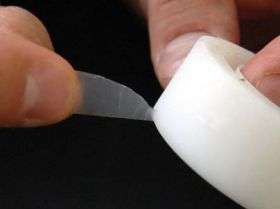
Frustrated by tape that won't peel off the roll in a straight line? Angry at wallpaper that refuses to tear neatly off the wall? A new study reveals why these efforts can be so aggravating. Wallpaper is not out to foil you-it's just obeying the laws of physics, according to a team of researchers from the Centre National de la Recherche Scientifique (CNRS) in Paris, the Universidad de Santiago, Chile, and MIT.
The report, published in the March 30 online issue of Nature Materials, sheds light on a phenomenon many people have experienced, which the researchers dubbed “the wallpaper problem.”
“You want to redecorate your bedroom, so you yank down the wallpaper. You wish that the flap would tear all the way down to the floor, but it comes together in a triangle and you have to start all over again,” said Pedro Reis, one of the authors of the paper and an applied mathematics instructor at MIT.
This pattern, where two cracks propagate toward each other and meet at a point, is extremely robust. It applies not only to wallpaper but other adhesives such as tape, as well as nonadhesive plastic sheets such as the shrink-wrap that envelops compact discs. It even extends to fruit: The skin on a tomato or a grape typically forms a triangle when peeled off.
“This has happened to everyone. it's frustrating,” said Reis, who collaborated with Enrique Cerda and Eugenio Hamm of the Universidad de Santiago, Benoit Roman of CNRS and Michael LeBlanc of the University of Chicago.
The team found that those ubiquitous triangular tears arise from interactions between three inherent properties of adhesive materials: elasticity (stiffness), adhesive energy (how strongly the adhesive sticks to a surface) and fracture energy (how tough it is to rip).
The researchers developed a formulation that predicts the angle of the triangle formed, based on those three properties.
They also figured out just how those triangular tears arise. As the strip is pulled, energy builds up in the fold that forms where the tape is peeling from the surface. The tape can release that energy in two ways: by unpeeling from its surface and by becoming narrower, both of which it does.
In a possible industrial application, materials engineers could use this method to calculate one of the three key properties, if the other two are known. This could be particularly useful in microtechnologies, such as stretchable electronics, where the characterization of thin material properties is very difficult.
Reis, who now works in MIT's Applied Mathematics Laboratory, and his collaborators at CNRS and Universidad de Santiago got the idea for the project after noticing consistent tearing patterns in plastic sheets such as the plastic wrapping of CDs.
The researchers tried controlled experimental versions of the same process in their lab and got the same results. “This shape is really robust, so there must be something fundamental going on that gives rise to these shapes,” Reis said.
However, the shapes formed by tearing nonadhesive sheets proved difficult to study because they are not perfect triangles, and without adhesion, the physics of the problem is more complicated. Instead, the researchers turned their attention to adhesives, which do form perfect triangles when torn.
The triangular shapes can also be seen in the work of French artist Jacques Villeglé. His art consists of posters taken from the streets of Paris and other French cities, complete with the same sort of rips that the researchers studied. One of the posters may be featured on the cover of Nature Materials to illustrate the team's paper.
Torn posters, tape and tomato skins may seem like strange research topics for physicists and applied mathematicians, but it's perfectly normal to Reis and his colleagues, who draw inspiration from an array of everyday objects.
Such real-world applications are not only fun to study, but “we can really learn things that will be useful for industry and help us understand the everyday world around us. It is also a great way to motivate students to be interested in science,” Reis said.
Source: Massachusetts Institute of Technology


