Researchers publish MRI images of genes in action in the living brain
March 31, 2008 MRI Images

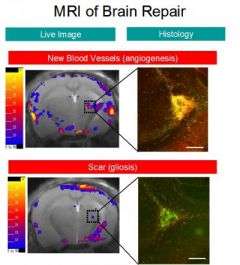
Probes administered by eye drop attach to special cells during repair and cause them to have different magnetic movement, or magnetic resonance, when viewed by a magnetic resonance imaging scanner. The images generated by the MRI scanner make it possible to see these repair processes in action. This method is the first to provide scientists, clinicians, teachers, and students a means to visualize the process of brain repair in live subjects. Image courtesy Philip Liu of Harvard Medical School

Biologists have just confirmed what poets have known for centuries: eyes really are windows of the soul—or at least of the brain. In a new study published in the April 2008 print issue of The FASEB Journal, Harvard researchers describe the development of gene probe eye drops that—for the first time—make it possible to monitor and detect tissue repair in the brain of living organisms using MRI. Current methods involve a risky, invasive, and relatively slow process of penetrating the skull to extract tissue samples and then examining those samples in a laboratory.

“We hope our study provides a tool for better treatments of neurological diseases, diagnosis, prognosis during therapy, and improved delivery of therapeutic agents to the brain,” said Philip Liu of Harvard, one of the researchers involved in the study. Liu also said that more research is necessary to determine exactly how these gene probes reach brain tissue.

In this report, Harvard researchers describe how they link a relatively common MRI probe (superparamagnetic iron oxide nanoparticles) to a short DNA sequence that binds to proteins in cells responsible for brain tissue repair (glia and astrocytes). Then, researchers used the eye drops on mice with conditions that cause “leaks” in the blood-brain barrier. When the animals’ brains were scanned using MRI, brain repair activity was visible.

Glia and astrocytes help repair brain and nerve tissue, and have a role in numerous diseases and disorders that cause at least microscopic breaches in the blood-brain barrier, including traumatic brain injury, multiple sclerosis, stroke, cardiac arrest, and glioma, among others. Furthermore, the researchers believe that the probes may also help diagnose thinning of vascular walls in brains, which occurs as Alzheimer’s disease progresses.

“When people are sick, the last thing you want to do is puncture their skulls for a biopsy,” said Gerald Weissmann, MD, Editor-in-Chief of The FASEB Journal, “but sometimes this is unavoidable. These probes of genes in action go a long way toward ushering in an age where extracting brain tissue to identify a disease will seem as crude as when doctors measured skulls to diagnose a mental disease.”

Source: Federation of American Societies for Experimental Biology


print this article email this article download pdf blog this article bookmark this article     Stumble it Digg this share on Facebook retweet share on Reddit add to delicious
Rate this story - 4.8 /5 (6 votes)


March 31, 2008 all stories

Comments: 0

4.8 /5 (6 votes)
  • Stumble this up

  • Digg this

  • share this

  • hide
  • Related Stories

  • Study sheds light on brain's fear processing center
    created 21 hours ago | popularity not rated yet | comments 0
  • Two molecules affecting brain plasticity
    created 21 hours ago | popularity not rated yet | comments 0
  • New discovery about the formation of new brain cells
    created Nov 23, 2009 | popularity not rated yet | comments 0
  • Intel wants a chip implant in your brain
    created Nov 23, 2009 | popularity not rated yet | comments 0
  • Beyond genomics, biologists and engineers decode the next frontier
    created Nov 18, 2009 | popularity not rated yet | comments 0


  • hide
  • Relevant PhysicsForums posts

  • 23 Years in a Vegetative State....or not?
    created Nov 25, 2009
  • Has the H1N1 vaccine been scientifically proven to work?
    created Nov 24, 2009
  • nesfatin
    created Nov 22, 2009
  • Obsessive Compulsive Disorder
    created Nov 20, 2009
  • More from Physics Forums - Medical Sciences

Other News

An end to sleep problems? Researchers discover enzyme behind effects of sleep deprivation

Medicine & Health / Research

created 27 minutes ago | popularity not rated yet | comments 0

There is hope for those who miss one night too many or whose children keep them up at night. The unwelcome effects of a bad night's sleep - forgetfulness, impaired mental performance - can be dealt with by reducing the concentration ...


Ginkgo biloba doesn’t prevent cardiovascular events but may have potential peripheral artery disease benefits

Medicine & Health / Research

created 51 minutes ago | popularity not rated yet | comments 0

(PhysOrg.com) -- Ginkgo biloba didn’t prevent cardiovascular death or major events such as heart attack and stroke in people age 75 and older, but the herb may affect peripheral vascular disease, according to research reported ...


Implant-based cancer vaccine is first to eliminate tumors in mice

Implant-based cancer vaccine is first to eliminate tumors in mice

Medicine & Health / Cancer

created 19 hours ago | popularity 4.7 / 5 (22) | comments 4

(PhysOrg.com) -- A cancer vaccine carried into the body on a carefully engineered, fingernail-sized implant is the first to successfully eliminate tumors in mammals, scientists report this week in the journal ...


Brain's endocannabinoid signaling pathway kept in check by two enzymes

Medicine & Health / Research

created 16 hours ago | popularity 4 / 5 (4) | comments 1

(PhysOrg.com) -- A research team has shown that blocking the degradation of two naturally occurring cannabinoids in the endocannabinoid signaling pathway of the brain produces marijuana-like behavioral effects in mice, according ...


Scientists find emotion-like behaviors, regulated by dopamine, in fruit flies

Medicine & Health / Neuroscience

created 20 hours ago | popularity 5 / 5 (3) | comments 0

Scientists at the California Institute of Technology have uncovered evidence of a primitive emotion-like behavior in the fruit fly, Drosophila melanogaster. Their findings, which may be relevant to the relationship betwee ...