Exploding star in NGC 2397
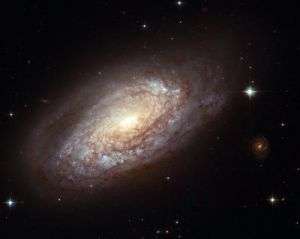
March 31, 2008 Exploding star in NGC 2397

NGC 2397, pictured in this image from Hubble, is a classic spiral galaxy with long prominent dust lanes along the edges of its arms, seen as dark patches and streaks silhouetted against the starlight. Hubble's exquisite resolution allows the study of individual stars in nearby galaxies. Located nearly 60 million light-years away from Earth, the galaxy NGC 2397 is typical of most spirals, with mostly older, yellow and red stars in its central portion, while star formation continues in the outer, bluer spiral arms. The brightest of these young, blue stars can be seen individually in this high resolution view from the Hubble's Advanced Camera for Surveys. Credit: NASA, ESA & Stephen Smartt (Queen's University Belfast, UK)

NGC 2397, pictured in this image from Hubble, is a classic spiral galaxy with long prominent dust lanes along the edges of its arms, seen as dark patches and streaks silhouetted against the starlight. Hubble’s exquisite resolution allows the study of individual stars in nearby galaxies.

Located nearly 60 million light-years away from Earth, the galaxy NGC 2397 is typical of most spirals, with mostly older, yellow and red stars in its central portion, while star formation continues in the outer, bluer spiral arms. The brightest of these young, blue stars can be seen individually in this high resolution view from the Hubble’s Advanced Camera for Surveys (ACS).

One atypical feature of this Hubble image is the view of supernova SN 2006bc taken when it was still fairly faint and its brightness on the increase. Astronomers from Queen's University Belfast in Northern Ireland, led by Professor of Astronomy Stephen J. Smartt, requested the image as part of a long project studying the massive exploding stars — supernovae. Exactly which types of star will explode and the lowest mass of star that can produce a supernova are not known.

When a supernova is discovered in a nearby galaxy the group begins a painstaking search of earlier Hubble images of the same galaxy to locate the star that later exploded; often one of hundreds of millions of stars in the galaxy. This is a little like sifting through days of CCTV footage to find one frame showing a suspect. If the astronomers find a star at the location of the later explosion, they may work out the mass and type of star from its brightness and colour. Only six such stars have been identified before they exploded and the Queen’s team have discovered the nature of five of them.

In their latest work on Hubble images, to be presented at the UK National Astronomy Meeting 2008 in Belfast, the Queen's team reveals the results of their ten-year search for these elusive supernova precursor stars. It appears that stars with masses as low as seven times the mass of the Sun can explode as supernovae. The team have not found any very massive stars that exploded, suggesting that the most massive stars may collapse to form black holes either without producing a supernova or by producing one that is too faint to observe. This intriguing possibility will be discussed at the meeting.

A public lecture at Queen's University Belfast showing how the Hubble Space Telescope has built a bridge between science and art will coincide with a presentation of the latest scientific study of Hubble galaxy images by Queen's astronomers.

The images were obtained on 14 September 2006 with Hubble's Advanced Camera for Surveys (ACS) through three different colour filters (blue, green and near-infrared).

Source: Hubble Information Centre


print this article email this article download pdf blog this article bookmark this article     Stumble it Digg this share on Facebook retweet share on Reddit add to delicious
Rate this story - 4.7 /5 (10 votes)


March 31, 2008 all stories

Comments: 0

4.7 /5 (10 votes)
  • Stumble this up

  • Digg this

  • share this

  • hide
  • Related Stories


  • hide
  • Relevant PhysicsForums posts

  • Some help with a X-Ray astronomy question please!
    created Nov 27, 2009
  • Help with Images and Optical Instrument Question..
    created Nov 26, 2009
  • Redshift as a distance indicator
    created Nov 26, 2009
  • Question about 2-body gravity
    created Nov 24, 2009
  • More from Physics Forums - General Astronomy

Other News

Fermi Telescope Peers Deep into Microquasar

Fermi Telescope Peers Deep into Microquasar (w/ Video)

Space & Earth / Astronomy

created 17 hours ago | popularity 4.7 / 5 (10) | comments 0

(PhysOrg.com) -- NASA's Fermi Gamma-ray Space Telescope has made the first unambiguous detection of high-energy gamma-rays from an enigmatic binary system known as Cygnus X-3. The system pairs a hot, massive ...


The Energy Sources of Ultraluminous Galaxies

The Energy Sources of Ultraluminous Galaxies

Space & Earth / Astronomy

created 18 hours ago | popularity 4.5 / 5 (13) | comments 1

(PhysOrg.com) -- Ultraluminous infrared galaxies ((ULIRGs) are galaxies whose luminosity exceeds that of a trillion suns; for comparison, the Milky Way galaxy has a typical (and much more modest) luminosity ...


New climate targets may not change daily life much (AP)

New climate targets may not change daily life much

Space & Earth / Environment

created 22 hours ago | popularity 3.8 / 5 (13) | comments 9

(AP) -- Americans' day-to-day lives won't change noticeably if President Barack Obama achieves his newly announced goal of slashing carbon dioxide pollution by one-sixth in the next decade, experts say.


Space shuttle Atlantis, 7 astronauts back on Earth (AP)

Space shuttle Atlantis, 7 astronauts back on Earth

Space & Earth / Space Exploration

created 19 hours ago | popularity not rated yet | comments 0

(AP) -- Space shuttle Atlantis and its seven astronauts returned to Earth with a smooth touchdown Friday to end an 11-day flight that resupplied the International Space Station.


China is set to launch its second moon orbiter next October, state media have reported

China to launch second lunar probe: state media

Space & Earth / Space Exploration

created 23 hours ago | popularity 5 / 5 (5) | comments 0

China will launch its second moon orbiter next October, state media reported Friday, as it powers ahead with a space programme that has sparked concerns abroad.