Virtual smash-ups show teenaged dome-skulled dinos could knock heads
March 31, 2008 Dome-skulled Dinos Went Head-to-head

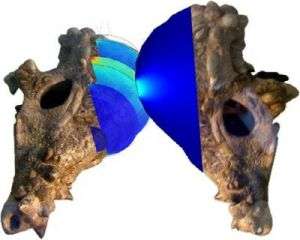
Fossil evidence and computer simulations show which pachycephalosaurs could butt heads. Photo illustration by Chris Kriegner and Tetsuto Miyashita

After half a century of debate, a University of Alberta researcher has confirmed that dome-headed dinosaurs called pachycephalosaurs could collide with each other during courtship combat. Eric Snively, an Alberta Ingenuity fellow at the U of A, used computer software to smash the sheep-sized dinosaurs together in a virtual collision and results showed that their bony domes could emerge unscathed.

The computer simulations by Snively and his co-author Andrew Cox of Villanova University offer clues as to how the dinosaurs (between 80 and 65 million years old and native to Canada, the United States and Mongolia), might have survived head-to-head combat like modern marine iguanas and musk oxen.

Some researchers have suggested that pachycephalosaur domes, which ranged from one to 20 centimetres thick, enabled head-butting contests as a way to attract mates, similar to the contests bighorn sheep engage in today. “Pachycephalosaur domes are unique and we can’t yet tell for certain if they butted heads, but we can test their capabilities for the behaviour with math and physics,” says Snively. He and Cox did just that by constructing three-dimensional computer models and then putting them to the test in virtual smash-ups.

In a study published in the journal Palaeontologica Electronica this month, the authors used a method called finite element analysis to simulate collisions in three kinds of pachycephalosaurs. Dome shapes immediately dropped stresses below those that would break even spindly struts of bone in some domes, and the collisions were mild enough to avoid concussions.

“It turns out that nearly-adult pachycephalosaurs would be best at handling collisions,” Snively said. “Other researchers have shown that big adults and young juveniles would be worse off, because they couldn’t heal as well. We think young adults could go at it, and older adults might intimidate youngsters with their giant domes.”

The key to safe collisions wasn’t just in the domes, but behind them in the body. Special sliding joints in vertebrae of pachycephalosaurs, including Stegoceras at the University of Alberta, show their backbones could buckle from collisions and then spring back into position. “It’s a little like in giraffes, who have sideways springiness in their neck ligaments and smash the heck out of each other with their heads,” Snively noted.

Source: University of Alberta


print this article email this article download pdf blog this article bookmark this article     Stumble it Digg this share on Facebook retweet share on Reddit add to delicious
Rate this story - 5 /5 (1 vote)


March 31, 2008 all stories

Comments: 0

5 /5 (1 vote)
  • Stumble this up

  • Digg this

  • share this

  • hide
  • Related Stories


  • hide
  • Relevant PhysicsForums posts

  • Selenocysteine in pH=7
    created 18 hours ago
  • What is the formula for calculating the speed of thought?
    created 23 hours ago
  • What does word "absorption" mean in the intestine?
    created 23 hours ago
  • What is transpulmonary pressure?
    created Nov 24, 2009
  • More from Physics Forums - Biology

Other News

Message gone viral? Blame it on altruistic, yet image-conscious Internet  'e-mavens'

Message gone viral? Blame it on altruistic, yet image-conscious Internet 'e-mavens'

Other Sciences / Economics

created 19 hours ago | popularity 3.5 / 5 (2) | comments 0

(PhysOrg.com) -- Why do some online ad campaigns go viral while other online marketing messages gather "cyber-dust" on the information superhighway? The key may lie in the motivation of Internet users to email ...


The skyline of Tokyo in Japan, where scientists have criticised the new government for plans to slash research budgets

Japan scientists attack govt research cut plans

Other Sciences / Other

created 12 hours ago | popularity 5 / 5 (1) | comments 0

Top Japanese scientists, including four Nobel laureates, have criticised the new government for plans to slash research budgets, warning the country will loose its high-tech edge.


Researcher: Faint writing seen on Shroud of Turin (AP)

Researcher: Faint writing seen on Shroud of Turin (Update)

Other Sciences / Archaeology & Fossils

created Nov 20, 2009 | popularity 2.3 / 5 (31) | comments 45

(AP) -- A Vatican researcher has rekindled the age-old debate over the Shroud of Turin, saying that faint writing on the linen proves it was the burial cloth of Jesus. Experts say the historian may be reading ...


Explained: The Discrete Fourier Transform

Explained: The Discrete Fourier Transform

Other Sciences / Mathematics

created Nov 25, 2009 | popularity 4.3 / 5 (26) | comments 8

(PhysOrg.com) -- In 1811, Joseph Fourier, the 43-year-old prefect of the French district of Isčre, entered a competition in heat research sponsored by the French Academy of Sciences. The paper he submitted ...


Climate change could boost incidence of civil war in Africa

Other Sciences / Social Sciences

created Nov 23, 2009 | popularity 2.4 / 5 (16) | comments 9

Climate change could increase the likelihood of civil war in sub-Saharan Africa by over 50 percent within the next two decades, according to a new study led by a team of researchers at University of California, Berkeley, ...