First evidence that blocking key energy protein kills cancer cells
March 31, 2008
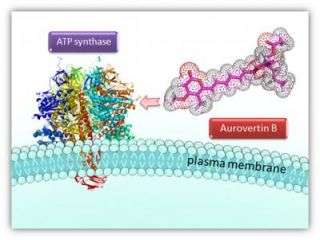
In a finding that could lead to more effective anti-cancer medication, scientists exposed breast cancer cells to a substance that blocks a protein called ATP synthase. The cancer cells were killed while normal ones were preserved. Courtesy of Hsin-Yi Chang and Hsueh-Fen Juan
Researchers in Taiwan report for the first time that blocking a key energy-supplying protein kills cancer cells. The finding, described as the first to test possible medical uses of so-called ATP-synthase inhibitors, may lead to new and more effective anti-cancer medications, according to their report, which is scheduled for the April 4 issue of ACS’ monthly Journal of Proteome Research.
In the new study, Hsueh-Fen Juan and colleagues focused on ATP synthase, a key protein involved in producing the energy-rich molecules of ATP that power all life processes.
For years researchers thought that the protein existed only in mitochondria, structures located inside cells that convert nutrients into energy. Recent studies found high levels of ATP synthase on the surface of cancer cells, but until now the medical implications went unexplored.
The researchers analyzed tissue samples from breast cancer patients and found for the first time that the surface of breast cancer cells contains high levels of ATP synthase. In cell studies, exposing breast cancer cells to a substance that blocks ATP synthase killed the cancer cells but did not harm normal cells, the researchers say. The findings suggest that ATP synthase inhibitors may represent a new approach for fighting breast cancer and other cancer types, they say.
Source: ACS
-
Metabolic errors can spell doom for DNA
Jan 31, 2012 |
not rated yet |
0
-
In lab, Pannexin1 restores tight binding of cells that is lost in cancer
Jan 30, 2012 |
5 / 5 (1) |
0
-
New information on the waste-disposal units of living cells
Jan 11, 2012 |
5 / 5 (1) |
0
-
Fewer animal experiments thanks to nanosensors
Jan 03, 2012 |
4.6 / 5 (5) |
0
-
Deciphering the mechanism of an ion pump
Dec 16, 2011 |
not rated yet |
0
-
Engineers build first sub-10-nm carbon nanotube transistor
Feb 01, 2012 |
4.9 / 5 (32) |
30
-
Something old, something new: Evolution and the structural divergence of duplicate genes
Jan 31, 2012 |
4.6 / 5 (7) |
1
-
The hidden nanoworld of ice crystals: Revealing the dynamic behavior of quasi-liquid layers
Jan 30, 2012 |
5 / 5 (4) |
1
-
Stock market network reveals investor clustering
Jan 27, 2012 |
3.9 / 5 (23) |
8
-
Of microchemistry and molecules: Electronic microfluidic device synthesizes biocompatible probes
Jan 26, 2012 |
5 / 5 (2) |
0
-
Is Everyday Technology Killing Us?
Feb 08, 2012
-
Exercise and weight loss
Feb 08, 2012
-
Why do we have head aches? Our brains can't feel anything.
Feb 07, 2012
-
"The end of diseases" by David Agus, interview from Daily Show with Jon Stewart
Feb 04, 2012
-
Oncolytic adenovirus
Feb 04, 2012
-
Nutrition label stuffs and diets
Feb 02, 2012
- More from Physics Forums - Medical Sciences
More news stories
Starve a virus, feed a cure? Findings show how some cells protect themselves against HIV
A protein that protects some of our immune cells from the most common and virulent form of HIV works by starving the virus of the molecular building blocks that it needs to replicate, according to research published online ...
1 hour ago |
5 / 5 (1) |
0
|
Injured boomers beware: Know when to see doctor
(AP) -- It happened to nurse Jane Byron years after an in-line skating fall, business owner Haralee Weintraub while doing "men's" push-ups, and avid cyclist Gene Wilberg while lifting a heavy box.
2 hours ago |
5 / 5 (1) |
0
FDA-approved drug rapidly clears amyloid from the brain, reverses Alzheimer's symptoms in mice
Neuroscientists at Case Western Reserve University School of Medicine have made a dramatic breakthrough in their efforts to find a cure for Alzheimer's disease. The researchers' findings, published in the journal Science, show t ...
Medicine & Health / Neuroscience
Feb 09, 2012 |
4.9 / 5 (55) |
21
|
Green tea found to reduce disability in the elderly
(Medical Xpress) -- A lot of research has been done over the past several years looking into the health benefits of green tea. As a result, scientists have found that regular consumption of the beverage leads ...
Teen school drop-outs three times as likely to be on benefits in later life
Teen school drop-outs are almost three times as likely to be on benefits in later life as their peers who complete their schooling, indicates research published online in the Journal of Epidemiology and Community Health.
Feb 06, 2012 |
not rated yet |
13
Lab study raises questions over nano-particle impact
Tests involving chickens have raised questions about the impact on health from engineered nano-particles, the ultra-fine grains commonly used in drugs and processed foods, scientists said on Sunday.
Iran blocks email, restricts net access: reports
Iran has further restricted access to the Internet and blocked popular email services for the past few days, in a move a top lawmaker said could "cost the regime dearly," media reports said on Sunday.
Salvage workers begin pumping fuel from Italian shipwreck
Salvage workers Sunday began pumping fuel from the shipwrecked Italian cruise liner Costa Concordia, a day ahead of schedule, officials said.
Scientists discover molecular secrets of 2,000-year-old Chinese herbal remedy
For roughly two thousand years, Chinese herbalists have treated Malaria using a root extract, commonly known as Chang Shan, from a type of hydrangea that grows in Tibet and Nepal. More recent studies suggest that halofuginone, ...
New method to examine batteries -- MRI from the inside
There is an ever-increasing need for advanced batteries for portable electronics, such as phones, cameras, and music players, but also to power electric vehicles and to facilitate the distribution and storage of energy derived ...
A mitosis mystery solved: How chromosomes align perfectly in a dividing cell
Although the process of mitotic cell division has been studied intensely for more than 50 years, Whitehead Institute researchers have only now solved the mystery of how cells correctly align their chromosomes during symmetric ...
Mar 31, 2008
Rank: 1 / 5 (1)
Apr 01, 2008
Rank: not rated yet
No cooling wont do the same thing, we are warm-blooded animals, we maintain thermal homeostasis. Slowing the mitosis wouldn't help much either, it might slow cancer growth but it wont kill cancer cells. Besides there are no good ways of slowing the mitosis in normal cells (besides calorie restriction) and even if there were cancers cells have the mitosis control short -circuited anyway. You can only block mitosis with certain poisons and thats exactly what some chemotherapeutics do, but those are extremely toxic to both cancer and normal cells (to cancer cells a tiny bit more thats why they are used).
What makes you think that you know more about cancer then legions of scientists and physicians?
Especially since your comments seem to prove otherwise. Stop posting in caps and realize that every physician and scientist in the world would love to come up with a cure (as it means saving millions of people plus fame and money).
If you think that you've found a simple solution (like 'slowing mitosis') missed by everyone else it's an obvious indication that your understanding of the problem is flawed.