Newly discovered galaxy cluster in early stage of formation is farthest ever identified
March 31, 2008
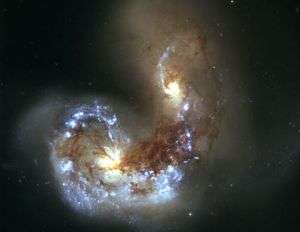
Two galaxies interacting. Credit: University of California - Irvine
UC Irvine scientists have discovered a cluster of galaxies in a very early stage of formation that is 11.4 billion light years from Earth – the farthest of its kind ever to be detected. These galaxies are so distant that the universe was in its infancy when their light was emitted.
The galaxy proto-cluster, named LBG-2377, is giving scientists an unprecedented look at galaxy formation and how the universe has evolved. Before this discovery, the farthest known event like this was approximately 9 billion light years away.
“When you observe objects this far away, you are actually seeing the universe as it was a very long time ago,” said Jeff Cooke, a McCue Postdoctoral Fellow in physics and astronomy at UCI and lead author of this study. “It is as if a timeline is just sitting out there in front of you. These galaxies represent what the universe looked like well before the Earth existed.”
This research is reported in the online bulletin astro-ph.
Using the Keck Telescope in Hawaii, Cooke detected LBG-2377 while looking for single galaxies. At first, it appeared to be a bright, single object. But after analyzing the wavelengths of its light (galaxies emit light with telltale colors) he discovered it was three galaxies merging together, and likely two additional smaller galaxies.
Scientists use light to look back in time. Because light takes a measurable amount of time to travel, detecting it on Earth today allows scientists to view the source as it was billions of years ago. In the case of LBG-2377, scientists believe the light has been traveling for 11.4 billion years, beginning just a few billion years after the Big Bang when the universe was only 15 percent of its current age. By comparison, the Earth was formed about 4.5 billion years ago.
The process of galaxy formation largely is a mystery. Current theory is that large galaxies formed over time from the interaction and merging of smaller galaxies. This process began more than 12 billion years ago, shortly after the Big Bang. Scientists have observed galaxies merging over a large range of distances and time, providing hard evidence to reinforce the theory. However, using current technology, it is difficult to detect this process at the most extreme distances, when galaxy formation was in its infancy.
Scientists believe galaxy clusters form in a similar manner. As galaxies congregate and interact in large, dense regions of space, the cluster grows with time. Witnessing this process first-hand helps scientists confirm their theory and deepen their understanding of the universe. Galaxy clusters can be detected at extreme distances with current technology because they are bright, but they are difficult to find.
Clusters closer to Earth contain upwards of 1,000 galaxies. Our Milky Way galaxy belongs to a lesser grouping of galaxies called the Local Group, which contains more than 35 galaxies, but only a few bright ones.
“We believe LBG-2377 is a seed that eventually will grow into a massive galaxy cluster,” said James Bullock, director of the Center for Cosmology at UCI and a study co-author.
“Our finding suggests that this is a monster structure being born in a very bright, catastrophic event with a lot of gas and matter collapsing at once,” Bullock said. “We are not just seeing one solitary galaxy. We are seeing a bunch of bright galaxies coming together at the dawn of structure formation in the universe.”
Source: University of California - Irvine
-
Distorting the lens
12 hours ago |
5 / 5 (2) |
2
-
New images capture 'stealth merger' of dwarf galaxies
Feb 08, 2012 |
4.3 / 5 (4) |
0
-
Astronomy team discovers nearby dwarf galaxy
Feb 08, 2012 |
4.2 / 5 (6) |
5
-
Classic portrait of a barred spiral galaxy
Feb 03, 2012 |
4.7 / 5 (7) |
3
-
Do black holes help stars form?
Feb 03, 2012 |
4.5 / 5 (6) |
1
-
Engineers build first sub-10-nm carbon nanotube transistor
Feb 01, 2012 |
4.9 / 5 (30) |
30
-
Something old, something new: Evolution and the structural divergence of duplicate genes
Jan 31, 2012 |
4.6 / 5 (7) |
1
-
The hidden nanoworld of ice crystals: Revealing the dynamic behavior of quasi-liquid layers
Jan 30, 2012 |
5 / 5 (3) |
1
-
Stock market network reveals investor clustering
Jan 27, 2012 |
3.9 / 5 (23) |
8
-
Of microchemistry and molecules: Electronic microfluidic device synthesizes biocompatible probes
Jan 26, 2012 |
5 / 5 (1) |
0
-
Titan's lack of impact craters
23 hours ago
-
Real pictures of black hole eating a star?
Feb 08, 2012
-
Hypothetical way to travel faster than light, but not technically exceed lightspeed
Feb 06, 2012
-
How do scientists monitor the Sun's activity?
Feb 05, 2012
-
Search patterns in observational studies
Feb 05, 2012
-
Derivation of Pogson's law
Feb 03, 2012
- More from Physics Forums - General Astronomy
More news stories
Sandy streets over the Atlantic
Thick dust from the Sahara blowing over the ocean off the western coast of Africa encounters the islands of Cape Verde, forming a wake of swirling vortex streets visible by satellite.
Space & Earth / Earth Sciences
48 minutes ago |
not rated yet |
0
Domestic consumption main contributor to Africa's growing e-waste
West Africa faces a rising tide of e-waste generated by domestic consumption of new and used electrical and electronic equipment, according to a new United Nations report. Domestic consumption makes up the majority (up to ...
20 minutes ago |
not rated yet |
0
Could Venus be shifting gear?
(PhysOrg.com) -- ESAs Venus Express spacecraft has discovered that our cloud-covered neighbour spins a little slower than previously measured. Peering through the dense atmosphere in the infrared, the ...
Space & Earth / Space Exploration
1 hour ago |
5 / 5 (3) |
2
|
Humans may have helped the decline of African rainforests 3000 years ago
(PhysOrg.com) -- Large areas of rainforests in Central Africa mysteriously disappeared over three thousand years ago, to be replaced by savannas. The prevailing theory has been that the cause was a change ...
Clam fields found at deep, low-temperature Mariana vents
(PhysOrg.com) -- Scientists have marveled at the unusual life forms thriving at high temperature hydrothermal vents of the deep ocean.
Space & Earth / Earth Sciences
1 hour ago |
not rated yet |
0
|
The power of estrogen -- male snakes attract other males
A new study has shown that boosting the estrogen levels of male garter snakes causes them to secrete the same pheromones that females use to attract suitors, and turned the males into just about the sexiest ...
Experts reveal how plants don't get sunburn
(PhysOrg.com) -- Experts at the University of Glasgow have discovered how plants survive the harmful rays of the sun.
Team isolates nerve cells involved in storing long term memory and gene proteins associated with them
(Medical Xpress) -- A research team in Taiwan has succeeded in isolating two nerve cells in fruit fly brains that are believed to be the major players in allowing for the formation of long term memories. Furthermore, ...
Fool's gold may prove an unlikely alternative to overexploited catalytic materials
Catalytic materials, which lower the energy barriers for chemical reactions, are used in everything from the commercial production of chemicals to catalytic converters in car engines. However, with current catalytic materials ...
SLAC, Stanford team focuses on high-energy electrons to treat cancer
Accelerator physicists at SLAC and cancer specialists from Stanford are working on a new technology that could dramatically reduce the time needed for cancer radiation treatments. The team ran an initial experiment ...
News of plaque-clearing drug tops week of major advances against Alzheimer's disease
In the last eight days, scientists have delivered a powerful one-two punch in the fight to defeat Alzheimer's disease. At the same time, the White House and members of Congress are proposing increases in Alzheimer's research ...