Elevated concentrations of metals in China’s e-waste recycling workshops
March 31, 2008 Elevated concentrations of metals in China’s e-waste recycling workshops

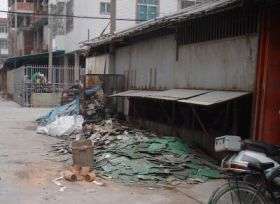
Scientists report environmental contamination from crude recycling practices after collecting dust samples near e-waste processing workshops. Above are discarded printed circuit boards outside a shop in the Beilin district of Guiyu, Guangdong Province.Courtesy of Croucher Institute for Environmental Sciences, Hong Kong Baptist University

In a case study on how not to recycle electronic waste (e-waste), scientists in the United States and Hong Kong have documented serious environmental contamination with potentially toxic metals from crude e-waste recycling in a village located in southeast China.

Recycling methods used in family-run workshops could pose a serious health risk to residents of the area through ingestion and inhalation of contaminated dust, the researchers say. Their study is scheduled for the April 15 issue of ACS’ Environmental Science & Technology.

The process of discarding computers and other consumer electronics has emerged as one of the fastest growing segments of the global waste stream. Known as e-waste, these scrapped electronic goods contain lead, copper and other hazardous materials, which can release dangerous toxins that cause air and water contamination. Up to 50-million tons of e-waste is generated worldwide each year — enough to fill a line of garbage collection trucks stretching halfway around the world — according to the United Nations Environment Program.

China is now the destination for 70 percent of the computers, TVs, cell phones, and other e-waste recycled globally each year. Ming H. Wong and colleagues collected dust samples from roads adjacent to e-waste processing workshops in Guiya, China, to find that lead levels were 330 and 371 times higher than non e-waste sites located 5 miles and 19 miles away. Copper levels were 106 and 155 times higher.

“Currently, there are no guidelines or regulations for heavy metals in dust. It is hoped that the results can serve as a case study for similar e-waste activities in countries such as Africa, India and Vietnam where e-waste is becoming a growing problem, so that the same mistakes could be prevented.”

Source: ACS


print this article email this article download pdf blog this article bookmark this article     Stumble it Digg this share on Facebook retweet share on Reddit add to delicious
Rate this story - 4 /5 (2 votes)


March 31, 2008 all stories

Comments: 0

4 /5 (2 votes)
  • Stumble this up

  • Digg this

  • share this


  • hide
  • Relevant PhysicsForums posts

  • The IPCC and the term "most"
    created Nov 23, 2009
  • Is global warming a fact?
    created Nov 23, 2009
  • Random variability of wind patterns
    created Nov 23, 2009
  • Record precipitation in the UK
    created Nov 22, 2009
  • More from Physics Forums - Earth

Other News

Cosmic 'dig' reveals vestiges of the Milky Way's building blocks

Cosmic 'Dig' Reveals Vestiges of the Milky Way's Building Blocks

Space & Earth / Astronomy

created 9 hours ago | popularity 4.9 / 5 (12) | comments 1

(PhysOrg.com) -- Peering through the thick dust clouds of our galaxy's "bulge" (the myriads of stars surrounding its center), a team of astronomers has unveiled an unusual mix of stars in the stellar grouping ...


No Wheel Stall in Diagnostic Drive

Spirit Mars Rover: No Wheel Stall in Diagnostic Drive

Space & Earth / Space Exploration

created 4 hours ago | popularity 5 / 5 (1) | comments 0

(PhysOrg.com) -- On Sol 2095 (Tuesday, Nov. 24), Spirit performed a set of diagnostic actions related to a stall of the right-rear wheel on the previous drive, three days earlier.


Monster Waves on the Sun are Real

Monster Waves on the Sun are Real (w/ Video)

Space & Earth / Astronomy

created 4 hours ago | popularity 5 / 5 (8) | comments 0

Sometimes you really can believe your eyes. That's what NASA's STEREO (Solar Terrestrial Relations Observatory) spacecraft are telling researchers about a controversial phenomenon on the sun known as the "solar ...


Oceanic crust formation is dynamic after all

Oceanic crust formation is dynamic after all

Space & Earth / Earth Sciences

created 8 hours ago | popularity 4.3 / 5 (3) | comments 0

Imagine the Earth's crust as the planet's skin: Some areas are old and wrinkled while others have a fresher, more youthful sheen, as if they had been regularly lathered with lotion.


Climate experts debate strategies for reducing atmospheric carbon and future warming

Climate experts debate strategies for reducing atmospheric carbon and future warming

Space & Earth / Environment

created 5 hours ago | popularity 3 / 5 (4) | comments 4

(PhysOrg.com) -- Reducing carbon dioxide to safe levels may require extracting carbon from the air, says Cornell climate researcher.