March 31, 2008 weblog
Soldiers to get 3-D maps in near-real-time
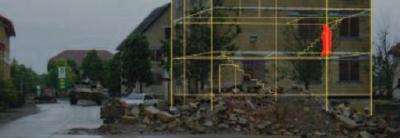
In the near future, soldiers may be using maps that are more akin to long-range but highly accurate security cameras: the maps will enable troops to see both the exterior and interior of buildings, as well as streets and larger areas, as they appeared just minutes ago.
The technology, designed by General Dynamics UK Limited, is called Masthead and is part of the company's UrbanISTAR concept. The company plans to debut the urban intelligence system this week at the SOFEX 2008 exhibition in Amman, Jordan.
The system uses infrared laser technology known as LIDAR (Light Intensity Direction and Ranging). By combining LIDAR sensors with thermal imaging and X-ray backscatter techniques, the General Dynamics researchers can fuse the data from these systems to create near-real-time 3-D pictures of buildings and streets. With the addition of radar, the system could even detect objects and people inside buildings.
All this equipment is carried in the back of a military vehicle, undercover civilian 4x4, or even a plane, as it drives or flies through an area. As the vehicle moves forward, the LIDAR system scans the scene with the infrared laser, measuring the distance to objects and creating a 3-D map.
With the map, troops could plan urban operations, identify targets, and determine the best routes to take when approaching terrorist sites. Soldiers could virtually walk through buildings to rehearse operations. Since the LIDAR system provides measurements of doors, windows, and alleys with millimeter accuracy, the technology could even be used for the targeting of weapons. Such maps would be much more useful than outdated conventional maps or 2-D aerial images.
"You can utilize [the Masthead system] in any number of ways," according to a recent article in Dynamics, the company´s quarterly publication. "You can, for example, employ it like the worlds created in a computer game to ´walk´ through the scene, perhaps to understand what can be seen from a particular doorway or window. ... The key thing is that the data underlying the map is only minutes old."
In addition to combat applications, the system could also be used for civilian applications. For example, a police force could use the technology when planning security measures for an upcoming event at a large sports stadium, determining the best evacuation routes in the case of an emergency.
More information: www.GeneralDynamics.uk.com
via: Defense News


