Two new star systems are first of their kind ever found
March 31, 2008
Two new star systems are first of their kind ever found

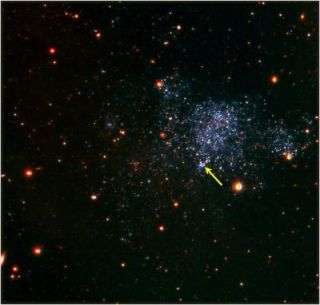
Ohio State University astronomers and their colleagues took this image of the dwarf galaxy Holmberg IX with the Large Binocular Telescope. The arrow indicates the approximate location of the newly discovered star system. Image courtesy of Ohio State University

Astronomers have spied a faraway star system that is so unusual, it was one of a kind -- until its discovery helped them pinpoint a second one that was much closer to home.

In a paper published in a recent issue of the Astrophysical Journal Letters, Ohio State University astronomers and their colleagues suggest that these star systems are the progenitors of a rare type of supernova.

They discovered the first star system 13 million light years away, tucked inside Holmberg IX, a small galaxy that is orbiting the larger galaxy M81. They studied it between January and October 2007 with the Large Binocular Telescope (LBT) on Mt. Graham in Arizona.
Two new star systems are first of their kind ever found

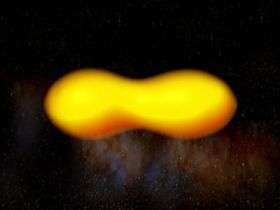
Ohio State University astronomers and their colleagues have discovered a new type of star system, one that may be the progenitor of a rare type of supernova. The star system is called a "yellow supergiant eclipsing binary" -- it contains two very bright, massive yellow stars that are very closely orbiting each other. In fact, the stars are so close together that a large amount of stellar material is shared between them, so that the shape of the system resembles a peanut. Image by Kevin Gecsi, courtesy of Ohio State University.

The star system is unusual, because it’s what the astronomers have called a “yellow supergiant eclipsing binary” -- it contains two very bright, massive yellow stars that are very closely orbiting each other. In fact, the stars are so close together that a large amount of stellar material is shared between them, so that the shape of the system resembles a peanut.

In a repeating cycle, one star moves to the front and blocks our view of the other. From Earth, the star system brightens and dims, as we see light from two stars, then only one star.

The two stars in this system appear to be nearly identical, each 15 to 20 times the mass of our sun.

José Prieto, Ohio State University graduate student and lead author on the journal paper, analyzed the new star system as part of his doctoral dissertation. In his research, he scoured the historical record to determine whether his group had indeed found the first such binary.

To his surprise, he uncovered another one a little less than 230,000 light years away in the Small Magellanic Cloud, a small galaxy that orbits our own Milky Way.

The star system had been discovered in the 1980s, but was misidentified. When Prieto re-examined the data that astronomers had recorded at the time, he saw that the pattern of light was very similar to the one they had detected outside of M81. The stars were even the same size -- 15 to 20 times the mass of the sun -- and melded together in the same kind of peanut shape. The system was clearly a yellow supergiant eclipsing binary.

“We didn’t expect to find one of these things, much less two,” said Kris Stanek, associate professor of astronomy at Ohio State. “You never expect this sort of thing. But I think this shows how flexible you have to be in astrophysics. We needed the 8.4-meter LBT to spot the first binary, but the second one is so bright that you could see it with binoculars in your back yard. Yet, if we hadn’t found the first one, we may never have found the second one.”

“It shows that there are still valuable discoveries hidden in plain sight. You just have to keep your eyes open and connect the dots.”

The find may help solve another mystery. Of all the supernovae that have been studied over the years, two have been linked to yellow supergiants -- and that’s two more than astronomers would expect.

Prieto explained why. Over millions of years, a star will burn hotter or cooler as it consumes different chemical elements in its core. The most massive stars swing back and forth between being cool red supergiants or hot blue ones. They spend most of their lives at one end of the temperature scale or the other, but spend only a short time in-between, where they are classified as yellow. Most stars end their life in a supernova at the red end of the cycle; a few do at the blue end. But none do it during the short yellow transitional phase in between.

At least, that’s what astronomers thought.

Prieto, Stanek, and their colleagues suspect that yellow binary systems like the ones they found could be the progenitors of these odd supernovae.

“When two stars orbit each other very closely, they share material, and the evolution of one affects the other,” Prieto said. “It’s possible two supergiants in such a system would evolve more slowly, and spend more time in the yellow phase -- long enough that one of them could explode as a yellow supergiant.”

The discovery of this yellow supergiant binary system is just the first result of a long-term LBT project to monitor stellar variability in the nearby universe. That project is led by Ohio State professor of astronomy, Chris Kochanek. He and Rick Pogge, also a professor of astronomy, are coauthors on the paper in Astrophysical Journal Letters.

Source: Ohio State University

4.8 /5 (53 votes)  

Filter


Move the slider to adjust rank threshold, so that you can hide some of the comments.


Display comments: newest first

earls
Apr 01, 2008

Rank: not rated yet
With the stars being so close together, what's the dominate force in this situation? Electromagnetism or gravity?
Rank 4.8 /5 (53 votes)
Tags

Related Stories
Relevant PhysicsForums posts
  • Titan's lack of impact craters
    createdFeb 09, 2012
  • Real pictures of black hole eating a star?
    createdFeb 08, 2012
  • Hypothetical way to travel faster than light, but not technically exceed lightspeed
    createdFeb 06, 2012
  • How do scientists monitor the Sun's activity?
    createdFeb 05, 2012
  • Search patterns in observational studies
    createdFeb 05, 2012
  • Derivation of Pogson's law
    createdFeb 03, 2012
  • More from Physics Forums - General Astronomy

More news stories

Could Venus be shifting gear?

(PhysOrg.com) -- ESA’s Venus Express spacecraft has discovered that our cloud-covered neighbour spins a little slower than previously measured. Peering through the dense atmosphere in the infrared, the ...

Space & Earth / Space Exploration

created 2 hours ago | popularity 5 / 5 (3) | comments 4 | with audio podcast

Clam fields found at deep, low-temperature Mariana vents

(PhysOrg.com) -- Scientists have marveled at the unusual life forms thriving at high temperature hydrothermal vents of the deep ocean.

Space & Earth / Earth Sciences

created 3 hours ago | popularity not rated yet | comments 0 | with audio podcast

Mars Science Laboratory computer issue resolved

(PhysOrg.com) -- Engineers have found the root cause of a computer reset that occurred two months ago on NASA's Mars Science Laboratory and have determined how to correct it.

Space & Earth / Space Exploration

created 3 hours ago | popularity 5 / 5 (4) | comments 2 | with audio podcast

Humans may have helped the decline of African rainforests 3000 years ago

(PhysOrg.com) -- Large areas of rainforests in Central Africa mysteriously disappeared over three thousand years ago, to be replaced by savannas. The prevailing theory has been that the cause was a change ...

Space & Earth / Environment

created 6 hours ago | popularity 5 / 5 (3) | comments 5 | with audio podcast report

Two new moons for Jupiter

Advances in technology have lead to the discovery of new planets outside of our Solar System, and now even new moons in our own backyard.

Space & Earth / Space Exploration

created 2 hours ago | popularity not rated yet | comments 2


Zuckerberg's focus drives Facebook's ascent

When Mark Zuckerberg showed up to rent Judy Fusco's Los Altos, Calif., house in the fall of 2004, soon after he'd arrived in Silicon Valley, the landlord was immediately struck by his confidence.

Antidepressants and pregnancy: Women must consider the impact of drugs on baby, and of depression on baby, themselves

Upon learning they are pregnant, most women dutifully nix the alcohol, sushi and caffeine. But what about antidepressants?

Both maternal and paternal age linked to autism

Older maternal and paternal age are jointly associated with having a child with autism, according to a recently published study led by researchers at The University of Texas Health Science Center at Houston (UTHealth).

Curry spice component may help slow prostate tumor growth

Curcumin, an active component of the Indian curry spice turmeric, may help slow down tumor growth in castration-resistant prostate cancer patients on androgen deprivation therapy (ADT), a study from researchers ...

The power of estrogen -- male snakes attract other males

A new study has shown that boosting the estrogen levels of male garter snakes causes them to secrete the same pheromones that females use to attract suitors, and turned the males into just about the sexiest ...

Netflix light on flicks as viewers soak up TV shows

Like most fresh faces that arrive in Hollywood, Netflix wanted to be a movie star. But now it's learning what many in Tinseltown have known for decades: Movies are sexy, but the real money is in television.