Feed that cold! New study shows that lower food intake has a negative effect on immune system
April 1, 2008 Deer Mouse

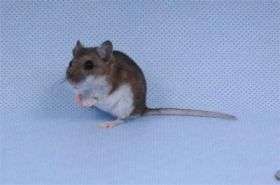
A deer mouse (Peromyscus maniculatus). Credit: Photograph by Clint Cook, University of South Carolina; courtesy of the Peromyscus Genetic Stock Center

Researchers studying deer mice have discovered evidence to support what mothers everywhere have long suspected: the immune system needs food to function properly. In an article titled “Food Restriction Compromises Immune Memory in Deer Mice (Peromyscus maniculatus) By Reducing Spleen-Derived Antibody-Producing B-Cell Numbers,” Lynn Martin and coauthors find that reduced food intake leads to a decline in immune function in their subjects. The findings, which will be published in the May/June 2008 issue of Physiological and Biochemical Zoology, could have profound implications for human health.

Why immune activity is variable in many wild animals is a question that has long puzzled researchers. “Animals live different lifestyles, so they may use different types of defenses against infection depending on the situation. Perhaps this is why immune defenses vary seasonally in most species; some may be too expensive to use all the time,” Martin said, referring to previous work on Peromyscus and other small mammals and birds.

While it is known that the immune system expends energy when it gears up to fight a virus or an infection—a fever, for example—the researchers found that restricting their subjects’ diet by 30% significantly decreased the amount of available B cells, which produce antibodies and maintain immune memory. Without these cells, the immune system must relearn how to fight a threat if it reappears.

Research on the relationship between food and the immune system could have profound implications for humans. Martin and fellow researchers cite previous studies that have found that infections are “more frequent and tend to be chronic in malnourished children.” Vaccines, in order to work effectively, must provoke B cells to produce sufficient antibodies for immune memory. Previous studies have found that vaccines such as those for measles have a significantly lower rate of efficacy among the malnourished.

“A 30% restriction in food intake doesn’t affect body mass and only minimally reduces activity in deer mice, but it eliminates the long-term immune protection provided by antibodies. One wonders whether similar moderate food restriction has comparable immune effects in humans," Martin asked. Although other variables may be at work, the authors propose that for both wild animals and humans, food availability impinges on immunity and future research should determine what specific components of a diet (calories, protein, micronutrients) are responsible.

Source: University of Chicago


print this article email this article download pdf blog this article bookmark this article     Stumble it Digg this share on Facebook retweet share on Reddit add to delicious
Rate this story - 4.1 /5 (12 votes)


April 1, 2008 all stories

Comments: 0

4.1 /5 (12 votes)
  • Stumble this up

  • Digg this

  • share this

  • hide
  • Related Stories

  • Bugs in the gut trigger production of important immune cells
    created Oct 15, 2008 | popularity not rated yet | comments 0
  • Study on salmonella self-destruction
    created Aug 21, 2008 | popularity not rated yet | comments 0
  • Protein discovery targets antibiotic-resistant bacteria
    created Feb 14, 2007 | popularity not rated yet | comments 0
  • Assisting NASA in biology mission, Stanford helps E. coli visit the final frontier
    created Jan 17, 2007 | popularity not rated yet | comments 0
  • Genetic link to vitamin A deficiency
    created Nov 17, 2009 | popularity not rated yet | comments 0


Other News

The Monarchs' annual migration ritual has yet to be scientifically explained

Tree-eating bugs threaten Monarch butterfly in Mexico

Biology / Ecology

created 5 hours ago | popularity 4 / 5 (1) | comments 0

The mysterious Monarch butterfly, which migrates en masse annually between Canada and Mexico, is now facing a new peril: another insect thriving in Western Mexican forests.


Extinct goat Myotragus balearicus

Extinct goat was cold-blooded

Biology / Plants & Animals

created Nov 18, 2009 | popularity 4.9 / 5 (32) | comments 10

(PhysOrg.com) -- An extinct goat that lived on a barren Mediterranean island survived for millions of years by reducing in size and by becoming cold-blooded, which has never before been discovered in mammals.


Bigger not necessarily better, when it comes to brains

Bigger not necessarily better, when it comes to brains

Biology / Plants & Animals

created Nov 17, 2009 | popularity 4.5 / 5 (17) | comments 11

(PhysOrg.com) -- Tiny insects could be as intelligent as much bigger animals, despite only having a brain the size of a pinhead, say scientists at Queen Mary, University of London.


Right-handed chimpanzees provide clues to the origin of human language

Biology / Plants & Animals

created Nov 16, 2009 | popularity 3 / 5 (1) | comments 7

Most of the linguistic functions in humans are controlled by the left cerebral hemisphere. A study of captive chimpanzees at the Yerkes National Primate Research Center (Atlanta, Georgia), reported in the January 2010 issue ...


The creature was found at a depth of 161 metres

Japanese researchers film rare baby fish 'fossil'

Biology / Plants & Animals

created Nov 17, 2009 | popularity 4.7 / 5 (7) | comments 4

Japanese marine researchers said Tuesday they had found and successfully filmed a young coelacanth -- a rare type of fish known as "a living fossil" -- in deep water off Indonesia.