Scientists discover 356 animal inclusions trapped in 100 million years old opaque amber

April 1, 2008

Paleontologists from the University of Rennes (France) and the ESRF have found the presence of 356 animal inclusions in completely opaque amber from mid-Cretaceous sites of Charentes (France). The team used the X-rays of the European light source to image two kilogrammes of the fossil tree resin with a technique that allows rapid survey of large amounts of opaque amber. At present this is the only way to discover inclusions in fully opaque amber.

Opaque amber has always been a challenge for paleontologists. Researchers cannot study it because the naked eye cannot visualize the presence of any fossil inclusion inside. In the Cretaceous sites like those in Charentes, there is up to 80% of opaque amber. It is like trying to find, in complete blindness, something that may or may not be there.
Scientists discover 356 animal inclusions trapped in 100 million years old opaque amber

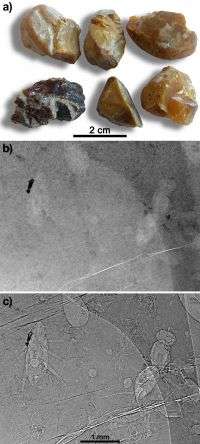
a) Opaque amber blocs from Charente-Maritime. b) radiography of a bloc with inclusions in absorption mode. c) the same radiograph in propagation phase contrast mode with 990 mm of propagation distance (pixel size: 5 µm). Credit: M. Lak, P. Tafforeau, D. Néraudeau (ESRF Grenoble et UMR CNRS 6118 Rennes)

However, the paleontologists Malvina Lak, her colleagues from the University of Rennes and the ESRF paleontologist Paul Tafforeau, together with the National Museum of Natural History of Paris, have applied to opaque amber a synchrotron X-ray imaging technique known as propagation phase contrast microradiography. It sheds light on the interior of this dark amber, which resembles a stone to the human eye. “Researchers have tried to study this kind of amber for many years with little or no success. This is the first time that we can actually discover and study the fossils it contains”, says Paul Tafforeau.

The scientists imaged 640 pieces of amber from the Charentes region in southwestern France. They discovered 356 fossil animals, going from wasps and flies, to ants or even spiders and acarians. The team was able to identify the family of 53% of the inclusions.

Most of the organisms discovered are tiny. For example, one of the discovered acarians measures 0.8 mm and a fossil wasp is only 4 mm. “The small size of the organisms is probably due to the fact that bigger animals would be able to escape from the resin before getting stuck, whereas little ones would be captured more easily”, explains Malvina Lak.

The surface features of amber pieces, like cracks, stand out more in the images than the fossil organisms in the interior when using synchrotron radiation. In order to solve this problem, scientists soaked the amber pieces in water before the experiment. Because water and amber have very similar densities, immersion made the outlines of the amber pieces and the cracks almost invisible. At the same time, it increased overall inclusion visibility, leading to better detection and characterization of the fossils.

Once discovered on the radiographs, some of the organisms were imaged in three dimensions and virtually extracted from the resin. The high quality of these 3D reconstructions enables paleontologists to precisely study and describe the organisms. The success of this experiment shows the high value of the ESRF for the study of fossils. “Opaque amber hosts many aspects of past life on our planet that are still unknown, and the use of third generation synchrotron sources will continue to play an important role in unveiling them”, asserts Malvina Lak.

Source: European Synchrotron Radiation Facility


print this article email this article download pdf blog this article bookmark this article     Stumble it Digg this share on Facebook retweet share on Reddit add to delicious
Rate this story - 4.5 /5 (26 votes)

Rank Filter

Move the slider to adjust rank threshold, so that you can hide some of the comments.


Display comments: newest first

  • kuczman - Oct 20, 2008
    • Rank: not rated yet
    No comments yet?
    Well this way of peering into amber is great. Of course it allowed scientists to finally get a peak at what's inside of this opaque amber.
    The printer allowing visualising of these inclusions: it can print a 12" 3-D image of the miniscule inclusion in the amber, but costs not thousands but rather hundreds of thousands of E.
    But still, once you have the "huge" 3-D model in your hands, one can determine the details of the specimen a lot better and the original is safe in the deposit.

April 1, 2008 all stories

Comments: 1

4.5 /5 (26 votes)
  • Stumble this up

  • Digg this

  • share this

  • hide
  • Related Stories

  • Ancient muscle tissue extracted from 18 million year old fossil
    created Nov 05, 2009 | popularity not rated yet | comments 0
  • Oldest known spider's web found in amber
    created Nov 02, 2009 | popularity not rated yet | comments 0
  • Ancient 'monster' insect offers Halloween inspiration
    created Oct 26, 2009 | popularity not rated yet | comments 0
  • Unexpected amber find rewrites botanical history
    created Oct 02, 2009 | popularity not rated yet | comments 0
  • Flying frog among 353 new Himalayan species: WWF
    created Aug 10, 2009 | popularity not rated yet | comments 0


Other News

The six elephants in Sierra Leone were shot and "crudely butchered"

S.Leone elephants 'wiped out' by poachers: official

Biology / Ecology

created 5 hours ago | popularity 5 / 5 (2) | comments 3

Poachers "wiped out" the entire elephant herd in Sierra Leone's only wildlife park, wildlife managers said Thursday after police said they had arrested a gang of 10 poachers.


First-ever blueprint of a minimal cell is more complex than expected

First-ever blueprint of a minimal cell is more complex than expected

Biology / Cell & Microbiology

created 3 hours ago | popularity 5 / 5 (5) | comments 0

What are the bare essentials of life, the indispensable ingredients required to produce a cell that can survive on its own? Can we describe the molecular anatomy of a cell, and understand how an entire organism ...


Knockouts in human cells point to pathogenic targets

Knockouts in human cells point to pathogenic targets

Biology / Cell & Microbiology

created 6 hours ago | popularity not rated yet | comments 0

(PhysOrg.com) -- Whitehead researchers have developed a new approach for genetics in human cells and used this technique to identify specific genes and proteins required for pathogens.


Whiteflies sabotage alarm system of plant in distress

Whiteflies sabotage alarm system of plant in distress

Biology / Plants & Animals

created 7 hours ago | popularity 5 / 5 (1) | comments 0

(PhysOrg.com) -- When spider mites attack a bean plant, the plant responds by producing odours which attract predatory mites. These predatory mites then exterminate the spider mite population, thus acting ...


Ecological speciation by sexual selection on good genes: Is speciation adaptive?

Biology / Ecology

created 3 hours ago | popularity not rated yet | comments 0

Darwin suggested that the action of natural selection can produce new species, but 150 years after the publication of his famous book, 'On the Origin of Species', debate still continues on the mechanisms of speciation. New ...