Researchers purposely damage batteries to see how much abuse they can take
April 1, 2008 Researchers purposely damage batteries to see how much abuse they can take

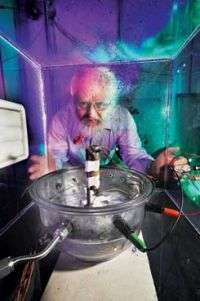
Sandia researcher Peter Roth prepares to blow up a battery to see how robust it is. The work is part of the DOE-funded FredomCAR program. (Photo by Randy Montoya)

Researchers in the Power Sources R&D group at Sandia National Laboratories have been driving nails into batteries, heating them to extreme temperatures, overcharging them, and putting them into some of the most adverse conditions possible to see how much abuse they can take before they blow up. And for certain types of lithium-ion batteries the answer is a lot.

The research is part of the DOE-funded FreedomCAR program that is looking at lithium-ion batteries to be part of hybrid electric-gasoline powered vehicles and eventually plug-in hybrids.

Current hybrid vehicles run on gasoline and use nickel-metal hydride batteries as the energy storage device for the electric motor. The intent of the battery portion of the FreedomCAR program is to replace the older type batteries with safe lithium-ion batteries that have six times the energy density of lead-acid batteries and two to three times the energy density of nickel-metal hydride batteries.

“Lithium-ion batteries, generally found in laptop computers and power tools, have greatly improved over the past few years,” says Peter Roth, lead researcher for Sandia’s FreedomCAR battery efforts. “In fact, they have improved so much that we expect to see them in hybrids later this year and possibly even in short-range plug-in hybrids within two years.”

He notes the battery industry has made great strides in manufacturing safe, long-lasting, and affordable batteries. Sandia has played a role in assuring that the lithium-ion batteries are indeed safe and can operate for long periods of time.

One way Sandia researchers have helped determine how safe and long-lasting batteries are is by testing them in adverse situations to determine when and how they can fail or leak their electrolyte.

The Sandia research group obtains batteries and battery materials from research laboratories, like Argonne National Laboratory, and companies that manufacture and sell batteries. They then study the stability of the materials, their flame-retardant performance, high-temperature integrity of separators between the cathode and anode, and general thermophysical properties.

“We look at fundamental chemistry, wanting to discover the kinds of gases they emit when they are heated and explode,” Roth says. “We also build smaller prototype batteries that once we get the chemistry right may eventually be built full size to go into vehicles.”

Roth says that some of the newer batteries, like the new lithium/iron phosphate ones used in handheld power tools, are extremely resilient and less reactive when subjected to extreme conditions, unlike other types of batteries.

These are the type of batteries the FreedomCAR program is seeking, particularly for plug-in hybrid electric vehicles (PHEV). A PHEV is a regular hybrid that operates both on gas and a battery but has an extension cord. It can be filled with gas at the gas station and also can be plugged into any 120-volt outlet for all-electric driving. It’s almost like having a second fuel tank that is used first — only it is filled up at home.

Industry experts predict that plug-ins that can run 10 miles on all electric are two to three years away while plug-ins that can run 40 miles on all electric are three to four years away.
Plug-in hybrids make it essential that batteries be completely safe since they will be sitting in people’s garages while they recharge.

Lithium-ion batteries that will go into vehicles will be similar to computer laptop batteries. One main difference is there will be “a lot of them,” Roth says.

The first hybrids using lithium-ion batteries will be on the market later this year. Mercedes-Benz has announced that it will shortly launch the S400 BlueHybrid. After that, it will launch the S300 Bluetec Hybrid, a diesel car that is combined with a lithium-ion battery. Also, General Motors plans to introduce a 40-mile plug-in hybrid with lithium-ion batteries in 2010.

Source: SandiaNational Laboratory


print this article email this article download pdf blog this article bookmark this article     Stumble it Digg this share on Facebook retweet share on Reddit add to delicious
Rate this story - 4 /5 (5 votes)

Rank Filter

Move the slider to adjust rank threshold, so that you can hide some of the comments.


Display comments: newest first

  • fooljoe - Apr 01, 2008
    • Rank: 5 / 5 (2)
    stop blowing up batteries and start putting them in cars.
  • Slotin - May 23, 2009
    • Rank: 1 / 5 (1)
    here's no sufficient amount of lithium for doing this. After all, existing concept of batteries, where large amount of oxidizing amount remains in close proximity of large amount of lithium makes them very unsafe device during car crash. It could even lead into chain explosion during chain collision.
  • lengould100 - Aug 28, 2009
    • Rank: not rated yet
    "large tonnages of lithium are contained in oil field brines in North Dakota, Wyoming, Oklahoma, east Texas and Arkansas where brines grading up to 700mg/lt are known to exist. Other lithium brines exist in the Paradox Basin, Utah and (other places) but the author is unaware of any global review of the potential." Many other resources worldwide not presently exploited or counted apparently exist -- ttp://lithiumabundance.blogspot.com/

    USGS estimates that present resources are about 11,000,000 tons carbonate (2,000,000 tons lithium?) http://minerals.u...cs06.pdf Presuming much lower concentrations can provide that much again, lets use a figure of 4,000,000 tonnes. At 50 kg per auto, that's enough for 80 million autos, which is not enough, alternate technology required but NOT SOON. R. Keith Evans, author of first link above, estimates world recoverable resources at 28.4 million tonnes Li, enough for 560 million autos, in which case no problem for a long time.

    Aside, I was interested to note on the USGS webpage that the US has an import tarrif against Lithium of nearly 4%, pesumeably to "protect" the one small local miner.

April 1, 2008 all stories

Comments: 3

4 /5 (5 votes)
  • Stumble this up

  • Digg this

  • share this

  • hide
  • Related Stories

  • Tips to keep iPhone battery going strong
    created 15 hours ago | popularity not rated yet | comments 0
  • Sony optimistic on 3-D TVs, in-house display
    created 15 hours ago | popularity not rated yet | comments 0
  • Smartphone app illuminates power consumption
    created Nov 20, 2009 | popularity not rated yet | comments 0
  • Pulling the plug on hybrid myths
    created Nov 19, 2009 | popularity not rated yet | comments 0
  • Liquid battery big enough for the electric grid?
    created Nov 19, 2009 | popularity not rated yet | comments 0


  • hide
  • Relevant PhysicsForums posts

  • Laser plasma emission
    created 4 hours ago
  • Achromat lens - magnifying LCD
    created Nov 25, 2009
  • Control System
    created Nov 24, 2009
  • Base Isolation Systems in Skyscrapers?
    created Nov 23, 2009
  • More from Physics Forums - General Engineering

Other News

Building real security with virtual worlds

Technology / Computer Sciences

created 9 hours ago | popularity 4 / 5 (4) | comments 0

(PhysOrg.com) -- Advances in computerized modeling and prediction of group behavior, together with improvements in video game graphics, are making possible virtual worlds in which defense analysts can explore and predict ...


McKinnon, accused of hacking into US military and NASA computers, faces extradition to the United States

UFO-obsessed Briton loses bid to block US extradition

Technology / Other

created 5 hours ago | popularity 4 / 5 (2) | comments 0

A Briton accused of hacking into US military and NASA computers faces extradition to the United States after the British government Thursday rejected last-ditch requests to block the move.


Sony optimistic on 3-D TVs, in-house display (AP)

Sony optimistic on 3-D TVs, in-house display

Technology / Hi Tech

created 15 hours ago | popularity not rated yet | comments 0

(AP) -- A third to a half of the Sony Corp. TV sets sold annually will be packed with 3-D features by the year ending March 2013, a senior executive said Thursday.


Roku adds more 'channels' of video and other digital content

Technology / Telecom

created 8 hours ago | popularity not rated yet | comments 0

Owners of Roku's digital video player will soon have a bunch more channels to choose from.


A worman works on a computer

Half of Euro online travel purchases legally unsafe: EU

Technology / Internet

created 6 hours ago | popularity not rated yet | comments 0

More than half of all people who buy flights, hotel rooms and hire cars online risk being left without compensation if companies fail under outdated law, the EU said Thursday.