Bon MOT: Innovative atom trap catches highly magnetic atoms
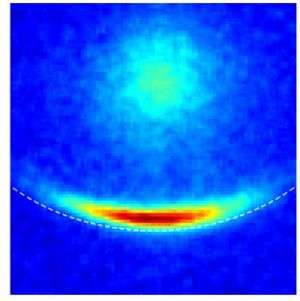
A research team from the National Institute of Standards and Technology and the University of Maryland has succeeded in cooling atoms of a rare-earth element, erbium, to within two millionths of a degree of absolute zero using a novel trapping and laser cooling technique. Their recent report is a major step towards a capability to capture, cool and manipulate individual atoms of erbium, an element with unique optical properties that promises highly sensitive nanoscale force or magnetic sensors, as well as single-photon sources and amplifiers at telecommunications wavelengths. It also may have applications in quantum computing devices.
The strongly counterintuitive technique of “laser cooling” to slow down atoms to very low speeds—temperatures close to absolute zero—has become a platform technology of atomic physics. Laser cooling combined with specially arranged magnetic fields—a so-called magneto-optical trap (MOT)—has enabled the creation of Bose-Einstein condensates, the capture of neutral atoms for experiments in quantum computing and ultra-precise time-keeping and spectroscopy experiments.
The technique originally focused on atoms that were only weakly magnetic and had relatively simple energy structures that could be exploited for cooling, but two years ago a NIST team showed that the far more complex energy structures of erbium, a strongly magnetic element, also could be manipulated for laser cooling.
The typical MOT uses a combination of six tuned laser beams converging on a point that is in a low magnetic field but surrounded by stronger fields. Originally, the lasers were tuned near a strong natural energy oscillation or resonance in the atom, a condition that provides efficient cooling but to only moderately low temperatures. In the new work, the research team instead used much gentler forces applied through a very weak resonance in order to bring erbium atoms to within a few millionths of a degree of absolute zero. Such weak resonances are only available in atoms with complex energy structures, and previously have been used only with a select group of non-magnetic atoms. When a strongly magnetic atom like erbium is used, the combination of strong magnetic forces and weak absorption of laser photons makes a traditional MOT unstable.
To beat this, the NIST/UM team turned classic MOT principles on their heads. Rather than shifting the laser frequency towards the red end of the spectrum—to impact fast, high-temperature atoms more than slow, cold ones—they shifted the laser towards the blue side to take advantage of the effects of the magnetic field on the highly magnetic erbium. Magnetism holds the atoms stably trapped while the lasers gently pushed them against the field, all the while extracting energy and cooling them. The delicate balancing act not only cools and traps the elusive erbium atoms, it does it more efficiently. The team’s modified trap design uses only a single laser and can cool erbium atoms to within two millionths of a degree of absolute zero. By contrast, a conventional MOT only brings rubidium atoms to about one ten-thousandth of a degree.
Erbium commonly is used in optical communications components for its convenient magneto-optical properties. The new trapping technique raises the possibility of using erbium and similar lanthanide elements for unique nanoscale magnetic field detectors, atomic resolution metrology, optical computing systems and quantum computing.
Citation: A.J. Berglund, J.L. Hanssen and J.J. McClelland. Narrow-line magneto-optical cooling and trapping of strongly magnetic atoms. Physical Review Letters, V. 100, p. 113002 , March 18, 2008.
Source: National Institute of Standards and Technology


