Nano-sized technology has super-sized effect on tumors
Anyone facing chemotherapy would welcome an advance promising to dramatically reduce their dose of these often harsh drugs. Using nanotechnology, researchers at Washington University School of Medicine in St. Louis have taken a step closer to that goal.
The researchers focused a powerful drug directly on tumors in rabbits using drug-coated nanoparticles. They found that a drug dose 1,000 times lower than used previously for this purpose markedly slowed tumor growth.
"Many chemotherapeutic drugs have unwanted side effects, and we've shown that our nanoparticle technology has the potential to increase drug effectiveness and decrease drug dose to alleviate harmful side effects," says lead author Patrick M. Winter, Ph.D., research assistant professor of medicine and biomedical engineering.
The nanoparticles are extremely tiny beads of an inert, oily compound that can be coated with a wide variety of active substances. In an article published online in The FASEB Journal, the researchers describe a significant reduction of tumor growth in rabbits that were treated with nanoparticles coated with a fungal toxin called fumagillin. Human clinical trials have shown that fumagillin can be an effective cancer treatment in combination with other anticancer drugs.
In addition to fumagillin, the nanoparticles' surfaces held molecules designed to stick to proteins found primarily on the cells of growing blood vessels. So the nanoparticles latched on to sites of blood vessel proliferation and released their fumagillin load into blood vessel cells. Fumagillin blocks multiplication of blood vessel cells, so it inhibited tumors from expanding their blood supply and slowed their growth.
Human trials have also shown that fumagillin can have neurotoxic side effects at the high doses required when given by standard methods. But the fumagillin nanoparticles were effective in very low doses because they concentrate where tumors create new blood vessels. The rabbits that received fumagillin nanoparticles showed no adverse side effects.
Senior author Gregory M. Lanza, M.D., Ph.D., associate professor of medicine and of biomedical engineering, and Samuel A. Wickline, M.D., professor of medicine, of physics and of biomedical engineering, are co-inventors of the nanoparticle technology. The nanoparticles measure only about 200 nanometers across, or 500 times smaller than the width of a human hair. Their cores are composed mostly of perfluorocarbon, a safe compound used in artificial blood.
The nanoparticles can be adapted to many different medical applications. In addition to carrying drugs to targeted locations, they can be manufactured to highlight specific targets in magnetic resonance imaging (MRI), nuclear imaging, CT scanning and ultrasound imaging.
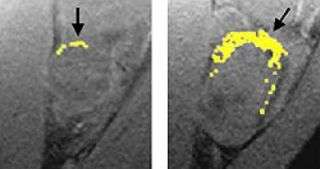
In this study, researchers loaded blood-vessel-targeted nanoparticles with MRI contrast agent and were able to make detailed maps of tumor blood vessel growth using standard MRI equipment. The MRI scans showed that blood vessel formation tended to concentrate in limited areas on the surface at one side of tumors instead of dispersing uniformly, which was a surprise.
"Using the blood-vessel targeted nanoparticles, we get a far more complete view of tumor biology than we would get with any other technique," Winter says. "If you followed a tumor over a period of time with the nanoparticles and MRI scans, you would have a much better understanding of the tumor's reaction to treatment."
The researchers say they believe nanoparticle technology will be very useful for monitoring cancer treatment results in both the short and long term.
"It gives you a way of determining whether you should continue treatment, change the dose or even try a different treatment altogether," Lanza says.
Prior work has shown that the nanoparticles can be loaded with many kinds of drugs. The researchers used fumagillin nanoparticles in these experiments to demonstrate the feasibility of this approach, but they plan further investigations with other versions of the nanoparticles.
"What this report clearly demonstrates is that our nanoparticles can carry chemotherapeutic drugs specifically to tumors and have an effect at the tumor site," Lanza says. "Sometimes when I give presentations about our nanotechnology, people react as if it was science fiction or at best a technology of the distant future. But we've shown that the technology is ready for medical applications now."
The nanoparticles will be tested this year in preliminary human clinical trials to determine the optimal method for using them as imaging agents. These studies will lay essential groundwork for using the nanoparticles as therapeutic agents.
Source: Washington University School of Medicine


