Preliminary DNA analysis completed on California wolverine
April 3, 2008
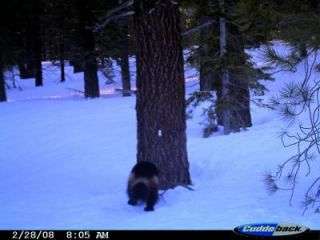
Scientists believe a wolverine was photographed with a remote-controlled camera on Feb. 28 on the Tahoe National Forest. Evidence of wolverines in California has not been scientifically verified since the 1920s. Credit: US Forest Service, Oregon State University photo
Preliminary results from DNA analysis of wolverine scat samples collected on the Tahoe National Forest do not match those of historic California wolverine populations, according to U.S. Forest Service scientists.
Geneticists with the agency’s Rocky Mountain Research Station recently began analyzing samples, when wildlife biologists with the Tahoe National Forest and California Department of Fish and Game began sending hair and scat samples they collected from wolverine detection sites on the national forest to a lab in Missoula, Mont.
The interagency effort began in March after an Oregon State University graduate student working on a cooperative project with the U.S. Forest Service’s Pacific Southwest Research Station photographed a wolverine, an animal whose presence has not been confirmed in California since the 1920s.
DNA analysis is critical to scientists working to determine if the animal first photographed on February 28 and in later detection work is a wolverine that dispersed from outside of California, escaped from captivity or is part of a historic remnant population.
Key findings from the preliminary analysis indicate the animal in the photographs is a male wolverine that is not a descendent of the last known Southern Sierra Nevada population, said Bill Zielinski, a Forest Service scientist with the Pacific Southwest Research Station and an expert at detecting wolverine, marten and fisher. It also does not genetically match populations in Washington, he said.
U.S. populations are found largely in the Northern Cascades in Washington, and Northern Rockies in Montana, Wyoming and Idaho. The nearest known resident population is about 600 miles northeast of the Tahoe National Forest in Idaho’s Sawtooth Range.
Scientists determined the sample is a haplotype A, which is a genetic type that is found throughout the Rocky Mountains, Alaska and Canada, according to Michael Schwartz, conservation genetics team leader at the Rocky Mountain Research Station. He said haplotype A is not found in historic California samples or in the Cascade Range.
Additional analysis of the wolverine DNA to pinpoint this animal’s origin will be conducted by the Rocky Mountain Research Station and independent labs, Schwartz said.
“We can exclude the Washington and the Southern Sierra Nevada populations from haplotype A, but more information about the population of origin will be investigated through additional genetic analysis,” Zielinski said.
Genetic samples for historic California wolverine populations were gathered from museum pieces, fur pelts and scientific specimens, he said.
Source: US Forest Service
-
Fox spit helped Forest Service confirm rare find
Sep 03, 2010 |
4.6 / 5 (10) |
3
-
Origins of wolverine in California genetically verified
Apr 29, 2009 |
4.3 / 5 (3) |
1
-
Reliance on unverifiable observations hinders successful conservation of wildlife species
Jun 23, 2008 |
5 / 5 (1) |
0
-
Additional evidence of wolverine found in the Tahoe National Forest
Mar 27, 2008 |
5 / 5 (1) |
0
-
Camera Spots Wolverine in Sierra Nevada
Mar 06, 2008 |
4.6 / 5 (21) |
1
-
Engineers build first sub-10-nm carbon nanotube transistor
Feb 01, 2012 |
4.9 / 5 (33) |
30
-
Something old, something new: Evolution and the structural divergence of duplicate genes
Jan 31, 2012 |
4.6 / 5 (7) |
1
-
The hidden nanoworld of ice crystals: Revealing the dynamic behavior of quasi-liquid layers
Jan 30, 2012 |
5 / 5 (5) |
1
-
Stock market network reveals investor clustering
Jan 27, 2012 |
3.9 / 5 (23) |
8
-
Of microchemistry and molecules: Electronic microfluidic device synthesizes biocompatible probes
Jan 26, 2012 |
5 / 5 (2) |
0
More news stories
Germination of Bacillus species which can lead to food poisoning
Some bacteria can form spores (survival capsules) that are particularly resistant to heat. Since sporogenous bacteria can also cause food poisoning and a reduction in food quality, they constitute a significant ...
15 minutes ago |
not rated yet |
0
New molecule has potential to help treat genetic diseases and HIV
(PhysOrg.com) -- Chemists at The University of Texas at Austin have created a molecule that's so good at tangling itself inside the double helix of a DNA sequence that it can stay there for up to 16 days before ...
1 hour ago |
5 / 5 (2) |
0
|
Integrated pest management recommendations for the southern pine beetle
The southern pine beetle, Dendroctonus frontalis Zimmermann, is a chronic insect pest within pine forests in the southeastern United States. Under favorable environmental and host conditions, it is an agg ...
4 hours ago |
not rated yet |
0
A mitosis mystery solved: How chromosomes align perfectly in a dividing cell
Although the process of mitotic cell division has been studied intensely for more than 50 years, Whitehead Institute researchers have only now solved the mystery of how cells correctly align their chromosomes during symmetric ...
18 hours ago |
4.5 / 5 (22) |
0
|
Researchers find extensive RNA editing in human transcriptome
In a new study published online in Nature Biotechnology, researchers from BGI, the world's largest genomics organization, reported the evidence of extensive RNA editing in a human cell line by analysis of RNA-seq data, demons ...
18 hours ago |
5 / 5 (4) |
0
|
With climate change, today's '100-year floods' may happen every three to 20 years: research
Last August, Hurricane Irene spun through the Caribbean and parts of the eastern United States, leaving widespread wreckage in its wake. The Category 3 storm whipped up water levels, generating storm surges ...
Researchers make better heat sensor based on butterfly wings
(PhysOrg.com) -- Scientists have long known that butterfly wings produce their iridescent colors by bouncing light around and between tiny ridges in structures made of chitin. More recently they’ve discovered ...
Manipulating genes with hidden TALENs
(PhysOrg.com) -- A better understanding of gene function in model plant and animal systems could be used to develop useful traits in livestock and crop plants, and might someday lead to developments in stem ...
Alien matter in the solar system: A galactic mismatch
This just in: The Solar System is different from the space just outside it.
The joy of cheques
An electronic cheque which eliminates the need for costly processing by banks but preserves the simplicity and ease of a traditional cheque book has been designed by a team of academics in the UK.
Research shows promise in converting camelina oil into jet fuel
(PhysOrg.com) -- Researchers at Montana State University-Northern have developed a process to convert camelina oil to jet fuel and other high-value chemicals. MSU has applied for a U.S. patent and research is ongoing.