Researchers find pre-Clovis human DNA
DNA from dried human excrement recovered from Oregon's Paisley Caves is the oldest found yet in the New World -- dating to 14,300 years ago, some 1,200 years before Clovis culture -- and provides apparent genetic ties to Siberia or Asia, according to an international team of 13 scientists.
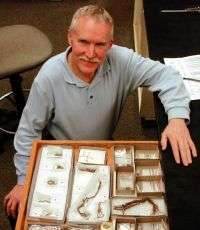
Among the researchers is Dennis L. Jenkins, a senior archaeologist with the University of Oregon’s Museum of Natural and Cultural History, whose summer field expeditions over two summers uncovered a variety of artifacts in caves that had caught the scientific attention of the UO’s Luther Cressman in the 1930s.
The Paisley Caves are located in the Summer Lake basin near Paisley, about 220 miles southeast of Eugene on the eastern side of the Cascade Range. The series of eight caves are westward-facing, wave-cut shelters on the highest shoreline of pluvial Lake Chewaucan, which rose and fell in periods of greater precipitation during the Pleistocene.
The team’s extensively documented analyses on mitochondrial DNA -- genetic material passed on maternally -- removed from long-dried feces, known as coprolites, were published online April 3 in Science Express ahead of regular publication in the journal Science.
“The Paisley Cave material represents, to the best of my knowledge, the oldest human DNA obtained from the Americas,” said Eske Willerslev, director of the Centre for Ancient Genetics at Denmark’s University of Copenhagen. “Other pre-Clovis sites have been claimed, but no human DNA has been obtained, mostly because no human organic material had been recovered.”
Willerslev visited the UO in 2004 to obtain samples for DNA analyses after word spread among archaeologists and anthropologists about Jenkins’ discoveries. A Danish team, led by Willerslev, examined 14 coprolites -- initially using multiplex polymerase chain reaction to rapidly amplify DNA and a minisequencing assay – that were found by Jenkins and colleagues during summer field work in 2002 and 2003.
A lengthy analysis, including the collection of DNA samples from 55 UO students, supervisors, and site visitors and 12 Danish DNA researchers, was done to screen for modern DNA contamination. From that analysis, six coprolites containing the ancient DNA were radiocarbon dated using accelerator mass spectrometry and calendar calibrated to between 1,300 and 14,300 years ago.
“Of these, half date from the early arrival time,” Jenkins said. “All six coprolites containing ancient DNA underwent additional testing at two independent labs. Three of the six also contained DNA similar to red fox, coyote or wolf.” The researchers suggest that these early Americans ate the animals or that the animals urinated on the human feces during times of non-human habitation.
The DNA testing indicated that the feces belonged to Native Americans in haplogroups A2 and B2, haplogroups common in Siberia and east Asia.
Clovis culture began sometime between 13,200 and 12,900 years ago, according to a re-evaluation of Clovis evidence published in Science (Feb. 23, 2008) by Michael R. Waters of Texas A&M University and Thomas W. Stafford Jr. of Stafford Research Laboratories in Colorado.
Skeletal remains dating to Clovis culture have proven elusive, leaving researchers with little hard evidence beyond tell-tale cultural components such as the distinctive fluted Clovis points and other tools.
Exactly who these people living in the Oregon caves were is not known, Jenkins said. In their conclusion, the authors wrote: “The Paisley Caves lack lithic tool assemblages, thus the cultural and technological association of the early site occupants, and their relationship to the later Clovis technology are uncertain.”
"All we're doing in this paper is identifying the haplogroups," Jenkins said in an interview. "We are not saying that these people were of a particular ethnic group. At this point, we know they most likely came from Siberia or Eastern Asia, and we know something about what they were eating, which is something we can learn from coprolites. We're talking about human signature.
"If our DNA evidence and radiocarbon dating hold up on additional coprolites that are now undergoing testing at multiple labs, then we have broken the Clovis sound barrier, if you will,” he said. “If you are looking for the first people in North America, you are going to have to step back more than 1,000 years beyond Clovis to find them."
The UO's Cressman was lured to the area after being told about a woman who was digging in the caves for artifacts and began uncovering large bones, Jenkins said. Cressman, an anthropologist, died in April 1994 after 35 years on the UO faculty.
During the two summers of fieldwork, Jenkins, colleagues and students, working in four of the caves, retrieved manufactured threads of sinew and plant fibers, hide, basketry, cordage, rope, wooden pegs, animal bones, two forms of projectile point fragments and diverse kinds of feces. These items were found "in an unbroken stratigraphic sequence spanning the late Pleistocene and Holocene," the researchers wrote in the study. Some of the thread is narrower than that holding buttons on many shirts today and date back 12,750 years, Jenkins said.
"To find these threads was just incredible," said Jenkins, who directs the Northern Great Basin Archaeological Field School. "We found a little pit in the bottom of a cave. It was full of camel, horse and mountain sheep bones, and in there we found a human coprolite. We radiocarbon-dated the camel and mountain sheep bones, as well as the coprolite, to 14,300 years ago."
With radiocarbon dating adjusted to calendar years, the materials date back to about 14,400 years ago, he added. Such a dating puts the Oregon site into about the same time period as Chile's Monte Verde site.
The UO’s Cressman reported his discoveries in 1940, but his conclusions on material he found were not widely accepted because of a lack of solid documentation. “Cressman was correct about the association of human cultural remains with Pleistocene animals such as the now extinct camels, horses, and bison that once ranged the plain in front of the Paisley Caves, but it has taken nearly 70 years and the development and application of new scientific methods to prove it,” Jenkins said.
“Had the human coprolites at the Paisley Caves not been analyzed for DNA and subjected to rigorous dating methodology,” he added, "the pre-Clovis age of the artifacts recovered with the megafaunal remains could not have been conclusively proven. In other words, the pre-Clovis-aged component of this site could very well have been missed or dismissed by archaeologists.”
Source: University of Oregon


