Enzyme complex could be key to new cancer treatments
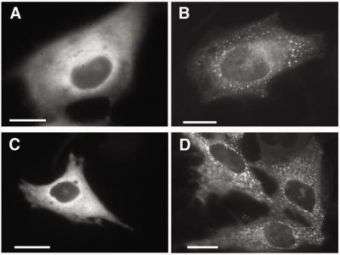
Penn State scientists are the first to observe in living cells a key step in the creation of adenine and guanine, two of the four building blocks that comprise DNA. Also called purines, the two building blocks are essential for cell replication. The findings, which will be published in the 4 April 2008 issue of the journal Science, could lead to new cancer treatments that prevent cancer cells from replicating by interfering with their abilities to make purines.
The group used cervical cancer cells--which have an increased demand for purines due to their rapid rates of replication--to demonstrate that a group of six enzymes is involved in the creation of purines. "Our research shows that these enzymes form a cluster prior to purine formation," said Erin Sheets, an assistant professor of chemistry and a collaborator on the project.
Although other researchers had, in the past, studied the enzymes individually in test tubes, no one, until now, had examined the group of enzymes together in living cells. "This is the first time that anyone has used the appropriate technology to look for this kind of complex in a living cell," said the team's leader Stephen Benkovic, Evan Pugh Professor of Chemistry and holder of the Eberly Family Chair in Chemistry.
Postdoctoral associates Songon An and Ravindra Kumar, from the Benkovic group, studied the enzyme clusters using a technique called fluorescence microscopy, in which fluorescent proteins are attached to molecules of interest and viewed under a special microscope. According to Sheets, the technique makes it easier to observe specific molecules in a cell. "It's like giving a bright orange helmet to your favorite football player so you can more easily monitor his actions," she said.
The researchers attached fluorescent proteins to the enzymes of cells grown in the presence and absence of purines. They found that in the absence of purines, enzymes formed clusters at much higher rates, suggesting that they play a role in the creation of new purines. In contrast, cells also can produce purines by recycling old purine material. Owing to this salvage process, cells do not always need enzyme clusters; indeed, cluster formation was not observed in cells that were grown in the presence of purines. In a key experiment, the researchers were able to influence the association and dissociation of the enzyme cluster by changing the cells' exposure to purines.
Not all of the cells that were grown in the absence of purines contained enzyme clusters. "We think that the enzymes form clusters only when a cell needs purines, and that happens when a cell is required to replicate its DNA at a certain stage in its cell cycle," said Sheets. "Since each of our samples contain cells at different stages of the cell cycle, we did not expect all of them to be actively replicating their DNA. Therefore, we weren't surprised to find that some of our cells did not contain enzyme clusters."
Because purines are necessary for DNA replication and, ultimately, for cell replication, the ability to halt purine synthesis could prove to be a valuable method for treating cancer. "Cancer cells have very high demands for purines," said Benkovic. "If we can find a way to disrupt the formation of this particular enzyme cluster, it could become a potential new target for cancer therapy."
Source: Penn State


