One large organic shade-grown coffee, please -- with extra bats
April 3rd, 2008 One large organic shade-grown coffee, please -- with extra bats

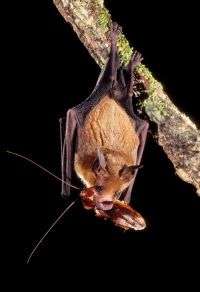
A big-eared bat of the genus Micronycteris. Bats of this genus are found in Mexican coffee plantations, where they glean insects from foliage and help limit pest populations. Credit: Merlin D. Tuttle, Bat Conservation International

If you get a chance to sip some shade-grown Mexican organic coffee, please pause a moment to thank the bats that helped make it possible. At Mexican organic coffee plantations, where pesticides are banned, bats and birds work night and day to control insect pests that might otherwise munch the crop.

Until now, the birds got nearly all the credit. But a new study from University of Michigan researchers shows that during the summer wet season, bats devour more bugs than the birds at Finca Irlanda, a 740-acre organic coffee plantation in Chiapas, Mexico.

And they often do it using a "perch and wait" hunting technique that is proving to be far more common than bat researchers had believed. A report on the study appears in Friday's edition of the journal Science.

At a time when bat populations are declining worldwide, this new-found benefit to organic coffee farmers is another example of how these much-maligned mammals provide ecological services that go largely unnoticed. In addition to aiding agriculture, bats pollinate wild plants, disperse fruit seeds, and gorge on pesky mosquitoes by the ton.

"Bats are impacting ecological systems in all kinds of ways, and I just want them to get the credit they deserve," said Kimberly Williams-Guillén, a tropical ecologist and a postdoctoral fellow at the U-M School of Natural Resources and Environment.

The bat's role in controlling coffee-eating insects has been overlooked for two reasons, Williams-Guillén said. The first involves a flaw in the design of "exclosure" experiments used to study the impacts of various animals on coffee plants.

In previous experiments, the exclosures---simply net-covered wood-and-plastic frameworks---were placed over coffee bushes around-the-clock. After several days, scientists counted the insects on the protected plants and compared the tally to totals from nearby unprotected plants. The protected plants usually had higher pest counts, and birds generally received the credit.

But because the netting remained in place day and night, bats also had been excluded, Williams-Guillén said. And their impact went unnoticed.

To determine the relative contributions of birds and bats at the Finca Irlanda plantation, Williams-Guillén and her U-M colleagues established four types of exclosures: birds-only excluded during the day, bats-only excluded at night, both excluded day and night, and control plants with no netting.

They found that during the summer wet season, the bat-only exclosures resulted in an 84 percent increase in the density of insects, spiders, harvestmen and mites---exceeding the impact of birds.

Williams-Guillén's co-authors on the Science paper are Ivette Perfecto of the U-M School of Natural Resources and Environment and John Vandermeer of the U-M Department of Ecology and Evolutionary Biology.

The second reason the bat's contribution to coffee-plantation pest control had been overlooked has to do with hunting techniques.

Bats are well known for a foraging strategy called aerial hawking, which involves fluttering through the night sky, zeroing in on prey using echolocation, and gulping countless flying bugs. A bat can eat half its body weight in a single night using this technique.

But many of the bats at the Chiapas plantation---about 45 species have been recorded there so far---rely largely on an approach called foliage gleaning. They patiently "perch and wait" in the tree canopy above the coffee bushes, inverted and clutching a branch with their feet, sometimes for hours at a stretch. Their large, pointy ears listen intently for the sounds of insects chewing, crawling across leaves, or chirping.

Then they swoop down and snatch the bug off the leaf or stem.

"People had believed that all the bats were flying around in mid-air and taking mosquitoes and moths," Williams-Guillén said. "And if that's all they were going for, then you wouldn't expect them to have an effect on insects that were just hanging around on the plants," such as katydids and leaf-eating beetles.

"But it turns out that foraging modes in bats are much more diverse than people had thought," she said. More than 200 species of insects feed on, or can otherwise damage, coffee plants.

Source: University of Michigan


print this article email this article download pdf blog this article bookmark this article     Digg this Stumble it share on Facebook share on Reddit add to delicious save to Yahoo! bookmarks
4.8/5 after 11 votes


April 3rd, 2008 all stories
Biology /

Comments: 0
Rank: 4.8/5 after 11 votes

  • Stumble this up

  • Digg this

  • Share it:
  • share on Facebook
  • share on MySpace
  • share on Slashdot
  • rss-newsfeed
  • share on Google
  • share on Reddit
  • add to delicious
  • save to Yahoo! bookmarks
  • share on Windows Live
  • Add to Mixx!
Rating: 4.8/5 after 11 votes

  • Related Stories

  • Shade coffee benefits more than birds
    created Dec 22, 2008 | popularity not rated yet | comments 0
  • Bumblebee re-introduced to UK
    created Jun 13, 2009 | popularity not rated yet | comments 0
  • Scientists announce top 10 new species
    created May 22, 2009 | popularity not rated yet | comments 0
  • Will dams on Amazon tributary wreak global havoc?
    created Apr 05, 2009 | popularity not rated yet | comments 0
  • How moths key into the scent of a flower
    created Mar 05, 2009 | popularity not rated yet | comments 0

Tags


  • Physicists Demonstrate Quantum Memory with Matter Qubits
    Physicists Demonstrate Quantum Memory with Matter Qubits
    Physics / General Physics
    created Jul 03, 2009 | popularity 4.4 / 5 (17) | comments 1
  • 'Holey' Nanosheets for Wastewater Dye Removal
    Nanotechnology / Nanomaterials
    created Jul 01, 2009 | popularity 5 / 5 (5) | comments 1
  • Jellyfish Robot Swims Like its Biological Counterpart
    Jellyfish Robot Swims Like its Biological Counterpart
    Electronics / Robotics
    created Jun 26, 2009 | popularity 4.4 / 5 (8) | comments 1
  • Could Maxwell's Demon Exist in Nanoscale Systems?
    Could Maxwell's Demon Exist in Nanoscale Systems?
    Physics / General Physics
    created Jun 24, 2009 | popularity 4.4 / 5 (18) | comments 29
  • Living Safely with Robots, Beyond Asimov's Laws
    Living Safely with Robots, Beyond Asimov's Laws
    Electronics / Robotics
    created Jun 22, 2009 | popularity 4.6 / 5 (52) | comments 40
  • Other News

    Researchers uncover the potential for super-sized abalone

    Biology / Microbiology

    created 2 hours ago | popularity not rated yet | comments 0

    (PhysOrg.com) -- Designer abalone could be an option in the foreseeable future, thanks to a project conducted at UQ's Heron Island Research Station and the St Lucia campus.


    Scientists 'rebuild' giant moa using ancient DNA

    Biology / Plants & Animals

    created Jul 01, 2009 | popularity 5 / 5 (10) | comments 12

    (PhysOrg.com) -- Scientists have performed the first DNA-based reconstruction of the giant extinct moa bird, using prehistoric feathers recovered from caves and rock shelters in New Zealand.


    Pacific Giant Salamander (Dicamptodon tenebrosus)

    Salamanders, regenerative wonders, heal like mammals, people

    Biology / Microbiology

    created Jul 01, 2009 | popularity 5 / 5 (20) | comments 11

    The salamander is a superhero of regeneration, able to replace lost limbs, damaged lungs, sliced spinal cord -- even bits of lopped-off brain. But it turns out that remarkable ability isn't so mysterious after ...


    California water plan aims to save Puget Sound orcas

    Biology / Ecology

    created 19 hours ago | popularity not rated yet | comments 0

    A plan to restore salmon runs on California's Sacramento River also could help revive killer whale populations 700 miles to the north in Puget Sound, as federal scientists struggle to protect endangered species in a complex ...


    Genetically modified trees

    Anti-biotech groups obstruct forest biotechnology

    Biology / Biotechnology

    created Jun 30, 2009 | popularity 3.7 / 5 (7) | comments 5

    The potential of forest biotechnology to help address significant social and environmental issues is being "strangled at birth" by the rigid opposition of some groups and regulations that effectively preclude ...