Solar Dynamics Laboratory's Smart Design Fosters Perfect Fit
April 3, 2008 Solar Dynamics Laboratory's Smart Design Fosters Perfect Fit

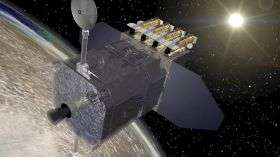
An artist's concept of SDO observing the sun. Credit: NASA/Goddard Space Flight Center Conceptual Image Lab

Imagine a wedding dress or a tailored suit that fit the first time you try it on. That's pretty similar to how engineers felt when the Solar Dynamics Observatory (SDO) spacecraft bus was lowered onto the propulsion module and it attached on the first try.

"It’s like lowering a telephone booth over a person," said Gary Davis, SDO propulsion subsystem manager at NASA Goddard Space Flight Center, Greenbelt, Md. "The mechanical people made the operation look easy. It's never easy. There are some mechanical things you can never model and predict."

SDO will help scientists zoom in on solar activity such as sunspots, solar flares and coronal mass ejections, to better understand the causes thus improving forecasts of solar storms. Bad "space weather" can pose a threat to astronauts in orbit, as well as to aircraft crews flying over the poles of Earth -- and that's just the tip of the iceberg. Electrical power to our homes, satellite communications and navigation systems can all be disrupted by magnetic storms triggered by solar activity. SDO will provide a close-up look at these events.

For the past year, all of the spacecraft avionics were integrated and tested on a spacecraft bus. The spacecraft bus includes Goddard-built electronics, instrument electronics as well as procured components. It has everything required to control the spacecraft and get the data from the instruments to the ground.

During the same time, another team at Goddard was building the propulsion module, which includes all the hardware needed to get the spacecraft from the point at which the rocket leaves the observatory, the transfer orbit, to its final orbit. "We built these modules up in parallel to allow us to get more done in a shorter amount of time," said Brent Robertson, SDO Observatory Manager at Goddard.

This was the first time Goddard engineers built a bipropellant propulsion system. A bipropellant system is a two tank system with fuel in one tank and oxidizer in another. When the chemicals mix, they burst into flame. The main engines use the same technology as the Lunar Landers for the Apollo missions.

The propellant tanks are titanium balloons with the thickness of just 9 sheets of notebook paper, but they can hold 27 times their weight. There are 8 smaller attitude control thrusters and one main engine thruster. Four of the attitude control thrusters are backups. If the main thruster goes out, the smaller thrusters will be able to carry out SDO's mission. SDO is a five year mission, but the spacecraft will carry enough fuel for at least 10 years.

"There was a lot of anxiety about mating these highly complex modules," said Robertson. "We wanted to avoid any interference that might damage items such as the harness or thermal blankets. We had a well thought out and documented procedure for this operation."

In a very short amount of time, 30 minutes, engineers and technicians lowered the spacecraft bus onto the propulsion module with surgical precision. "The whole design was smart from the beginning," Davis says.

Source: NASA, by Rani Gran


print this article email this article download pdf blog this article bookmark this article     Stumble it Digg this share on Facebook retweet share on Reddit add to delicious
Rate this story - 3 /5 (1 vote)


April 3, 2008 all stories

Comments: 0

3 /5 (1 vote)
  • Stumble this up

  • Digg this

  • share this

  • hide
  • Related Stories

  • The Sun's Sneaky Variability
    created Oct 28, 2009 | popularity not rated yet | comments 0
  • EVE: Measuring the Sun's hidden variability
    created Sep 22, 2009 | popularity not rated yet | comments 0
  • NASA's Solar Dynamics Observatory arrives at Kennedy Space Center
    created Jul 10, 2009 | popularity not rated yet | comments 0
  • Halloween Storms of 2003 Still the Scariest
    created Oct 29, 2008 | popularity not rated yet | comments 0
  • Spotless Sun: Blankest Year of the Space Age
    created Oct 01, 2008 | popularity not rated yet | comments 0


  • hide
  • Relevant PhysicsForums posts

  • Consistency of Meteor Shower Dates (i.e. the peak of Perseids always on Aug 13th)
    created 5 hours ago
  • Favourite Astronomy Book?
    created 20 hours ago
  • dark energy
    created 20 hours ago
  • The shape of our solar system's orbits.
    created Nov 07, 2009
  • More from Physics Forums - General Astronomy

Other News

Controversial new climate change results

Controversial new climate change results

Space & Earth / Environment

created 17 hours ago | popularity 4.5 / 5 (16) | comments 19

(PhysOrg.com) -- New data show that the balance between the airborne and the absorbed fraction of CO2 has stayed approximately constant since 1850, despite emissions of CO2 having risen from about 2 billion ...


Earth

Atomic Particles Help Solve Planetary Puzzle

Space & Earth / Earth Sciences

created 8 hours ago | popularity 4.6 / 5 (5) | comments 0

(PhysOrg.com) -- A University of Arkansas professor and his colleagues have shown that the Earth's mantle contains the same isotopic signatures from magnesium as meteorites do, suggesting that the planet formed ...


The Stars My Destination

The Stars My Destination

Space & Earth / Space Exploration

created 9 hours ago | popularity 5 / 5 (10) | comments 0

The Voyager spacecraft are now in the outermost layer of the heliosphere, traveling toward interstellar space - the first man-made spacecraft to travel such a vast distance from Earth.


Cave study links climate change to California droughts

Space & Earth / Earth Sciences

created 10 hours ago | popularity 3.7 / 5 (3) | comments 0

California experienced centuries-long droughts in the past 20,000 years that coincided with the thawing of ice caps in the Arctic, according to a new study by UC Davis doctoral student Jessica Oster and geology professor ...


Scientists prepare the Mini-Research Module 2 (MRM 2) "Poisk"

Rocket with new module for space station blasts off

Space & Earth / Space Exploration

created 11 hours ago | popularity 5 / 5 (1) | comments 0

A Soyuz rocket carrying a new Russian-made module for the International Space Station blasted off on Tuesday from the Baikonur space base in Kazakhstan, television pictures showed.