Researchers identify genes key to hormone production in plants
April 3, 2008 Researchers identify genes key to hormone production in plants

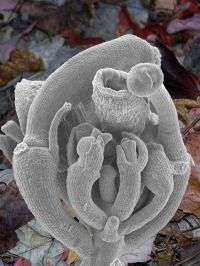
This scanning electron micrograph shows the abnormal anatomy of a group of developing flowers in an auxin-deficient wei8 tar2 double mutant plant. Credit: Jose Alonso, North Carolina State University

Researchers at North Carolina State University have pinpointed a small group of genes responsible for “telling” plants when, where and how to produce a hormone that is key to their development. Their findings shed light on the ways in which hormone production in plants affects both a plant’s growth and its ability to adapt to changing environments.

Dr. Jose Alonso, assistant professor of genetics, and a team of geneticists and plant biologists from NC State, Germany and the Czech Republic conducted the research. Their findings are published in the April 4 edition of the journal Cell.

Plant growth and development are regulated by a small number of hormones, which plants combine in various ways so that they can adapt to and thrive in changing environmental conditions. Auxin and ethylene are two of the most important of these growth-regulating hormones.

Scientists had previously established that plants respond differently to ethylene depending upon the type of plant tissue it is applied to, the developmental stage of the plant, and the surrounding environmental conditions. They also knew that the presence of auxin, another key growth-regulator, often served as a “trigger” for a plant to produce more ethylene, but were unsure of the ways in which auxin was synthesized.

“Auxin controls almost every process in a plant,” Alonso says, “and so it’s very important to understand how and why auxin is produced within the plant.”

In order to find out more about how auxin production is triggered, the NC State team identified a mutant strain of Arabidopsis – or mustard weed – that had a root system insensitive to the growth inhibitory effect of ethylene.

When the team looked at the genome of this mutant strain of mustard weed, they discovered that its lack of response to ethylene was due to the changes in a gene that they named TAA1. This gene produces a protein that is necessary for auxin synthesis. In a normal plant, the TAA1 gene recognizes the presence of ethylene as its signal to make proteins that in turn synthesize auxin, which controls growth.

The researchers found that if the TAA1 gene and two other related genes were “knocked out” or inactive, the plant had 50 percent less auxin than normal.

Their findings are the first to definitively establish a relationship between a particular family of genes, tissue-specific ethylene response, and auxin production in plants.

“If we want to do intelligent manipulation of plants, to breed them so that they ripen at a certain rate, or so that they’re well-adapted to particular environments, then we need to understand more about the ways that these hormones interact or ‘talk’ to each other,” Alonso says. “This research gives us concrete evidence for at least one way in which this happens.”

Source: North Carolina State University


print this article email this article download pdf blog this article bookmark this article     Stumble it Digg this share on Facebook retweet share on Reddit add to delicious
Rate this story - 3.8 /5 (6 votes)


April 3, 2008 all stories

Comments: 0

3.8 /5 (6 votes)
  • Stumble this up

  • Digg this

  • share this

  • hide
  • Related Stories

  • Explaining why pruning encourages plants to thrive
    created Sep 22, 2009 | popularity not rated yet | comments 0
  • At Long Last, How Plants Make Eggs
    created Jun 04, 2009 | popularity not rated yet | comments 0
  • New Breakthrough in Global Warming Plant Production
    created Mar 30, 2009 | popularity not rated yet | comments 0
  • Understanding Natural Crop Defenses
    created Feb 28, 2009 | popularity not rated yet | comments 0
  • Possible new hope for crops battling parasitic infection
    created Jan 16, 2009 | popularity not rated yet | comments 0


Other News

Hammerhead shark

Wide heads give hammerheads exceptional stereo view

Biology / Plants & Animals

created 10 hours ago | popularity 4.4 / 5 (5) | comments 4

Hammerhead sharks are some of the Ocean's most distinctive residents. 'Everyone wants to understand why they have this strange head shape,' says Michelle McComb from Florida Atlantic University. One possible ...


Golden Oldie: Key Role for Ancient Protein in Algae Photosynthesis

Golden Oldie: Key Role for Ancient Protein in Algae Photosynthesis

Biology / Biotechnology

created 2 hours ago | popularity not rated yet | comments 1

The discovery that an ancient light harvesting protein plays a pivotal role in the photosynthesis of green algae should help the effort to develop algae as a biofuels feedstock. Researchers with the Lawrence ...


Tough yet stiff deer antler is materials scientist's dream

Biology / Plants & Animals

created 10 hours ago | popularity not rated yet | comments 2

Prized for their impressive antlers, red deer have been caught in the hunters' sights for generations. But a deer's antlers are much more than decorative. They are lethal weapons that stags crash together when duelling. John ...


Indonesia rejects Bali plan for turtle sacrifices (AP)

Indonesia rejects Bali plan for turtle sacrifices

Biology / Ecology

created 8 hours ago | popularity not rated yet | comments 0

(AP) -- Indonesia has rejected a push by the resort island of Bali for rare turtles to be legally slain in Hindu ceremonies, siding with conservationists of the protected reptiles against religious advocates, ...


Ecologists sound out new solution for monitoring cryptic species

Biology / Ecology

created 11 hours ago | popularity not rated yet | comments 0

Ecologists have at last worked out a way of using recordings of birdsong to accurately measure the size of bird populations. This is the first time sound recordings from a microphone array have been translated into accurate ...