Exactly how much housework does a husband create?
April 3, 2008
Having a husband creates an extra seven hours a week of housework for women, according to a University of Michigan study of a nationally representative sample of U.S. families. For men, the picture is very different: A wife saves men from about an hour of housework a week.
The findings are part of a detailed study of housework trends, based on 2005 time-diary data from the federally-funded Panel Study of Income Dynamics, conducted since 1968 at the U-M Institute for Social Research (ISR).
"It's a well-known pattern," said ISR economist Frank Stafford, who directs the study. "There's still a significant reallocation of labor that occurs at marriage—men tend to work more outside the home, while women take on more of the household labor. Certainly there are all kinds of individual differences here, but in general, this is what happens after marriage. And the situation gets worse for women when they have children."
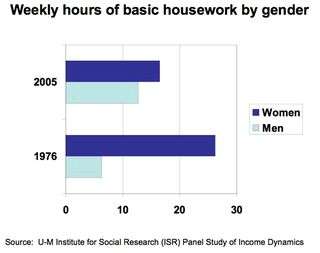
Overall, the amount of housework done by U.S. women has dropped considerably since 1976, while the amount of housework done by men has increased, according to Stafford. In 1976, women did an average of 26 hours of housework a week, compared with about 17 hours in 2005. Men did about six hours of housework a week in 1976, compared with about 13 hours in 2005.
But when the researchers looked at just the last 10 years, comparing how much housework single men and women in their 20s did in 1996 with how much they did in 2005 if they stayed single versus if they got married, they found a slightly different pattern.
Both the men and the women who got married did more housework than those who stayed single, the analysis showed. "Marriage is no longer a man's path to less housework," said Stafford, a professor in the College of Literature, Science, and the Arts.
For the study, researchers analyzed data from time diaries, considered the most accurate way to assess how people spend their time. They supplemented the analysis with data from questionnaires asking both men and women to recall how much time they spent on basic housework in an average week, including time spent cooking, cleaning and doing other basic work around the house. Excluded from these "core" housework hours were tasks like gardening, home repairs, or washing the car.
The researchers also examined how age and the number of children, as well as marital status and age, influenced time spent doing housework.
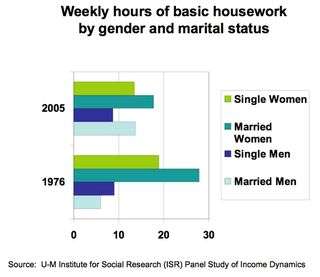
Single women in their 20s and 30s did the least housework—about 12 works a week on average, while married women in their 60s and 70s did the most—about 21 hours a week. Men showed a somewhat different pattern. Older men did more housework than younger men, but single men did more in all age groups than married men.
Married women with more than three kids did an average of about 28 hours of housework a week. Married men with more than three kids, by comparison, logged only about 10 hours of housework a week.
Source: University of Michigan
-
Working moms: Looking for more than a paycheck
Jan 24, 2012 |
not rated yet |
0
-
Social exclusion among shift workers and older people
Dec 13, 2011 |
5 / 5 (1) |
0
-
Study: Working moms multitask more and have worse time doing so than dads
Dec 01, 2011 |
not rated yet |
0
-
Early mortality risk reduced up to 40 percent through increased physical activity and sports
Oct 20, 2011 |
5 / 5 (1) |
0
-
Why women are still left doing most of the housework
May 24, 2011 |
1 / 5 (1) |
4
-
Engineers build first sub-10-nm carbon nanotube transistor
Feb 01, 2012 |
4.9 / 5 (31) |
30
-
Something old, something new: Evolution and the structural divergence of duplicate genes
Jan 31, 2012 |
4.6 / 5 (7) |
1
-
The hidden nanoworld of ice crystals: Revealing the dynamic behavior of quasi-liquid layers
Jan 30, 2012 |
5 / 5 (3) |
1
-
Stock market network reveals investor clustering
Jan 27, 2012 |
3.9 / 5 (23) |
8
-
Of microchemistry and molecules: Electronic microfluidic device synthesizes biocompatible probes
Jan 26, 2012 |
5 / 5 (1) |
0
-
Bohr-Einstein debate: why did Bohr not simply say...
Feb 06, 2012
-
Best/Worst U.S. Presidents
Jan 31, 2012
- More from Physics Forums - History & Humanities
More news stories
A frank discussion of the power law and linking correlation to causation
(PhysOrg.com) -- Michael Stumpf a mathematics professor at Imperial College in London, and Mason Porter a lecturer at Oxford have teamed together to write and publish a perspective piece in Science regarding the in ...
Employers feel no love for unscrupulous practice of 'service sweethearting'
A new study led by two Florida State University marketing professors finds that some frontline service employees who are rewarded for hikes in customer loyalty and satisfaction also may engage in "service ...
Other Sciences / Economics & Business
Feb 10, 2012 |
3.3 / 5 (3) |
11
US workers are 'giving away the store,' costing firms billions
Nearly 70 percent of the nation's service employees give away free goods and services from hamburgers to cable TV costing companies billions of dollars a year, according to a groundbreaking study.
Other Sciences / Economics & Business
Feb 09, 2012 |
3.5 / 5 (4) |
10
New insights into how to correct false knowledge
The abundance of false information available on the Internet, in movies and on TV has created a big challenge for educators.
Other Sciences / Social Sciences
Feb 07, 2012 |
4.9 / 5 (7) |
9
|
Neanderthal demise due to many influences, including cultural changes: study
As an ice age crept upon them thousands of years ago, Neanderthals and modern human ancestors expanded their territory ranges across Asia and Europe to adapt to the changing environment.
Other Sciences / Archaeology & Fossils
Feb 07, 2012 |
4.4 / 5 (5) |
8
|
Google might launch Drive for cloud storage soon
(PhysOrg.com) -- Google's next big move, according to the Wall Street Journal, is a cloud storage service called Drive. Hardly first to the plate, Google is simply catching up to introducing its cloud reposi ...
Latin America mining boom clashes with conservation
Latin America is experiencing a mining boom as prices rise fuelled by a hike in global demand, but the region is also being hit by a wave of violent protests, strikes and rallies by environmentalists.
Walney offshore wind farm is world's biggest (for now)
(PhysOrg.com) -- The Walney wind farm on the Irish Sea--characterized by high tides, waves and windy weather--officially opened this week. The farm is treated in the press as a very big deal as the Walney ...
Love a click away in Indonesia's Twitter Republic
He was a geeky kid from Yogyakarta, she a glamorous city girl in Jakarta. In a country with one of the world's most vibrant social networking scenes they fell in love on Twitter.
Europeans protest controversial Internet pact
Tens of thousands of people marched in protests in more than a dozen European cities Saturday against a controversial anti-online piracy pact that critics say could curtail Internet freedom.
Study finds that anti-diabetic medication can prevent the long-term effects of maternal obesity
In a study to be presented today at the Society for Maternal-Fetal Medicine's annual meeting, The Pregnancy Meeting, in Dallas, Texas, researchers will report findings that show that short therapy with the anti-diabetic medication ...
Apr 04, 2008
Rank: not rated yet
Comparing single mean & single women, (13 hours vs. 9 hours) does support the hypothesis that single women CREATE 4 hours of housework a week that doesn't really need to be done. If it did need to be done, how do the single men survive?
In 1976, the figures were that marriage created the same amount of work (about 8 hours). But in that case, women did it all.And the amount of work done by single men hasn't changed since 1976 (because it is necessary). Whilst single women have managed to save 6 hours a week just by getting 30 years wiser.
I suggest single women just wait another 10 years, by which time they will have learnt not to waste 4 hours a week doing unnecessary stuff, and will have parity with single men.