Cornell robot fails to break a record, but students learn
April 3, 2008 Cornell robot fails to break a record, but students learn

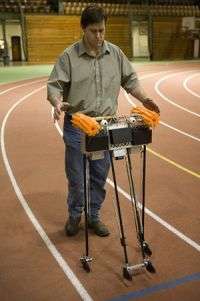
Jason Cortell, manager of the the Biorobotics and Locomotion Lab, follows the Cornell Ranger, on a test walk. The robot's body hides complex computer controls that sense the position of the legs to decide when to swing them forward and how to adjust the pivoting feet. Photo: Jason Koski

Engineering education needs to include a few rough spots to be worthwhile. An attempt to set an unofficial world record for how far a robot could walk failed the night of March 30, but the team will keep trying.

The Cornell Ranger, a robot developed by a team of students working with Andy Ruina, professor of theoretical and applied mechanics, fell down after about 4.75 laps -- about .95 kilometers ( .59 miles) -- around the running track in Barton Hall. An earlier version of the same robot had already set a record by free-walking a bit over 1 kilometer, about .62 miles. (Another robot has walked 2.5 kilometers (1.55 miles) on a treadmill, Ruina noted.)

Ruina was hoping for 10 or more kilometers, more than 6 miles, depending on how long the robot's battery charge would last. The Ranger, like other robots developed in Ruina's lab, is designed for maximum energy-efficiency. Although its four-legged design makes it look a bit like a walking sawhorse, it mimics human walking technique, using energy only to push off with its pivoting toes, but depending on gravity and forward motion to swing its legs forward.

The goal of the research, Ruina said, is not only to advance robotics but also to learn more about the mechanics of walking so the information can be applied to rehabilitation and prosthetics for humans.

After a promising start, the robot literally stubbed its toe after failing to tilt one of its feet upward as the leg came forward. With that, the team of students went into an intense diagnostic session, reviewing telemetry that showed the signals sent by the robot's computer controller to its motors and switches, watching video of the fall and taking new video as the robot was repeatedly tested. The problem was eventually diagnosed as a loose connection in the wires leading to a sensor that measures the angle of the legs relative to the ground.

"I'm actually sort of glad this happened," Ruina said as he watched the students cluster around a laptop to review the robot's programming. "They need to learn that failures are a part of engineering in the real world."

Source: Cornell University


print this article email this article download pdf blog this article bookmark this article     Stumble it Digg this share on Facebook retweet share on Reddit add to delicious
Rate this story - 4.7 /5 (3 votes)

Rank Filter

Move the slider to adjust rank threshold, so that you can hide some of the comments.


Display comments: newest first

  • Johnson442 - Apr 04, 2008
    • Rank: not rated yet
    As the old saying goes: "Do it right, learn a little. Do it wrong, learn a lot!"

April 3, 2008 all stories

Comments: 1

4.7 /5 (3 votes)
  • Stumble this up

  • Digg this

  • share this

  • hide
  • Related Stories

  • This smart wheelchair has laser vision
    created Nov 10, 2009 | popularity not rated yet | comments 0
  • Seattle team wins $900,000 in Space Elevator Games
    created Nov 07, 2009 | popularity not rated yet | comments 0
  • From nature, robots
    created Sep 25, 2009 | popularity not rated yet | comments 0
  • The Abyss: Deepest Part of the Oceans No Longer Hidden
    created Jun 03, 2009 | popularity not rated yet | comments 0
  • Cornell robot sets a record for distance walking
    created Apr 07, 2008 | popularity not rated yet | comments 0


  • hide
  • Relevant PhysicsForums posts

  • Laser plasma emission
    created Nov 26, 2009
  • Achromat lens - magnifying LCD
    created Nov 25, 2009
  • Control System
    created Nov 24, 2009
  • Base Isolation Systems in Skyscrapers?
    created Nov 23, 2009
  • More from Physics Forums - General Engineering

Other News

ASUS Debuts Eee PC T91MT -- First Netbook to Go Multi-touch

ASUS Debuts Eee PC T91MT -- First Netbook to Go Multi-touch

Electronics / Consumer & Gadgets

created 6 hours ago | popularity not rated yet | comments 0

ASUS today launched the Eee PC T91MT, the world's first convertible tablet netbook to feature a multi-touch screen that supports Windows 7 Multi-Touch gestures.


Gift Guide: Accessories to jazz up mobile phones (AP)

Gift Guide: Accessories to jazz up mobile phones

Electronics / Consumer & Gadgets

created 10 hours ago | popularity not rated yet | comments 1

People you know have spent small fortunes on shiny new smart phones such as the iPhone 3GS, a BlackBerry or the Droid. But the devices still don't have all the features they want.


Bling bling with your ring ring: Dekoden craze sees cell phones get a touch of glitz, glamour

Electronics / Consumer & Gadgets

created 9 hours ago | popularity not rated yet | comments 0

Cell phone owners are ringing the changes and putting a smile on their dial by adorning their mobiles with ornamental stickers, charms and beads -- and the craze just keeps getting bigger.


Review: A riff on robotics with self-tuning guitar (AP)

Review: A riff on robotics with self-tuning guitar

Electronics / Consumer & Gadgets

created Nov 25, 2009 | popularity 3.7 / 5 (7) | comments 4

(AP) -- New cars have been tuning themselves for the better part of two decades now, so it should feel less impressive that Gibson has built a guitar that can smoothly do the same.


Waseda Flutist Robot

Musical robots perform duets (w/ Video)

Electronics / Robotics

created Nov 26, 2009 | popularity 4 / 5 (5) | comments 0

(PhysOrg.com) -- A flute playing robot unveiled by Waseda University last year has been joined by a robot saxophonist in a Classical music duet. The aim of the project was to design robots that could respond ...