T-REX is monster light source with multiple applications
April 4th, 2008 T-REX is monster light source with multiple applications

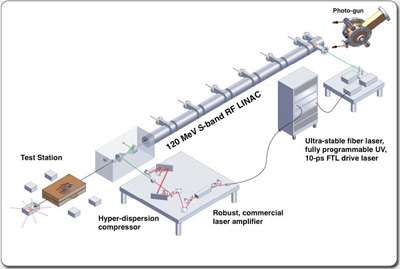
T-REX schematics.

When it comes to laser-based light sources, there are few brighter than T-REX, an LLNL project developed jointly by the NIF & Photon Science Principle Directorate and the Physical Sciences Directorate.

Technically known as the Thomson-Radiated Extreme X-ray Source, T-REX is an advanced, laser-based light source in which novel, energetic, picosecond laser pulses are scattered from relativistic electrons to produce monochromatic, highly collimated, tunable X-rays and gamma-rays.

The system will be able to study isotopes, allowing researchers to address challenges in homeland and international security, nonproliferation, advanced nuclear power systems and nuclear waste identification. For example, in the Department of Homeland Security's FINDER project for high-confidence detection of nuclear materials to enhance port security. Addressing these national security missions also may also lead to new possibilities for medical and industrial applications of isotope-specific imaging.

T-REX achieved megaelectronvolts (MeV) class first light late last month. On March 26, its 10 picosecond electron beam had been powered up to 120 MeV and collided with UV laser photons, and was used to produce gamma-ray energy of .776 MeV, making it the brightest such instrument in the world in this energy range.

"We are still working on verifying the absolute record brightness of the source," said Chris Barty, program director for the Lab's Photon Science and Applications Program.

"But without a doubt, the ~0.75 MeV radiation produced by T-REX is unique in the world with respect to its brightness, spectral purity, tunability, pulse duration and laser-like beam character," he said.

The system builds on a past Livermore project called Picosecond Laser-Electron Interaction for the Dynamic Evaluation of Structures (PLEIADES), which was funded by the Laboratory Directed Research and Development (LDRD) Program.

In 2003, the PLEIADES system generated record pulses of 70-kiloelectronvolts (keV) X-rays. Traditionally, beams in this particular energy regime are created in synchrotron facilities.

According to Barty, "With its MeV-range capabilities, T-REX's peak brightness will be up to 10 orders of magnitude greater than current third-generation synchrotron light sources."

Bright gamma-ray pulses tuned to specific nuclear energy levels may be used to detect specific nuclei and isotopes, through a process called nuclear resonance fluorescence, first described by Edward Teller in 1948.

Nearly all nuclei have a set of nuclear "fingerprints" — several photon-excited states unique to individual isotopes. When a photon with the defined energy hits a targeted nucleus, the photon is absorbed. The excited nucleus then decays, radiating photons of the characteristic energy in all directions. The absorption of resonant photons as well as the emitted energy spectrum can be used to identify the nuclear species or isotope of the target.

The Department of Homeland Security's Domestic Nuclear Detection Office is funding research to explore this imaging and detection capability. The proposed system, called fluorescence imaging in the nuclear domain with extreme radiation (FINDER), could be used to image the isotopic composition of materials inside well-shielded objects, such as cargo containers moving through an inspection terminal. If successful, a FINDER system based on T-REX technology could provide a solution to the challenge of detecting concealed highly enriched uranium.

Barty added that his team is pursuing dynamic applications for T-REX, such as capturing "isotope snapshots" of the movement of materials with 100-billionth of a second shutter speed.

"It's a new area that may very well have a large impact on the Lab's core national security missions," said Barty.

Source: Lawrence Livermore National Laboratory


print this article email this article download pdf blog this article bookmark this article     Digg this Stumble it share on Facebook share on Reddit add to delicious save to Yahoo! bookmarks
3.8/5 after 15 votes

Rank Filter

Move the slider to adjust rank threshold, so that you can hide some of the comments.


Display comments: newest first

  • toyo - Apr 04, 2008
    • Rank: not rated yet
    "10 orders of magnitude greater than current third-generation synchrotron light sources."?
    Isn't there any vetting of the news items before they get put on the website?

April 4th, 2008 all stories
Physics / General Physics

Comments: 1
Rank: 3.8/5 after 15 votes

  • Stumble this up

  • Digg this

  • Share it:
  • share on Facebook
  • share on MySpace
  • share on Slashdot
  • rss-newsfeed
  • share on Google
  • share on Reddit
  • add to delicious
  • save to Yahoo! bookmarks
  • share on Windows Live
  • Add to Mixx!
Rating: 3.8/5 after 15 votes


Tags


  • Transform a ball into a rock -- or make it invisible -- using transformation optics
    Transform a ball into a rock -- or make it invisible -- using transformation optics
    Physics / General Physics
    created 6 hours ago | popularity 3 / 5 (2) | comments 0
  • Could a quantum motor do work?
    Physics / General Physics
    created Jul 07, 2009 | popularity 4 / 5 (12) | comments 0
  • Physicists Demonstrate Quantum Memory with Matter Qubits
    Physicists Demonstrate Quantum Memory with Matter Qubits
    Physics / General Physics
    created Jul 03, 2009 | popularity 4.5 / 5 (20) | comments 1
  • 'Holey' Nanosheets for Wastewater Dye Removal
    Nanotechnology / Nanomaterials
    created Jul 01, 2009 | popularity 5 / 5 (5) | comments 1
  • Jellyfish Robot Swims Like its Biological Counterpart
    Jellyfish Robot Swims Like its Biological Counterpart
    Electronics / Robotics
    created Jun 26, 2009 | popularity 4.4 / 5 (9) | comments 1
  • Other News

    Transform a ball into a rock -- or make it invisible -- using transformation optics

    Transform a ball into a rock -- or make it invisible -- using transformation optics

    Physics / General Physics

    created 6 hours ago | popularity 3 / 5 (2) | comments 0

    (PhysOrg.com) -- Science fiction and fantasy tales are full of the ability to "cloak" characters with invisibility. Whether it is a spaceship with a cloaking device, or a young wizard with an invisibility ...


    Physicists take first step towards super-fast search algorithms for quantum computers

    Physics / General Physics

    created 1hour ago | popularity not rated yet | comments 0

    When you toss a coin, you either get heads or tails. By contrast, things are not so definite at the microcosmic level. An atomic 'coin' can display a superposition of heads and tails when it has been thrown. However, this ...


    Physical reality of string theory demonstrated

    Physics / General Physics

    created Jul 06, 2009 | popularity 4.4 / 5 (49) | comments 38

    String theory has come under fire in recent years. Promises have been made that have not been lived up to. Leiden (The Netherlands) theoretical physicists have now for the first time used string theory to describe a physical ...


    UQ researchers break the law -- of physics

    UQ researchers break the law -- of physics

    Physics / General Physics

    created Jul 06, 2009 | popularity 4.6 / 5 (31) | comments 15

    (PhysOrg.com) -- Two UQ Science researchers have proved two famous physical laws that have been widely used for the past 25 years do not always work.


    Mystery of bat with an extraordinary nose solved

    Mystery of bat with an extraordinary nose solved

    Physics / General Physics

    created Jul 07, 2009 | popularity 4.6 / 5 (7) | comments 6

    A research paper co-written by a Virginia Tech faculty member explains a 60-year mystery behind a rare bat's nose that is unusually large for its species. The findings soon will be published in the scientific ...